
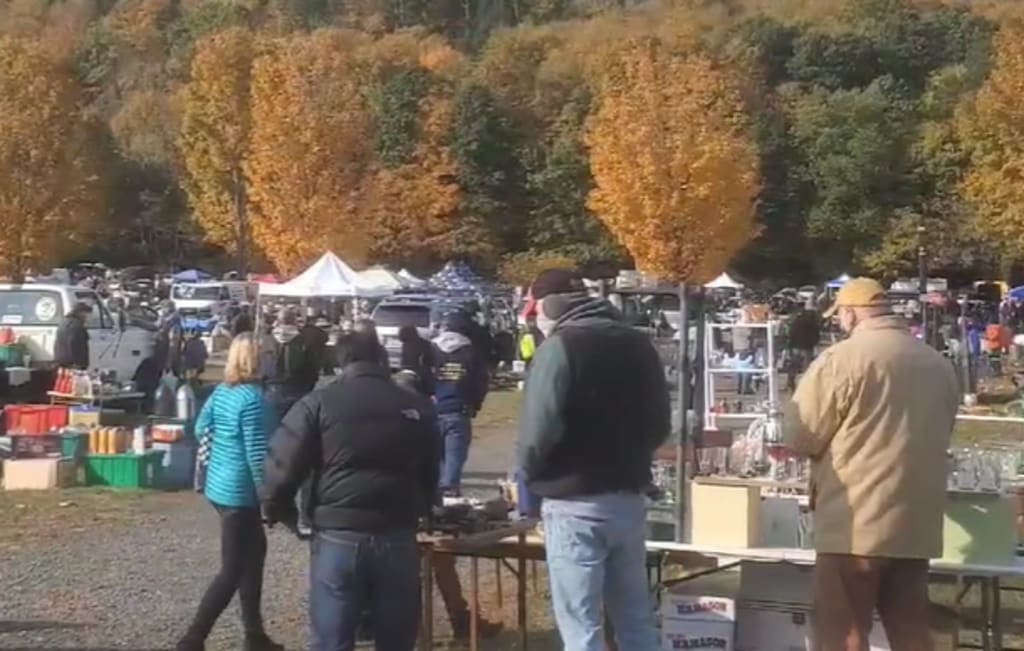
I run my fingers around the rim of the bowl and feel for irregularities imperceivable to the naked eye. Even something as innocuous as a tiny nick – a so called “fleabite,” will affect the value. I had spotted the bowl from several tables away at the flea market, the sunlight of the open field catching the floral engravings meticulously cut into the sides. It had been placed precariously near the edge of the small, folding card table to anchor the tablecloth from billowing in the early morning breeze. Turning the bowl over in my hands I can tell by the weight and brilliance that it is made with lead. Ancient alchemists, with their Quixotic efforts to turn base metals into gold, would have been dazzled by the chemical marvels of nineteenth century glassmaking. By adding lead as a purifying agent to glass, this toxic, dull metal transformed this, fragile, hazy material to a crystalline so clear that instead of shadows, it casts rainbows. A material that, when gently struck, rings like an ethereal silver bell. I gently ping the side of the bowl with my finger and hear the sweet, high-tone reverberation. It is not an idle action, nor is it a sentimental one. The ringing is a reassurance that I haven’t accidentally overlooked any cracks or damage hidden in the intricacy of the engraved pattern.
I scan the table for other treasures. It is mostly junk – porcelain figurines and limited edition collectibles. These are items whose values have only declined since they first left the salesroom. The vendor is a cheerful older woman with shoulder-length, greying blonde hair. She sees me holding the bowl and points out a glass dolphin figurine nearby. I am not interested but I pick it up and turn it over to humor her. It is lead crystal glass, but modern. One of tens of thousands mass produced in eastern Europe, lacking in craftsmanship. “It’s pretty.” I say lamely. This is what I always say. It is an easy compliment, a stupid one, but also magical. With these words I can put it down without insulting her. I pay her $5 for the bowl – probably about what it would have sold for originally. This would also have represented about week’s worth wages for the workers who had made it over a century before. I’ll be able to get at least $65. The vendor apologizes that she doesn’t have anything to wrap it in so I reach into my totebag and pull out a couple of pieces of old newspaper. I carefully wrap it and tuck it into my tote before pulling out a little black book and pen. “Engraved floral bowl, English” I write in it. Beside that I scribble five dollars as a five with a line after it. They say that you don’t feel like you’ve spent as much if you don’t see a dollar sign. I toss the pen and black book in with the glass parcel and move on to the next table.
It is a beautiful day, if breezy. I don’t mind that I haven’t found much as I make my way across the field. I take my time, scanning crowded tabletops and poking carefully through hastily packed boxes. I reach the last row of vendors and am browse a table covered in nautical items. An old man with a Greek fisherman’s cap and a white mustache is sitting back in a folding chair, idly watching people as they browse his wares. The chair is slightly buckled under his weight. He is a regular, lazily raising his hand and calling out greetings to familiar faces in the crowd. Several paintings of harbor scenes lean against the table and nautical tools are scattered across the table. There are a couple of ships’ lamps, as well as vintage souvenirs from beach and port towns around the Cape. A couple of fishing spears and boat pulls lean against one side of the table, on the other side is a pile of netting with a couple of boxes set along the edge.
I peer inside one of the boxes and see an enormous painted glass vase. I pull it out for a closer look. The decoration is not painted, I realize, but actually part of the glass itself. It is cameo glass, blown in layers into which a design is meticulously carved. The glass is cool, thick, and incredibly heavy. Ghostly white seagulls float against a fog-grey sky. A seafoam green ocean churns below. Whitecaps curl across the water, their shape reminding me of The Great Wave off Kanagawa. The man sees me looking at it and nods in my direction. “It’s a fake.” he says. I find myself nodding back. “It’s pretty.” I say. I agree with him – huge quantities of cameo glass are exported from China every day. Still, this one is well done, the details are extraordinary. The seagulls look as though they have been carved out of ivory. The ocean waters, of jade. Someone, I reason, will buy it, even just for the nautical theme. An old, beige price tag on the side reads sixteen dollars. I hand him a twenty and he digs around is his pants pocket for the change. He hand me the crumpled bills then wraps the vase in old packing paper. I take it from him and put it in the tote, moving the lighter bowl to the top. In the black book I write “Cameo glass seagull vase, 16”.
The tote is heavy and I am done for the day so I make my way back to the car. I place the bag gently on the floor and I take a moment to check my phone, typing “Cameo seagull glass vase” into the auction app. Nothing identical pops up, but I am encouraged to see that there are several nice cameo glass vases that are selling for a couple hundred.
When I arrive home, I unpack the glass and wash and dry them. I am disappointed to find a small chip on the base of the seagull vase. It is tiny, however, and not really very noticeable. It is hard to find space for these new additions – every square inch of my porch is already packed with inventory. Most items will sell eventually. Some won’t, and every so often I am forced to do a purge. I can see that it is almost time.
I research the engraved bowl first. Experience tells me that the scrolling floral design of the engraving indicates that the bowl was likely made in England. I am fortunate to find an almost identical one listed online. I copy and paste the format, take pictures against a black drop-cloth, and write a concise description. I list it at ninety-five dollars, a good thirty dollar less than the other. Perhaps if my porch were less cluttered I would be tempted to ask for more.
There are no listings, either sold or active, for a cameo glass seagull vase. I turn it over. It is large, cumbersome. Hidden in the waves is a Galle signature, or perhaps Yalle. It is not unusual for Chinese factories to try to deceive unwary buyers. I can not tell if it is a $95 reproduction or a $345 so I decide to list it as an auction. I always start auctions at $9 or $19 but for this vase, I take a chance and start it at $29. Someone will bid. As I take photographs with my cell-phone, a “cha-ching!” sound notifies me that I have made a sale. I check and see that it is the bowl I had just listed. I am happy that it sold quickly, but I realize by the quick sale that I probably should have asked for more. I take one close-up photograph of the Galle or Yalle signature. I also take a picture of the chip. In the description I write “Condition: Small chip under base. Shelf wear.” Shelf wear is a term to describe the roughness and scratch lines that develop on the bottom of a piece of glass over the course of its existence. Some unscrupulous dealers will fake wear by taking glass and rubbing it across concrete. Too many distinct, parallel lines suggest this artificial wear. There is wear on the base of this vase but the lines are erratic, small, and fuzzy. It must have some age to it – possibly mid-century, I think to myself. I wonder if there is some small chance it is Italian. I add the height and diameter. I hope it sells for a good amount –shipping will easily be thirty dollars, more than I am starting the auction at. Still, I reason with myself, someone will buy it. “Large Cameo Art Glass Vase Signed Galle, Seagull Nautical Ocean.” To protect myself, I add in the description, “Art glass cameo vase done in the style of Galle.” Glass dealers know “in the style of” means there is no guarantee of authenticity. I quickly scan the listing for accuracy. Once someone bids it is too late to make any changes. Satisfied, I press the “List Item” button. It is done. I leave the seagull vase on the photo stand and prepare the bowl for shipping.
Back inside, I make another note in the little black book next to the bowl’s purchase price, “$95”, this time with the dollar sign clearly showing beside the number and the entire thing circled for emphasis. Then I wrap the bowl in a layer of paper, then bubble wrap, and gently bury it in a deep flow of packing peanuts within the shipping box. The best packing is to place one box inside another with a padded layer of packing peanuts in between. This adds considerably to the weight and shipping cost, however, and so I try to compensate with extra space and peanuts in a solitary box. So long as it can survive a five foot drop it will make it to wherever it’s going, I tell myself. I finish packing with plenty of time to make it to the post office.
That night I check the listing. I am shocked to see that it has 42 watchers and the bidding has reached three hundred and twenty-five dollars. There are two questions and I answer them as well as I can. There is also a request for more pictures. I send them along. By the next morning the bidding has reached $2,150 and there are eighty-four people watching. My heart leaps into my throat. What if I wasn’t clear enough with my description? Have I misled people? What if the vase is bought by someone who thinks it’s real, and then it turns out not. Could I be arrested for fraud? A sort of glee tempers my anxiety as the number climbs throughout the day. Nearing five thousand the next. There are more questions. I add “Please note that this vase has not been authenticated and is being sold in the condition described in the listing.” to all my responses. The bidding continues and the number goes up.
I can barely sleep. On the final morning of the auction I wake up early. The bidding has just surpassed sixteen thousand dollars. I am dumbfounded. Despite my shaking hands, I carefully wrap the vase. As I pack, I run my hands over the cameo carvings. I can see, now, that the details truly are exquisite. For sixteen thousand, I ask myself, should I get on the plane and hand deliver? There is a jump again just before the auction ends. I stare at the screen, and then promptly call my parents. My mother screams as I tell her the good news. Then I hear it “cha-ching!” The bid was real - the buyer has paid. I open my black book and write down “$20,500.” I circle it for emphasis. Then I finish packing. This time, I double box.
About the Creator
Keep reading
More stories from Brijiana and writers in Motivation and other communities.
How Sustainable Water Systems Strengthen Rural Communities
Clean and reliable water remains one of the strongest drivers of rural development. When communities gain access to sustainable water systems, daily life improves in visible and lasting ways. Health outcomes rise, economic activity expands, and social stability grows. Sustainable water infrastructure does more than deliver water. It supports empowerment, resilience, and long-term progress for rural communities.
By Baitulmaal6 days ago in Motivation


Comments
There are no comments for this story
Be the first to respond and start the conversation.