
The Strange And Oddly Lucrative World of Cattle Gallstones
This Is No Bull.


Turns out, the beef industry might just be stepping into its golden age.
What’s that, you ask? Well, brace yourself—because gallstones found in beef carcasses during processing can be worth as much as the entire rest of the cow. Yep, you read that right. A little clump of hardened bile could be more valuable than the steak, the roast, and the burger combined. In fact, at the time of this publication, they are worth more than GOLD.
How on earth is that possible? Well, Chinese medicine places big value on beef gallstones. Some folks in China trust ancient remedies over modern medicine, and they’re willing to shell out serious cash for these little nuggets of… well, whatever they are. In fact, China spends an estimated $60 billion annually on traditional medicine, and beef gallstones are among the most sought-after ingredients.
And when I say valuable, I mean eye-wateringly valuable. Ground-up beef gallstones can sell for $5,800 an ounce—which, for those keeping score at home, is nearly double the current price of gold. That’s right. Some poor cow’s internal debris is worth more per ounce than the shiniest rock in Fort Knox.
Traditional Chinese medicine credits gallstones with treating everything from high blood pressure to heart disease to strokes. The practice has been around for centuries, but its popularity surged during the COVID-19 pandemic, when China’s government actively promoted it as a source of national pride.
But here’s where things take an even stranger turn. Some brokers believe gallstones are no longer just medicinal—they might also be turning into a form of currency. With China’s economy struggling and strict currency laws in place, wealthy individuals may be investing in gallstones like they would gold, storing them away or reselling them on the international market to convert cash into a more liquid (or, in this case, solidified) asset.
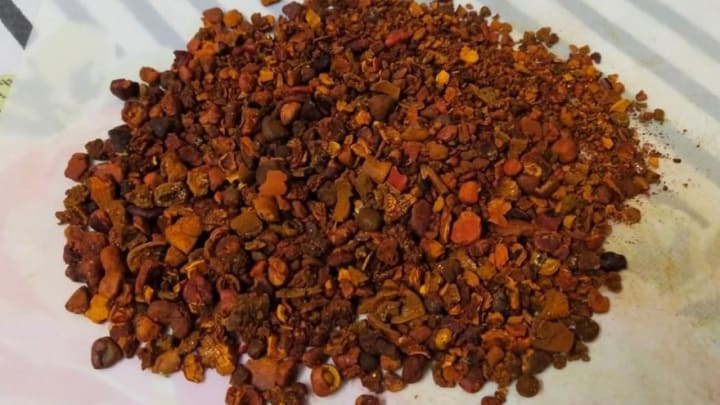
Now, before you start daydreaming about turning your backyard into a high-stakes gallstone farm, there’s a catch. Not every cow produces gallstones, and even when they do, those stones need to be properly harvested and handled. Otherwise, they can mold, degrade, or lose value.
Most of the world’s beef gallstones come from slaughterhouses in Brazil and Australia, with Australia producing around 200 kilograms per year—which may not sound like much, but when you consider that it takes 30,000 cattle to yield just one kilogram of gallstones, you start to see the scale of the challenge.
Cattle gallstones, also known as bovine gallstones or bezoars, are hardened deposits that form in a cow’s gallbladder, much like kidney stones in humans. They develop over time when bile components—such as cholesterol, calcium salts, and bilirubin—crystallize and clump together. These stones typically form as a result of liver function issues, diet, genetics, or infections. Unlike humans, however, most cattle never develop gallstones, making them a rare byproduct of the beef industry rather than an expected yield.
In facilities that are aware of their value, workers carefully remove and set aside any found stones. The quality and price of these stones depend on their size, color, texture, and purity—with larger, golden-yellow stones fetching the highest prices.
Now, I don’t know about you, but I see a massive opportunity here. If the beef industry could somehow breed cattle that naturally produce more gallstones—or better yet, if scientists could develop a feed supplement that encourages gallstone formation—well, let’s just say the Angus and Hereford might have to make room for some new breeds.
Of course, I’m mostly kidding. Mostly.
Because let’s be honest—if something can double the value of a beef carcass, it’s probably worth more than just a passing glance. And if we’re truly entering a new Golden Age of American prosperity, why shouldn’t the beef industry enjoy its own Gallden Age?
Stranger things have happened.
About the Creator
Rootbound Homestead
Rootbound Homestead is a community bound by roots. Leaving our old comfy life in FL to move to NY to start living cleaner, more simply, and with purpose. Garden hacks, tips and tricks, natural medicine, healing, animals, recipes and more!
Keep reading
More stories from Rootbound Homestead and writers in Longevity and other communities.
This Common Yard Weed Is Legally Used For Anxiety, Stress, and Chronic Fatigue
Mugwort is an herb native to Europe and Asia that has been used for centuries in both cooking and medicine. It was introduced to North America by early settlers who carried it across the Atlantic as ballast in ships. Today, mugwort continues to spread throughout the continent, particularly along roadsides and in areas disturbed by human activity. It is commonly found in the northeast, including New York State, and extends west past Minnesota and as far south as Florida.
By Rootbound Homestead12 months ago in Longevity
Day 4 of Quitting
If this is how sobriety feels, maybe it’s better to go through life a little buzzed… this, along with other hits like, I want to kill myself, I wish I was dead, and I’m going to throw myself off a bridge have been the only thoughts on rotation these past few days. I promise myself that if, in a month, I still feel like this (‘this’ meaning despondent, full of rage, and simultaneously numb) I can go back to smoking. Until mid-February though? Nicotine is off the table.
By sleepy drafts11 days ago in Longevity
Kratom Tea Guide for Beginners, Benefits, Effects, and How to Use It
Kratom tea is one of the most common ways people use kratom. Many users choose tea because it is easier to digest, faster to absorb, and simpler to control than powder or capsules. If you searched for kratom tea, you likely want to know what it does, how to make it, how strong it is, and whether it is better than other forms. This guide answers those questions in a clear and direct way.
By Jack Wilder4 days ago in Longevity




Comments
There are no comments for this story
Be the first to respond and start the conversation.