health
Keeping your mind and body in check - popular topics in health and medicine to maintain a long and healthy life.
Preservation as an Act of Care
Care is usually associated with people, not with ideas. It brings to mind attentiveness, patience, protection, and responsibility toward something fragile. Meaning rarely enters that picture. Thoughts are assumed to be abundant, replaceable, and endlessly renewable. If one is lost, another will come. This assumption feels practical, but it is wrong in a quiet and costly way. Some meanings are not interchangeable. Some insights arrive only once, shaped by a particular moment, a particular season, or a particular convergence of experience that will never repeat in the same form.
By Peter Thwing - Host of the FST Podcast26 days ago in Longevity
Country Diary: How Much Bad Weather Can One Village Take?. AI-Generated.
For the fourth time this winter, the narrow road into the village is closed by floodwater. The warning sign at the bend where the lane dips toward the river has become a permanent fixture, no longer a signal of exceptional weather but of routine disruption. Residents of this small rural community are beginning to ask a question once framed in frustration but now edged with exhaustion: how much bad weather can one village take? The rain has fallen almost without pause for weeks. Fields that once absorbed winter downpours have become shallow lakes, reflecting low grey skies. Hedges stand with their roots submerged, and the river that runs through the valley no longer looks like a river at all, but a wide brown sheet moving with quiet determination across pasture and footpaths alike. In the village centre, sandbags are stacked like bricks outside cottages whose doorsteps sit only inches above the waterline. Inside, furniture has been raised onto wooden blocks, and electric heaters hum constantly in an effort to chase away damp. Several households have endured flooding twice already this season. One resident says the smell of wet plaster has become “the scent of winter”. Older villagers remember storms and hard winters before, but few recall a year when rain arrived in such relentless succession. What makes this season different is not a single dramatic event, but the cumulative effect of storm after storm. No sooner has the water receded than another system arrives from the Atlantic, pushing rivers back over their banks and undoing weeks of repair work. The local pub, which has long served as a gathering point in times of trouble, now doubles as an informal relief centre. Volunteers brew tea for neighbours who cannot leave their homes and store donated food in the back room. Conversations revolve around weather forecasts and insurance claims, and the phrase “not again” has become a tired refrain. Farmers in the surrounding fields face their own struggle. Livestock have been moved to higher ground, and crops planted in autumn are already rotting beneath standing water. One farmer explains that machinery cannot enter saturated land without sinking, leaving him unable to prepare for spring planting. “We’ve lost time we can’t get back,” he says, scanning fields that resemble marshland more than farmland. Wildlife, too, is responding to the changed landscape. Ducks and geese gather in unusual numbers where meadows once lay dry. Fox tracks weave along the few remaining raised paths. A heron stands motionless in what was once a vegetable garden, waiting for fish displaced from the swollen river. Local authorities have deployed temporary pumps and issued repeated safety warnings, but resources are stretched across the region. Flood defences designed for rare events are now tested several times a year. Engineers speak of climate patterns shifting, of warmer seas feeding heavier rainfall, and of storms becoming slower and more persistent. For villagers, these explanations offer little comfort when facing another night of rain on already soaked ground. The psychological toll is becoming visible. Some residents admit they no longer unpack belongings stored upstairs, knowing they may soon be lifted again. Others speak of sleepless nights listening for the sound of water against their doors. Yet there is resilience here too. When the main road was cut off last week, neighbours organised boat trips to bring medicine to those stranded. Children have turned flooded fields into places of exploration, spotting frogs and floating branches. A handwritten sign near the church reads simply: “We’re still here.” As clouds gather once more over the valley, the question remains unanswered. The village endures, but patience wears thin. Bad weather has always been part of rural life, but this season feels like a test without a clear end point. Each storm leaves behind not just mud and damage, but the quiet worry that the next one is already on its way. For now, the river continues to rise and fall with the rain, and the village waits between floods, counting the days of dry ground like small victories. In the ledger of weather, this winter has written itself deeply into memory — and into the land.
By Fiaz Ahmed 26 days ago in Longevity
How a Sedentary Lifestyle Affects the Body
1. Musculoskeletal disorders The musculoskeletal system is one of the first organs to suffer. Prolonged sitting leads to tension in the neck and back muscles, weakening of the core muscles, and poor posture. Over time, this can lead to chronic pain in the lower back, neck, and shoulders, as well as the development of degenerative disc disease NJ and herniated discs.
By Amelia Grant26 days ago in Longevity
The Role of Chewing in Healthy Ageing. AI-Generated.
Chewing is something most people take for granted. Every meal begins with this simple action, yet it plays a surprisingly important role in overall health and long-term well-being. As people age, changes in teeth, jaw strength, and oral comfort can subtly affect how food is processed, impacting nutrition, digestion, and even confidence.
By Smile Sydney27 days ago in Longevity
Counting the Cost: Smoking, Addiction, and the Need for Support in Australia
Smoking remains a pressing issue in Australia, especially as the cost of living continues to climb. Whenever I see someone light a cigarette or vape, I can’t help but wonder how they afford it. Take, for example, a Melbourne dad whose weekly cigarette spending now rivals his family’s grocery bill—an expense that starkly highlights the financial strain smoking can place on households.
By Sarah Xenos27 days ago in Longevity
The Art of Happy Living With Simple Health Habits. AI-Generated.
Let’s sit and talk for a moment — no pressure, no perfection talk. When people hear “happy living” and “good health,” they often imagine strict diets, early alarms, intense workouts, and a life with zero stress. Honestly, that picture alone feels exhausting.
By Veronica Bennett27 days ago in Longevity
Global Drug Abuse Testing Market Size and Forecast 2025. AI-Generated.
Introduction: A Market Shaped by Public Health and Safety Priorities The global drug abuse testing market is entering a decisive decade, shaped by rising substance use, stricter regulatory frameworks, and rapid innovation in diagnostic technologies. According to Renub Research, the Drug Abuse Testing Market is expected to reach US$ 12.77 billion by 2033, up from US$ 6.64 billion in 2024, growing at a CAGR of 7.54% from 2025 to 2033.
By Sakshi Sharma28 days ago in Longevity
Daily consumption of coffee or tea may lower the risk of dementia, according to researchers.
Daily consumption of two to three cups of caffeinated coffee or one to two cups of tea may be associated with a lower risk of developing dementia later in life, as well as the potential to slow the progression of cognitive decline, according to new research. While the findings have excited both tea and coffee lovers, scientists stress that the results show correlation rather than definitive proof of cause and effect — and that a healthy lifestyle overall remains vital for brain health.
By Raviha Imran28 days ago in Longevity
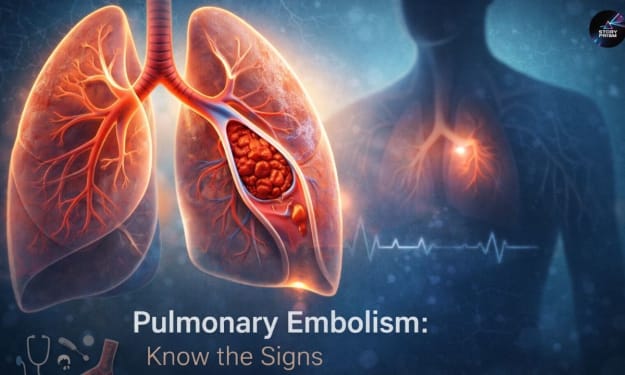
Pulmonary Embolism: Symptoms, Causes, Treatment, and Prevention of a Silent Killer
Introduction Pulmonary embolism (PE) is a serious, potentially life-threatening condition that occurs when a blood clot blocks one or more arteries in the lungs. It is one of the most critical emergencies in cardiovascular health, ranking just after heart attacks and strokes in terms of morbidity and mortality. PE often originates from deep vein thrombosis (DVT), a blood clot in the veins of the legs or pelvis, that travels through the bloodstream to the lungs. Understanding the risk factors, early symptoms, diagnostic methods, treatment options, and preventive strategies is essential to improving outcomes and saving lives.
By Story Prism28 days ago in Longevity