
Huntington’s Disease Treatment Market Size and Forecast 2025: A New Era of Hope for a Rare Genetic Disorder
From US$ 512.88 Million in 2024 to US$ 2,033.41 Million by 2033, the Global Huntington’s Disease Treatment Market Is Entering a Decade of Rapid Innovation and Investment

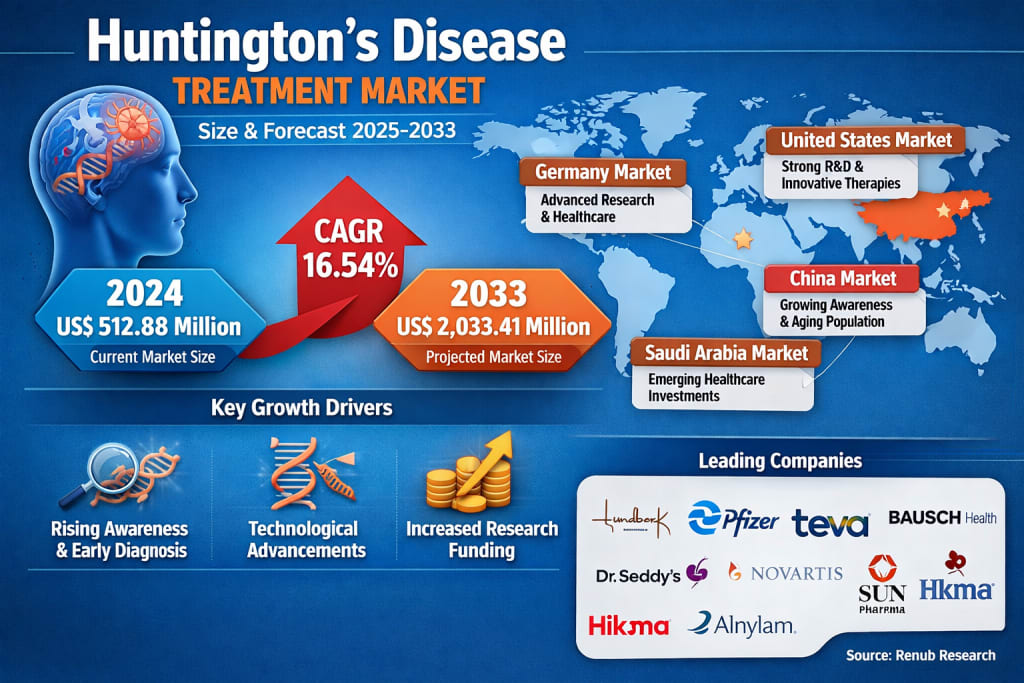
Global Huntington’s Disease Treatment Market Overview
The global Huntington’s disease (HD) treatment market is entering a transformative phase, driven by rapid advances in biotechnology, rising disease awareness, and a growing commitment from pharmaceutical companies to tackle rare and complex neurological disorders. Huntington’s disease is a hereditary, progressive neurodegenerative condition characterized by motor dysfunction, cognitive decline, and psychiatric disturbances. Although there is still no cure, the treatment landscape is evolving quickly, shifting from purely symptom management toward more targeted and potentially disease-modifying approaches.
According to Renub Research, the Huntington’s Disease Treatment Market is expected to reach US$ 2,033.41 million by 2033, up from US$ 512.88 million in 2024, growing at a strong CAGR of 16.54% from 2025 to 2033. This remarkable growth reflects both the unmet medical need in Huntington’s disease and the increasing confidence of investors and researchers in next-generation therapies, including gene-based and RNA-targeted treatments.
At present, most available therapies focus on controlling symptoms such as chorea (involuntary movements), depression, irritability, and cognitive impairment. Drugs like tetrabenazine and deutetrabenazine are commonly used to manage motor symptoms, while antidepressants and antipsychotics are prescribed for psychiatric manifestations. However, these treatments do not address the underlying cause of the disease: a genetic mutation in the huntingtin (HTT) gene that leads to the production of a toxic protein and progressive neuronal damage.
The scientific understanding of Huntington’s disease has improved significantly over the past decade. Researchers now have a clearer picture of how CAG repeat expansions in the HTT gene trigger neurodegeneration. In healthy individuals, the number of CAG repeats is typically below 35, while in Huntington’s disease patients, this number can range from 36 to more than 200. This genetic insight has opened the door to innovative therapeutic strategies such as gene silencing, antisense oligonucleotides, RNA interference, and even CRISPR-based gene editing.
Geographically, Huntington’s disease shows notable variation in prevalence. In North America, around 30,000 people are affected, with a prevalence of approximately 5.7 per 100,000 individuals. In the United States, the disease affects roughly 1 in every 10,000 people. In Europe, prevalence can reach up to 10 per 100,000 in certain regions. By contrast, reported prevalence is significantly lower in many Asian countries, a difference often attributed to genetic, diagnostic, and reporting variations rather than true absence of the disease.
As awareness increases and diagnostic capabilities improve, more patients are being identified earlier in the disease course. This trend is critical, because early diagnosis not only helps patients and families plan better, but also creates opportunities for early intervention with emerging therapies that may one day slow or alter disease progression.
Market Growth Drivers
Rising Awareness and Early Diagnosis
One of the most important growth drivers for the Huntington’s disease treatment market is the steady increase in awareness among both the general public and healthcare professionals. In the past, many cases of Huntington’s disease went undiagnosed or were misdiagnosed, especially in regions with limited access to genetic testing and specialized neurological care. Today, better education, stronger patient advocacy groups, and wider availability of genetic screening are helping to change this picture.
Early diagnosis plays a crucial role in disease management. While current therapies cannot cure Huntington’s disease, early intervention can significantly improve quality of life by helping to manage symptoms more effectively and plan supportive care. Moreover, as disease-modifying therapies move closer to clinical reality, identifying patients in the early stages will become even more important. This growing emphasis on early detection is increasing demand for both diagnostic services and long-term treatment solutions, directly supporting market growth.
Technological Advancements in Drug Development
Technological progress in drug development is another major force shaping the Huntington’s disease treatment market. The rise of personalized medicine, driven by advances in genomics and molecular biology, is enabling researchers to design therapies that target the specific genetic and molecular mechanisms underlying the disease.
Innovations in clinical trial design, such as adaptive trials and biomarker-driven studies, are also accelerating the development process. These approaches allow researchers to evaluate treatment efficacy more quickly and accurately, reducing both time and cost. In Huntington’s disease, where patient populations are small and disease progression can be slow, such efficient trial designs are especially valuable.
Perhaps most importantly, new therapeutic platforms—such as antisense oligonucleotides, RNA interference, and gene editing—are shifting the focus from symptom control to potential disease modification. While many of these approaches are still in clinical development, their progress is fueling optimism and attracting substantial investment into the market.
Increased Research Funding and Investment
The Huntington’s disease treatment market is also benefiting from a surge in research funding and investment from both public and private sources. Governments, non-profit organizations, and patient advocacy groups are increasingly recognizing the importance of supporting research into rare diseases, including Huntington’s disease. At the same time, pharmaceutical and biotechnology companies see significant long-term potential in developing breakthrough therapies for conditions with high unmet medical need.
This influx of funding is enabling large-scale clinical trials, supporting collaborations between academic institutions and industry, and accelerating the translation of laboratory discoveries into real-world treatments. In particular, cutting-edge fields such as gene therapy and RNA-based therapeutics require substantial financial resources, and the growing availability of capital is helping to push these innovations forward.
Key Challenges in the Market
Lack of Disease-Modifying Treatments
Despite impressive scientific progress, one of the biggest challenges in the Huntington’s disease treatment market remains the lack of approved disease-modifying therapies. Current treatments mainly address symptoms and do not stop or slow the underlying neurodegenerative process. This limitation highlights the complexity of the disease, which involves intricate genetic, molecular, and cellular mechanisms.
Developing therapies that can safely and effectively reduce the production of the toxic huntingtin protein, or repair the genetic mutation itself, is an enormous scientific challenge. While several promising approaches are in clinical development, proving long-term safety and efficacy in humans takes time. Until true disease-modifying treatments become widely available, the market will continue to rely heavily on symptomatic therapies.
Small Patient Population
Huntington’s disease is a rare disorder, and the relatively small patient population presents both economic and practical challenges. From a business perspective, smaller markets can make it harder for companies to justify large investments in research and development, especially given the high costs and risks associated with drug development.
From a clinical standpoint, recruiting enough patients for large, statistically robust clinical trials can be difficult. This can slow down the development process and increase costs. In addition, because development expenses must be spread across a limited number of patients, treatment prices can be high, potentially restricting access for some individuals. Balancing innovation, affordability, and accessibility remains a key challenge for the industry.
Regional Market Insights
United States Huntington’s Disease Treatment Market
The United States represents one of the most important markets for Huntington’s disease treatments, driven by relatively high disease awareness, strong research infrastructure, and significant investment in biotechnology. The country hosts many of the world’s leading pharmaceutical and biotech companies, as well as top academic research centers focused on neurodegenerative diseases.
While most currently available treatments in the U.S. focus on symptom management, there is growing momentum behind the development of disease-modifying therapies, particularly gene- and RNA-based approaches. Numerous clinical trials are underway, exploring innovative strategies to target the root cause of the disease. Although challenges such as regulatory complexity and high treatment costs remain, the U.S. market is expected to continue playing a central role in shaping the future of Huntington’s disease therapy.
Germany Huntington’s Disease Treatment Market
Germany is a key European market for Huntington’s disease treatments, supported by a strong healthcare system, advanced research capabilities, and increasing emphasis on early diagnosis and intervention. German research institutions and pharmaceutical companies are actively involved in clinical studies investigating novel therapeutic approaches, including gene editing and RNA-based treatments.
As in other countries, the market faces challenges related to the rarity of the disease and the high cost of advanced therapies. However, growing public and private investment in neurological research, combined with supportive healthcare infrastructure, positions Germany as an important contributor to the global Huntington’s disease treatment landscape.
China Huntington’s Disease Treatment Market
In China, the Huntington’s disease treatment market is still at an earlier stage of development compared to North America and Europe, but it is gaining momentum. Rising awareness of rare diseases, an aging population, and improvements in diagnostic capabilities are leading to more identified cases and increasing demand for effective treatments.
While most current therapies in China focus on symptom management, interest in advanced approaches such as gene therapy and RNA-based treatments is growing. Challenges include regulatory hurdles, limited access to specialized care in some regions, and high treatment costs. Nevertheless, China’s expanding healthcare system and increasing investment in medical research are likely to support steady market growth in the coming years.
Saudi Arabia Huntington’s Disease Treatment Market
Saudi Arabia’s Huntington’s disease treatment market is relatively small but shows promising potential. The country is placing greater emphasis on improving care for rare diseases and expanding its healthcare infrastructure. Although Huntington’s disease remains uncommon in the region, improved diagnostic awareness is leading to more identified cases, particularly among older populations.
Most current treatments focus on symptom management, but there is growing interest in advanced therapeutic approaches, including gene-based strategies. Challenges such as high treatment costs, limited specialist availability, and regulatory complexity persist. However, increased government investment in healthcare and collaborations with international pharmaceutical companies are expected to improve access to advanced treatments over time.
Market Segmentation
By Drug Type
The Huntington’s disease treatment market can be divided into two main categories based on drug type:
Approved Drugs: These include medications currently approved for managing symptoms such as chorea and psychiatric disturbances. They form the backbone of today’s treatment landscape.
Off-label Drugs: These are medications approved for other conditions but used in Huntington’s disease to manage specific symptoms, particularly psychiatric and behavioral issues.
By End User
Based on end-user distribution, the market is segmented into:
Hospital Pharmacy
Drug Store & Retail Pharmacy
Online Pharmacy
Hospitals and retail pharmacies currently dominate distribution, but online pharmacies are gradually gaining traction due to convenience and expanding digital healthcare platforms.
By Country
The market analysis covers 21 key countries, including:
United States, Canada, Germany, United Kingdom, France, Italy, Netherlands, Spain, China, South Korea, Japan, India, Indonesia, Malaysia, Argentina, Brazil, Mexico, Colombia, Saudi Arabia, South Africa, Israel, Australia, and the UAE.
Competitive Landscape
The Huntington’s disease treatment market features a mix of established pharmaceutical giants and innovative biotech companies. Key players include:
H. Lundbeck
Pfizer Inc.
Bausch Health Companies
Teva Pharmaceutical Industries
Dr. Reddy’s Laboratories
Sun Pharmaceutical Industries Limited
Hikma Pharmaceuticals Plc
Alnylam Pharmaceuticals
Novartis AG
uniQure
These companies are actively involved in developing new therapies, expanding clinical pipelines, and forming strategic partnerships to strengthen their positions in this evolving market. Their strategies typically focus on four main areas: overall company overview, leadership and key personnel, recent developments, and financial performance.
Final Thoughts
The global Huntington’s disease treatment market is on the brink of a major transformation. With the market projected to grow from US$ 512.88 million in 2024 to US$ 2,033.41 million by 2033, the coming decade is likely to bring unprecedented innovation and investment into this long-neglected area of neurology.
While significant challenges remain—particularly the lack of approved disease-modifying therapies and the constraints of a small patient population—the pace of scientific progress is encouraging. Advances in genetics, molecular biology, and drug development technologies are steadily shifting the focus from symptom management toward therapies that may one day change the course of the disease itself.
For patients and families affected by Huntington’s disease, this evolving landscape offers something that has long been in short supply: real hope. And for the healthcare and biotechnology industries, it represents a powerful example of how innovation, investment, and persistence can come together to tackle even the most complex and challenging conditions.
About the Creator
How Oral Health Awareness Supports Long-Term Wellbeing
Long-term wellbeing is often associated with habits like staying active, eating well, and managing stress. Oral health, however, is sometimes overlooked in conversations about longevity, even though it plays a meaningful role in everyday comfort and quality of life.
By Smile Sydney6 days ago in Longevity
Famous but Deadly Kite Flying Festival Returns After 19-Year Ban
After nearly two decades of prohibition, one of the world’s most controversial kite-flying festivals has returned, drawing thousands of spectators while reigniting debate over public safety and cultural tradition. Authorities lifted a 19-year ban on the event, allowing it to resume under strict regulations aimed at preventing the deadly accidents that once made it infamous. The festival, long celebrated for its vibrant skies and competitive spirit, had been suspended following a series of fatal incidents linked to the use of glass-coated strings, known locally as manja. These razor-sharp strings were traditionally used to cut rival kites during competitions but also caused severe injuries and deaths among participants, pedestrians, and motorcyclists. A Tradition Revived Organizers described the return of the festival as a moment of cultural renewal. Colorful kites once again filled the sky, accompanied by music, food stalls, and crowds gathering on rooftops and open grounds. For many residents, the revival marked a reclaiming of a cherished heritage that had been lost for a generation. “This festival is part of who we are,” said one participant who traveled from another city to attend. “For 19 years, we have waited to see the sky look like this again.” Local governments permitted the festival under a framework of new safety rules. Only approved cotton strings were allowed, and the sale or use of glass-coated or metallic strings was declared illegal. Police checkpoints were established near major venues, and vendors were required to show proof that their materials met safety standards. Memories of Tragedy The original ban followed a string of deadly accidents in the early 2000s. Sharp kite strings slashed throats of motorcyclists, entangled power lines, and caused falls from rooftops. Hospitals reported dozens of injuries every year during the festival season, including children and bystanders who were not participating in kite flying. Public outrage over these tragedies forced authorities to suspend the celebrations indefinitely. Critics argued that tradition could not justify the loss of life, while supporters maintained that safer alternatives could preserve the festival without endangering the public. The return of the event has therefore been met with both excitement and anxiety. “I still remember when my cousin was injured during the old festival,” said one resident. “I’m happy it’s back, but I worry whether people will really follow the rules.” Heavy Security and New Rules This year’s revival featured unprecedented security measures. Police patrols monitored rooftops and public spaces, while emergency medical teams were placed on standby. Drones were reportedly used to watch for illegal kite strings, and violators faced heavy fines and possible arrest. Authorities also launched awareness campaigns ahead of the festival, urging citizens to avoid dangerous materials and reminding them that the goal was celebration, not competition at any cost. “This is not just about flying kites,” said a senior official involved in organizing the event. “It is about showing that we can honor tradition responsibly.” In addition, local schools and community groups organized workshops teaching children how to fly kites safely and emphasizing respect for public spaces and electrical infrastructure. Mixed Reactions From the Public Crowds who attended the festival expressed relief that the event had returned in a controlled form. Many families treated it as a picnic-like gathering, with children running across open fields and elders watching from shaded areas. Tourism officials also welcomed the revival, noting that the festival once attracted visitors from across the region. Hotels and restaurants reported increased business as travelers arrived to witness the spectacle. However, human rights groups and safety advocates urged caution. They warned that enforcement would be the real test and that even a small lapse could result in serious injury. “The risk has not disappeared,” said one campaigner. “Only strict compliance and constant monitoring can prevent a repeat of the past.” A Symbol of Balance Between Culture and Safety The return of the kite festival highlights a broader challenge faced by many societies: how to preserve cultural traditions while adapting them to modern safety standards. Similar debates have occurred around fireworks displays, animal festivals, and street celebrations worldwide. Officials insist that the new version of the festival represents a compromise — one that allows people to reconnect with heritage without exposing the public to unacceptable danger. Whether the revival will become a permanent fixture depends largely on what happens in the coming years. If the festival passes without major incidents, authorities are likely to continue permitting it. If accidents occur, the ban could be reinstated. Looking Ahead For now, the skies filled once again with color and movement, offering a powerful image of resilience and cultural pride. Many attendees described the moment as emotional, recalling stories from parents and grandparents who had once celebrated the festival freely. “This is more than just kites,” said a young participant. “It’s about proving we can learn from the past and still celebrate together.” As night fell and the final kites drifted down, the success of the festival rested not only in its beauty but in whether it truly marked a safer chapter in a once-deadly tradition. The coming days will determine whether this revival becomes a model for balancing heritage with responsibility — or a reminder of why the ban existed in the first place.
By Fiaz Ahmed 3 days ago in Longevity
Our Song
Evening has given way to night. Gently, I settle next to you on the comfortable, old love seat and reach for your hand. You snatch it away, again. It cuts me to the quick, but I hide the pain, understanding that the reaction is but part of your demented state. Since the accident, your presence here in our cozy home has been clouded by a haze I can't see. Nevertheless, I feel the frigidity of your expressions and it serves as an excruciating reminder of the immeasurable distance between us.
By Dana Crandell7 days ago in Fiction



Comments
There are no comments for this story
Be the first to respond and start the conversation.