
Global Drug Abuse Testing Market Size and Forecast 2025
Rising Substance Use, Stricter Regulations, and Rapid Testing Technologies Drive a Market Set to Nearly Double by 2033

Introduction: A Market Shaped by Public Health and Safety Priorities
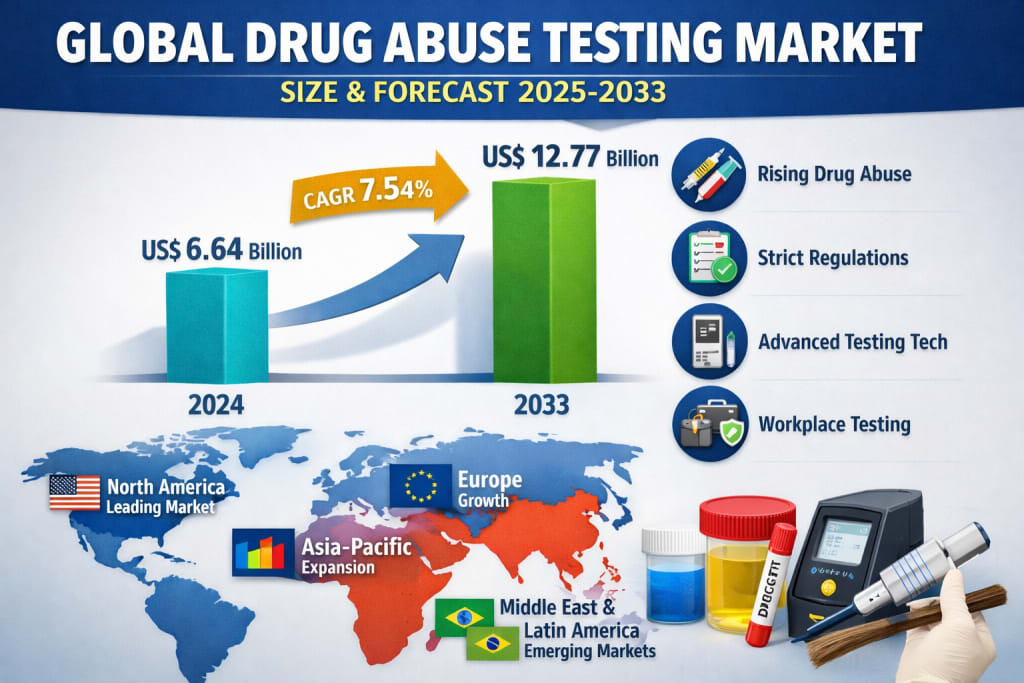
The global drug abuse testing market is entering a decisive decade, shaped by rising substance use, stricter regulatory frameworks, and rapid innovation in diagnostic technologies. According to Renub Research, the Drug Abuse Testing Market is expected to reach US$ 12.77 billion by 2033, up from US$ 6.64 billion in 2024, growing at a CAGR of 7.54% from 2025 to 2033.
This growth trajectory reflects more than just expanding healthcare spending. It mirrors deeper societal shifts: governments tightening workplace safety norms, healthcare systems prioritizing early detection, and organizations across sectors recognizing that substance abuse is not only a medical issue, but also an economic and social one.
Drug abuse testing today is no longer limited to law enforcement or rehabilitation centers. It has become a critical tool in hospitals, corporate offices, schools, sports organizations, and even home settings. With substance use disorders continuing to strain public health systems worldwide, the demand for accurate, fast, and accessible testing solutions is rising steadily.
Understanding Drug Abuse Testing and Its Expanding Role
Drug abuse refers to the intentional misuse of illegal substances or the excessive use of over-the-counter and prescription drugs for non-medical purposes. This behavior can lead to addiction, long-term health complications, mental health disorders, and severe social consequences.
Drug abuse testing plays a vital role in identifying substance use, supporting diagnosis, guiding treatment decisions, and ensuring compliance with legal and workplace regulations. In emergency departments, testing helps clinicians manage acute mental health episodes, seizures, and overdose cases. In neonatal and pediatric care, it can identify infants and toddlers at risk of exposure to illicit substances.
Employers increasingly use drug testing as part of pre-employment screening and ongoing workplace safety programs. Meanwhile, schools, sports authorities, and rehabilitation centers rely on testing to promote safer environments and support recovery pathways.
Substances commonly tested include alcohol, cannabis (marijuana), cocaine, opioids, amphetamines and methamphetamines, LSD, and other psychoactive drugs. The growing prevalence of substance use disorders globally is one of the core reasons why demand for testing solutions continues to rise.
Market Growth Drivers
1. Rising Drug Abuse and Addiction Rates
One of the strongest forces driving the global drug abuse testing market is the steady increase in substance use and addiction worldwide. The problem spans age groups, but is particularly pronounced among young adults and working-age populations.
Data from the Organisation for Economic Co-operation and Development (OECD) highlights the scale of the issue in Europe alone: nearly one in three adults aged 15 to 64—around 97 million people—have used illegal drugs at least once in their lifetime, with higher prevalence among men than women. Similar trends are observed across North America and parts of Asia-Pacific.
As addiction rates rise, so does the need for prevention, early detection, treatment, and legal monitoring. Drug testing is central to all these efforts. Healthcare providers rely on it for diagnosis and treatment planning, while governments and organizations use it to enforce regulations and promote safer communities. The growing emphasis on rehabilitation and recovery further reinforces long-term demand for reliable testing solutions.
2. Technological Advancements in Testing Methods
Technology is reshaping how drug abuse testing is conducted. Traditional urine testing remains widely used, but newer methods such as saliva, hair, and breath testing are gaining traction due to their speed, convenience, and non-invasive nature.
Modern testing devices offer improved sensitivity and specificity, enabling the detection of a broader range of substances, including new synthetic drugs. Portable and user-friendly instruments now allow on-site testing in workplaces, schools, roadside checks, and remote healthcare settings. This shift toward point-of-care and rapid testing significantly improves accessibility and turnaround times.
A notable example of innovation in this space occurred in May 2024, when Cannabix Technologies Inc. and Omega Laboratories announced a collaboration to integrate Cannabix’s THC breathalyzer into Omega’s drug testing offerings. Under this partnership, Omega became Cannabix’s exclusive laboratory services provider, enhancing the accuracy and efficiency of THC detection. Such developments highlight how technology is expanding both the scope and practicality of drug testing worldwide.
3. Workplace and Government Regulations
Regulation is another major growth engine for the drug abuse testing market. Many countries have strengthened laws requiring drug testing, especially in safety-sensitive industries such as healthcare, construction, transportation, and manufacturing.
These regulations aim to reduce workplace accidents, improve productivity, and protect public safety. At the same time, governments are launching broader initiatives to combat substance abuse, promote drug-free environments, and support preventive healthcare.
As compliance becomes more stringent, organizations are increasingly investing in reliable testing programs and certified laboratory services. This regulatory push ensures that drug abuse testing remains not just a healthcare tool, but also a core component of corporate governance and public safety policy.
Key Challenges Facing the Market
1. Privacy and Ethical Concerns
Despite its benefits, drug testing raises important ethical and privacy issues. In workplaces and educational institutions, individuals may feel that mandatory testing infringes on personal rights. Concerns about data security, consent, and misuse of test results can lead to resistance and mistrust.
For the industry to maintain credibility, stakeholders must ensure strict confidentiality, transparent consent procedures, and full compliance with data protection regulations. Balancing public safety and individual rights remains one of the market’s most sensitive challenges.
2. Regulatory Variations Across Regions
The global nature of the drug abuse testing market also brings regulatory complexity. Different countries and regions follow different standards, protocols, and approval processes for testing methods and devices.
For multinational companies, navigating these varying regulations increases costs and can delay product launches. Frequent updates to regulatory frameworks further complicate long-term planning and require continuous adaptation of testing procedures and product portfolios.
Regional Market Overview
The drug abuse testing market is expanding worldwide, with regional dynamics shaped by regulation, healthcare infrastructure, and public awareness.
North America leads the market, driven by strict regulations, widespread workplace testing, and advanced healthcare systems.
Europe follows closely, supported by strong public health policies and growing emphasis on safety and compliance.
Asia-Pacific is emerging as a high-growth region due to increasing awareness, expanding healthcare infrastructure, and government initiatives.
Latin America and the Middle East & Africa are witnessing gradual adoption, supported by improving regulatory frameworks and healthcare investments.
United States Drug Abuse Testing Market
The United States represents one of the most mature and dynamic markets for drug abuse testing. Growth is fueled by rising substance abuse rates, mandatory workplace testing policies, and continuous innovation in diagnostic technologies.
The country benefits from a well-established legal framework, advanced healthcare infrastructure, and strong awareness of the role drug testing plays in workplace safety and public health—particularly in sectors such as transportation, healthcare, and construction.
In September 2024, Quest Diagnostics acquired a portion of Allina Health’s laboratory operations, improving access to high-quality and affordable laboratory services for patients and physicians in Minnesota and western Wisconsin. This move reflects growing demand for reliable substance abuse testing and diagnostics in the region.
Earlier, in August 2024, Quest Diagnostics also announced an agreement with University Hospitals to acquire certain assets from the health system’s outreach laboratory services division. These strategic expansions strengthen Quest’s testing capabilities, including drug abuse testing, and underline the robust growth momentum of the U.S. market.
Germany Drug Abuse Testing Market
Germany’s market is driven by strict regulations, a strong healthcare system, and increasing awareness of substance abuse risks. Drug testing is widely used in workplaces, schools, and healthcare facilities, supported by EU-level guidelines and national safety standards.
Technological advancements, particularly in hair and saliva testing, are improving detection speed and accuracy. Combined with government initiatives focused on prevention and public health, these factors are sustaining steady growth in the German market.
India Drug Abuse Testing Market
India is witnessing a gradual but significant rise in demand for drug abuse testing, driven by increasing drug abuse cases and growing public awareness of their social and economic impact. The country’s expanding healthcare sector and focus on workplace safety are further supporting market growth.
In June 2022, the Punjab government launched a drug screening campaign in prisons, screening around 8,000 inmates across 14 jails. The results were striking: 42% of those tested were found to be drug addicts, highlighting the scale of the problem and the urgent need for effective testing solutions.
Technological adoption, including hair and saliva testing methods, is also contributing to the market’s expansion in India, particularly in law enforcement, rehabilitation, and public health programs.
Saudi Arabia Drug Abuse Testing Market
Saudi Arabia’s market is shaped by strict government policies, strong legal enforcement, and growing public awareness about substance abuse. Drug testing plays an important role in schools, rehabilitation centers, and workplaces, supported by rigorous safety and compliance standards.
The government’s focus on preventing drug trafficking and promoting public health, along with investments in modern diagnostic technologies, is helping drive steady growth in the Saudi market.
Market Segmentation Overview
By Product & Services:
Analysers
Rapid Testing Devices
Consumables
Laboratory Services
By Sample Type:
Urine
Oral Fluid
Breath
Hair
Others
By Drug Type:
Alcohol
Cannabis/Marijuana
Cocaine
Opioids
Amphetamine & Methamphetamine
LSD
Others
By End Users:
Drug Testing Laboratories
Workplaces
Hospitals
Rehabilitation Centers
Academic Institutes and Research Centers
Others
By Countries:
North America: United States, Canada
Europe: France, Germany, Italy, Spain, United Kingdom, Belgium, Netherlands, Turkey
Asia-Pacific: China, Japan, India, South Korea, Thailand, Malaysia, Indonesia, Australia, New Zealand
Latin America: Brazil, Mexico, Argentina
Middle East & Africa: Saudi Arabia, UAE, South Africa
Competitive Landscape and Key Players
The market features several major global players competing on technology, accuracy, service reach, and innovation. All key players are analyzed across five viewpoints: overview, product portfolio, recent developments and strategies, and revenue analysis.
Key Companies Include:
Danaher Corporation
LabCorp
Abbott Laboratories
Quest Diagnostics
Thermo Fisher Scientific Inc.
F. Hoffmann-La Roche Ltd.
Bio-Rad Laboratories Ltd.
Medtronic Plc.
These companies continue to invest in advanced testing technologies, expand laboratory networks, and pursue strategic partnerships and acquisitions to strengthen their market positions.
Final Thoughts: A Market with Strong Long-Term Fundamentals
The global drug abuse testing market stands at the intersection of healthcare, public safety, and regulatory compliance. With the market projected to grow from US$ 6.64 billion in 2024 to US$ 12.77 billion by 2033 at a CAGR of 7.54%, the long-term outlook remains firmly positive.
Rising substance abuse rates, stricter workplace and government regulations, and continuous technological innovation will keep demand strong across regions and end-user segments. At the same time, the industry must navigate challenges related to privacy, ethics, and regulatory complexity.
Ultimately, as societies place greater emphasis on prevention, early detection, and safer environments, drug abuse testing will remain a critical tool—supporting not only market growth, but also broader public health and social well-being.
About the Creator
Sakshi Sharma
Content Writer with 7+ years of experience crafting SEO-driven blogs, web copy & research reports. Skilled in creating engaging, audience-focused content across diverse industries.
Keep reading
More stories from Sakshi Sharma and writers in Longevity and other communities.
United States Retinal Surgery Devices Market Size & Forecast 2026–2034
Market Overview The United States retinal surgery devices market is projected to witness consistent and robust growth over the forecast period, driven by the increasing burden of retinal disorders, rising diabetes prevalence, and rapid adoption of technologically advanced ophthalmic solutions. According to Renub Research, the market is expected to expand from US$ 902.54 million in 2025 to US$ 1,852.87 million by 2034, registering a Compound Annual Growth Rate (CAGR) of 8.32% during 2026–2034.
By Sakshi Sharma9 days ago in Longevity
How Were 500 Patients Evacuated from a Hospital?
When emergency alarms rang through the corridors of a major regional hospital late one evening, few could have imagined the scale of the operation that would follow. Within hours, more than 500 patients — including those in intensive care, newborn infants, and elderly residents — were safely evacuated after a sudden infrastructure failure threatened the facility’s ability to function. Hospital officials later described the evacuation as one of the largest and most complex medical relocations in recent years, requiring precise coordination between doctors, nurses, firefighters, police, and ambulance crews. The Trigger for Evacuation The emergency began with a critical failure in the hospital’s power and ventilation systems after flooding from heavy rain entered a key utility area. Backup generators activated but soon became unstable, raising fears that life-support equipment and operating theaters could shut down. Hospital leadership made the decision to evacuate when engineers confirmed the damage could not be repaired quickly. The priority was clear: protect the most vulnerable patients first. “This was not a drill,” said one senior nurse involved in the response. “We had minutes to organize teams and hours to move hundreds of people safely.” A Carefully Ordered Process The evacuation followed a strict medical triage plan. Patients were categorized based on their condition: Critical care patients were transferred first, including those on ventilators and cardiac monitors. Maternity and neonatal units followed, with premature babies transported in portable incubators. Surgical and general ward patients were moved next. Stable patients who could walk were guided out with staff assistance. Each patient was tagged with medical records and destination details to prevent confusion during transport. A Citywide Response More than 100 ambulances were dispatched from surrounding districts, along with fire engines and police escorts. Roads near the hospital were temporarily closed to allow emergency vehicles to move quickly and safely. Nearby hospitals were alerted in advance and cleared beds for incoming patients. Temporary treatment centers were set up in sports halls and community clinics for less critical cases. Inside the hospital, staff formed human chains to move equipment, oxygen tanks, and essential medication. Elevators were reserved for patients who could not be moved by stairs, while stairwells were turned into carefully controlled transport routes. “It felt like a military operation,” said a paramedic. “Everyone knew their role.” Challenges and Risks Moving critically ill patients always carries risk. Doctors had to stabilize individuals before transport and monitor them constantly during the journey. Portable power supplies and oxygen systems were checked repeatedly to ensure no interruptions. Communication also posed a challenge. With hundreds of patients heading to different facilities, command centers were established to track every transfer in real time. Family members were informed through emergency hotlines and social media updates. Volunteers and hospital social workers helped reunite relatives with patients at receiving hospitals. Staff Endurance and Teamwork Many nurses and doctors worked more than 18 hours without rest. Some staff accompanied patients in ambulances, continuing care even after arrival at new hospitals. “There was no panic,” said a hospital administrator. “There was fear, but it was controlled. The professionalism was extraordinary.” Medical students and retired healthcare workers were called in to assist with paperwork, logistics, and basic patient support. Outcome and Investigation By dawn, all 500 patients had been relocated without any reported fatalities linked directly to the evacuation. A small number required additional treatment due to stress or transport-related complications, but authorities described the operation as a success. An investigation has since been launched to determine why flood defenses failed and whether safety systems were adequate. Engineers are assessing whether the hospital can reopen fully or if major repairs are required. Health officials have promised to review emergency preparedness plans nationwide, using the evacuation as a case study for future crises. Lessons Learned Experts say the operation highlights the importance of disaster planning in healthcare facilities. Hospitals are among the most complex environments to evacuate, and success depends on training, communication, and infrastructure resilience. “This incident shows what can be achieved when preparation meets teamwork,” said a public health analyst. “But it also reminds us that climate-related risks and aging facilities make such events more likely.” For the patients involved, the evacuation was frightening but ultimately life-saving. For the staff, it was a test of endurance and commitment. As one nurse reflected, “We didn’t just move people. We protected lives under pressure. That’s what healthcare is about.”
By Fiaz Ahmed 5 days ago in Longevity
The Doctor Who Couldn't Heal Me
My hands shook as I read the test results for the third time. Everything came back normal. Again. Yet my body was falling apart. Chronic migraines. Digestive issues that left me doubled over. A fatigue so deep that climbing stairs felt like running a marathon. I'd seen five specialists, tried twelve medications, and spent thousands of dollars searching for answers that never came.
By Fazal Hadi4 days ago in Longevity



Comments
There are no comments for this story
Be the first to respond and start the conversation.