
Global Ophthalmic Devices Market Trends & Summary
Rising Vision Disorders, AI-Powered Diagnostics, and Advanced Surgical Solutions Fuel Steady Global Growth Through 2033

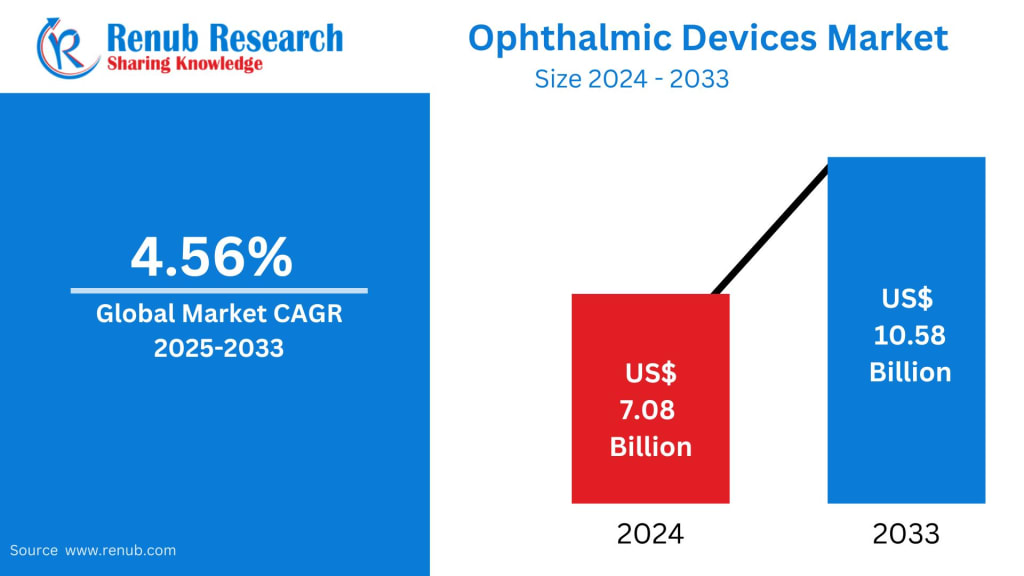
The Global Ophthalmic Devices Market, valued at USD 7.08 billion in 2024, is on a trajectory to reach USD 10.58 billion by 2033, expanding at a 4.56% CAGR from 2025 to 2033. This steady growth reflects a powerful combination of rising global vision disorders, rapid technological evolution, and growing consumer awareness surrounding preventive and corrective eye care.
Driven by advanced diagnostic tools, cutting-edge surgical devices, and expanding vision correction solutions such as glasses and contact lenses, the industry is becoming increasingly essential to global healthcare. Additionally, government-backed initiatives, AI-enabled screening solutions, and breakthroughs in surgical systems are accelerating adoption across both developed and emerging markets.
This comprehensive summary examines market drivers, challenges, segment insights, country-specific trends, and the competitive landscape shaping the future of vision care technology.
Understanding Ophthalmic Devices and Their Rising Role in Healthcare
Ophthalmic devices encompass a broad set of tools and products used to diagnose, treat, and correct a wide range of eye disorders. These include:
Diagnostic equipment: ophthalmoscopes, autorefactors, OCT scanners, ultrasound imaging systems
Surgical devices: intraocular lenses (IOLs), lasers, glaucoma drainage implants
Vision correction devices: spectacles and contact lenses
These tools are essential in managing cataracts, glaucoma, refractive errors, diabetic retinopathy, and age-related macular degeneration (AMD)—conditions that are increasingly prevalent as global lifestyles shift and populations age.
With over 2.2 billion people experiencing vision impairment, according to the WHO, demand for advanced devices and accessible eye care solutions continues to rise. Meanwhile, minimally invasive surgical innovations and AI-assisted diagnostics are redefining the scope and precision of modern ophthalmology.
Key Market Growth Drivers
1. Rising Prevalence of Eye Disorders and Growth in the Aging Population
As life expectancy increases worldwide, age-related vision disorders are rising sharply. Cataracts, glaucoma, and AMD are among the most common conditions driving the demand for diagnostic and surgical eye care technologies.
WHO reports that by 2030, 1 in 6 people globally will be aged 60 or above.
The number of people aged 80+ is expected to triple to 426 million by 2050.
Diabetes rates—which directly correlate with diabetic retinopathy—continue to surge in both developed and developing economies.
These demographic shifts are significantly contributing to increased demand for cataract surgeries, glaucoma implants, refractive correction tools, advanced imaging systems, and routine diagnostic procedures.
2. Technological Transformation and Innovation in Ophthalmic Care
The ophthalmology sector is undergoing rapid modernization. Breakthroughs are enhancing diagnostic speed, accuracy, and surgical precision, while reducing patient recovery time.
Key technological advancements include:
Femtosecond laser–assisted cataract surgery
Minimally invasive glaucoma surgery (MIGS)
AI-powered diagnostic software
High-resolution OCT and digital fundus imaging
Smart contact lenses with AR and health-monitoring capabilities
Robotic-assisted surgical systems
A notable milestone occurred in October 2024, when RetinAI US, Inc. launched RetinAI Discovery for Clinics, an AI-driven ophthalmic software platform designed to enhance image analysis and improve clinical workflow efficiency.
As more clinics adopt AI and automation, patient outcomes are expected to improve dramatically while also enabling remote diagnostics and teleophthalmology services.
3. Growing Eye Health Awareness and Government Initiatives
International agencies and national governments are increasingly investing in eye care infrastructure and awareness programs. These initiatives aim to reduce preventable blindness—much of which stems from conditions that are easily treatable when diagnosed early.
A major development came in May 2024, when the World Health Organization introduced SPECS 2030, a global program to increase access to affordable spectacles by 40%.
Additionally, numerous developing countries—including India, Indonesia, and many African nations—have launched public-private partnerships to expand screening services, cataract surgery availability, and primary eye care delivery.
The increased emphasis on preventive care, early screening, and affordable treatment greatly contributes to ophthalmic device adoption worldwide.
Challenges Constraining Market Growth
1. High Costs of Advanced Equipment and Procedures
State-of-the-art ophthalmic technologies—including femtosecond lasers, premium IOLs, and robotic surgical systems—carry high price tags, limiting their adoption in lower-income regions. Many patients also face insufficient insurance coverage for surgeries such as LASIK or refractive corrections.
The cost barrier narrows patient access while slowing device penetration in emerging markets, despite huge unmet needs.
2. Shortage of Trained Ophthalmologists and Eye Care Technicians
Many regions, especially in Africa, Asia, and Latin America, lack trained eye care professionals capable of operating complex imaging systems or performing advanced surgical interventions.
A shortage of skilled providers results in:
Delayed diagnosis
Increased disease progression
Underutilization of available technologies
Slower adoption of innovations
Without expanded training programs or technological solutions like AI-guided diagnostics, the full potential of ophthalmic devices cannot be realized.
Segment-Wise Analysis
1. Surgical Devices
This segment includes glaucoma drainage devices, stents and implants, intraocular lenses, lasers, and other surgical tools.
Glaucoma drainage devices are witnessing strong demand as MIGS procedures gain acceptance for long-term intraocular pressure control. The rising prevalence of glaucoma—one of the leading causes of irreversible blindness—makes this segment particularly important.
Intraocular lenses dominate the surgical device space due to the global surge in cataract surgeries. The market is shifting toward multifocal, toric, and extended depth-of-focus (EDOF) IOLs, driven by consumer preference for premium vision correction.
2. Diagnostic and Monitoring Devices
This category includes:
Autorefractors & keratometers
Corneal topography devices
Ophthalmic ultrasound systems
Ophthalmoscopes
OCT scanners
The increasing incidence of myopia, diabetic retinopathy, and macular degeneration drives demand.
OCT scanners and digital ophthalmoscopes are becoming essential in early screening, while AI-assisted analysis enhances accuracy and speeds up diagnosis.
3. Vision Correction Devices
These include:
Spectacles
Contact lenses
The spectacles segment benefits from rising screen usage and fashion trends, while blue-light protection lenses and lightweight materials are gaining strong consumer interest.
The contact lens market is being reshaped by:
Silicone hydrogel lenses
Daily disposables
Colored and cosmetic lenses
Smart lenses with biosensing capabilities
E-commerce and online optometry platforms have further accelerated sales worldwide.
Country-Specific Market Insights
United States
The U.S. leads global adoption due to:
Advanced clinical infrastructure
Strong insurance coverage
High demand for LASIK and cataract surgeries
Rapid acceptance of AI and teleophthalmology
In March 2025, Bausch + Lomb launched Arise, a cloud-based AI system for designing orthokeratology lenses, marking a major advancement in myopia management.
France
France benefits from well-funded healthcare, widespread access to premium ophthalmic technologies, and a strong innovation environment.
The French company Théa expanded its product portfolio significantly in 2022, strengthening its global footprint in both OTC and prescription ophthalmic solutions.
India
India’s ophthalmic devices market is booming due to:
Large patient population
High prevalence of cataracts and diabetic retinopathy
Government programs such as NPCBVI
Growing private sector eye hospitals
In February 2025, Kerala’s government launched Nayanamritham 2.0, the world’s first government-led AI-driven eye disease screening program, in partnership with Remidio.
Saudi Arabia
Strong growth is anticipated as Vision 2030 investments modernize healthcare infrastructure. Rising diabetes rates are fueling demand for advanced diagnostic and surgical treatments, while the population’s growing purchasing power increases demand for premium eyewear.
Market Segmentation Overview
Surgical Devices
Glaucoma Drainage Devices
Glaucoma Stents & Implants
Intraocular Lenses
Lasers
Other Surgical Devices
Diagnostic & Monitoring Devices
Autorefractors & Keratometers
Corneal Topography Systems
Ophthalmic Ultrasound Systems
Ophthalmoscopes
OCT Scanners
Others
Vision Correction Devices
Spectacles
Contact Lenses
Regions Covered
North America, Europe, Asia-Pacific, Latin America, Middle East & Africa
Key Companies Analyzed
Alcon Inc.
Bausch Health Companies Inc.
Carl Zeiss Meditec AG
EssilorLuxottica SA
HAAG-Streit Group
Hoya Corporation
Johnson & Johnson
Nidek Co. Ltd
Topcon Corporation
Ziemer Ophthalmic Systems AG
Each company is evaluated across four parameters: Overview, Key Persons, Recent Developments, and Revenue.
Final Thoughts
The global ophthalmic devices market is entering a transformative decade. Driven by a rising burden of eye diseases, increasing awareness, and rapid innovations in surgical technology and AI-assisted diagnostics, the industry is set for sustainable growth.
However, closing the gap in skilled professionals, improving affordability, and expanding access in developing nations remain essential priorities. With government initiatives, emerging AI tools, and consumer demand aligning, the next decade is likely to witness a more accessible, efficient, and technologically advanced vision care landscape—and ophthalmic devices will be at its core.
About the Creator
Marthan Sir
Educator with 30+ years of teaching experience | Passionate about sharing knowledge, life lessons & insights | Writing to inspire, inform, and empower readers.
Keep reading
More stories from Marthan Sir and writers in Longevity and other communities.
Molecular Diagnostics Market Trends & Summary
The global molecular diagnostics market continues to evolve at an impressive pace, fueling one of the most vital transformations in modern medical science. According to Renub Research, the market was valued at USD 16.43 billion in 2024 and is projected to reach USD 28.83 billion by 2033, expanding at a CAGR of 6.45% from 2025 to 2033. This steady climb reflects the worldwide demand for faster, more accurate diagnostics, rising infectious disease burdens, personalized medicine growth, and technological leaps in genomics and molecular biology.
By Marthan Sir2 months ago in Longevity
Day 4 of Quitting
If this is how sobriety feels, maybe it’s better to go through life a little buzzed… this, along with other hits like, I want to kill myself, I wish I was dead, and I’m going to throw myself off a bridge have been the only thoughts on rotation these past few days. I promise myself that if, in a month, I still feel like this (‘this’ meaning despondent, full of rage, and simultaneously numb) I can go back to smoking. Until mid-February though? Nicotine is off the table.
By sleepy drafts8 days ago in Longevity
More Than 5 Million Native Plants Reintroduced in Deserts Are Slowing Land Degradation and Rebooting Arid Ecosystems
Deserts are often seen as barren, unforgiving landscapes, but they are far from lifeless. These ecosystems, while harsh, support unique biodiversity and provide critical environmental services, from carbon sequestration to regulating local climates. Yet, decades of overgrazing, unsustainable land use, and climate change have taken their toll, leaving many arid regions struggling with soil erosion, loss of native vegetation, and diminished ecological resilience. Now, a bold rewilding effort is turning the tide: over five million native plants have been reintroduced into deserts worldwide, and the early results are promising. The scale of the initiative Across regions from the deserts of the Middle East and North Africa to the arid plains of Australia and North America, conservation organizations, local communities, and governments have collaborated to replant native species that were once nearly wiped out. These plants range from hardy shrubs and grasses to iconic desert flowers, all carefully selected for their ability to survive in extreme conditions and restore ecological balance. The numbers are staggering: more than 5 million individual plants have been transplanted over the last five years, covering thousands of hectares. While this effort is labor-intensive, involving soil preparation, irrigation during establishment phases, and ongoing monitoring, the environmental payoff has been remarkable. Slowing land degradation One of the primary goals of these reintroductions is to combat land degradation, a process that affects over 40% of the planet’s land surface. In deserts, degradation is particularly acute because soil erosion occurs rapidly in the absence of stabilizing vegetation. Without plants to anchor the soil, wind and water can strip away fertile topsoil, creating a feedback loop of declining vegetation and worsening erosion. Early monitoring reports suggest that reintroduced native plants are helping to stabilize sandy soils and reduce the spread of desertification. In some areas of the Middle East, for instance, wind erosion rates have decreased by up to 30% in regions where shrubs and grasses were replanted. This stabilization not only benefits the environment but also local communities that rely on the land for grazing, agriculture, and other livelihoods. Rebooting arid ecosystems Beyond slowing soil loss, these plant reintroductions are rebooting entire desert ecosystems. Deserts are home to a diverse array of wildlife, including insects, birds, and mammals that rely on native plants for food and shelter. By re-establishing vegetation cover, these efforts have triggered a cascade of ecological benefits. In parts of the Sonoran Desert in North America, researchers observed a noticeable increase in pollinator populations, such as bees and butterflies, following the reintroduction of native flowering plants. Similarly, small mammals and reptiles that had disappeared from degraded areas are gradually returning, attracted by improved habitat structure and food availability. Climate resilience Another key advantage of reintroducing native plants is enhancing climate resilience. Many desert plants are adapted to survive extreme heat, drought, and poor soils. By re-establishing these species, ecosystems can better withstand climate-related stresses, such as prolonged droughts or extreme heatwaves. Additionally, some species improve soil moisture retention and reduce surface temperatures, creating microclimates that further support biodiversity. Community engagement and knowledge transfer What makes these rewilding efforts particularly successful is the integration of local communities. Indigenous knowledge about native species, planting techniques, and seasonal cycles has been invaluable. In some regions, schools and community groups participate in planting days, turning conservation into a source of pride and education. This engagement ensures that restored areas are maintained, monitored, and valued over the long term. Looking ahead While the reintroduction of five million native plants is a significant achievement, experts caution that long-term success requires continued investment, monitoring, and protection from overgrazing, development, and climate pressures. However, the initiative provides a compelling example of how targeted, science-backed restoration can reverse environmental damage. For arid ecosystems, these efforts are more than just planting trees and shrubs—they represent hope. They demonstrate that even the most fragile landscapes can recover when humans actively collaborate with nature, restoring not only plants but the entire web of life that depends on them. As the world grapples with climate change and land degradation, the lessons from these desert rewilding projects offer a blueprint for action: by investing in native biodiversity, we can slow degradation, rebuild ecosystems, and create landscapes that are resilient, productive, and teeming with life once again.
By Fiazahmedbrohi a day ago in Longevity


Comments
There are no comments for this story
Be the first to respond and start the conversation.