
The 'AI Dark Funnel' Is Silently Killing Your Marketing ROI. Here’s the New Playbook.
Clicks Are Disappearing. Attribution Is Breaking.

Clicks Are Disappearing. Attribution Is Breaking.
Your analytics dashboard says things are going great. “Direct” traffic is up. Branded searches are rising. The charts look bullish. But what if those green arrows are actually red flags?
Welcome to the AI Dark Funnel: the invisible part of the customer journey happening inside generative AI systems like ChatGPT, Perplexity, and Google’s AI Overviews.
Here’s how it works: customers ask AI about your category, compare options, and even make a decision — without ever visiting your website. By the time they type your brand into Google or land on your site, the decision has already been made. And your dashboards can’t trace it.
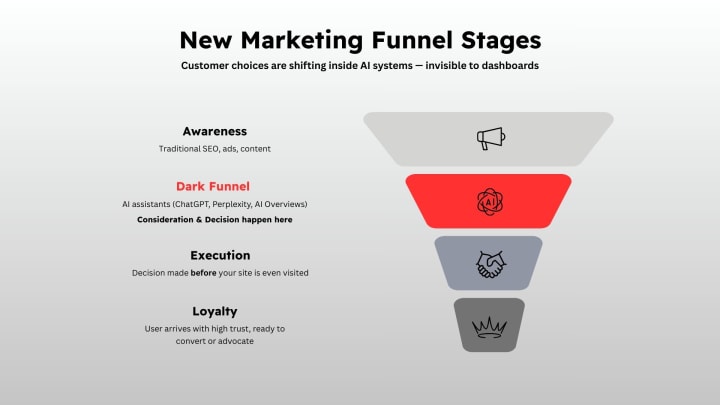
This hidden funnel is breaking attribution models, making legacy KPIs shaky, and quietly reshaping marketing ROI in ways most companies don’t yet realize.
The Illusion on Your Dashboard
At first glance, rising branded traffic looks like proof of stronger equity. In reality, it’s often just the echo of invisible choices made inside AI.
A traveler in London asks ChatGPT: “Best transfer service to Chamonix?” The AI cites one brand. The traveler later Googles that brand directly.
Your dashboard celebrates a spike in “direct” traffic. What you don’t see are the dozens of competitors who never entered the conversation.
This pattern is replicating across all high-stakes industries. In healthcare, patients now ask AI to vet clinics before searching for doctors. In finance, investors receive AI-synthesized 'best broker' lists that silently shape their choices.
Growth in direct traffic may no longer signal loyalty. It may just mean AI picked you — or ignored you.
The New Reality: How AI Broke the Customer Journey
Generative AI is rapidly becoming the new front door to the internet.
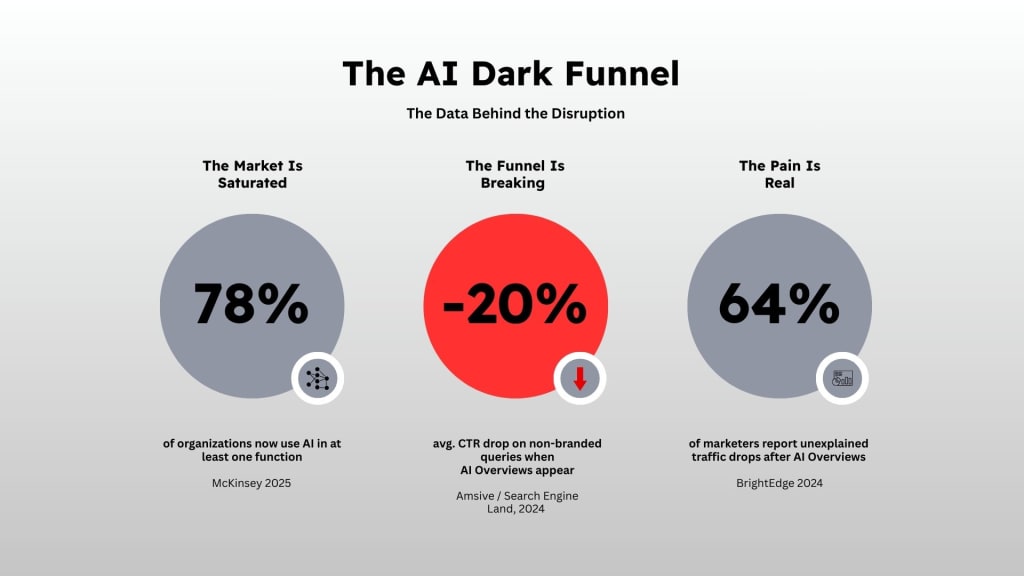
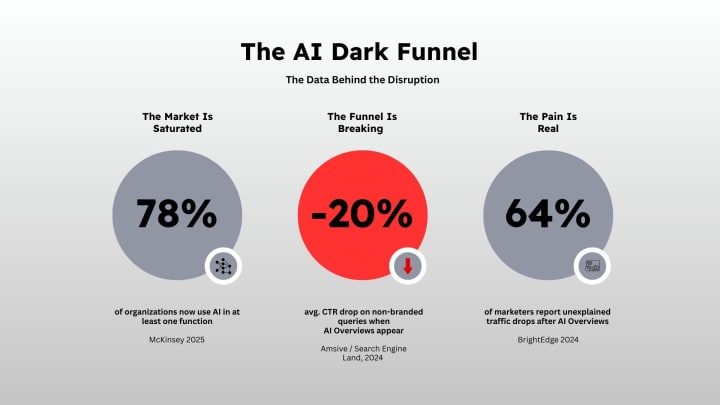
- Organizational adoption: 78% of companies now use AI in at least one function; 71% use generative AI specifically (McKinsey, 2025).
- User behavior: Nearly half of ChatGPT interactions are information-seeking and practical guidance — direct substitutes for search (NBER, 2025).
- Click-through impact: Ahrefs found CTR for position #1 drops by 34% when AI Overviews appear. Amsive measured average declines of ~15%, closer to 20% for non-branded queries.
- Media impact: MailOnline’s data showed CTR fell from 13% to below 5% on desktop — a drop of over 50%. SimilarWeb tracked a 26% decline in publisher traffic as AI queries surged.
- Search economics: BrightEdge found impressions up but clicks down since Overviews launched; 64% of marketers reported unexplained traffic losses.
The traditional “Zero Moment of Truth” — when customers researched your brand via search — now happens inside the AI black box. Trust is formed and preferences are set before you ever appear in analytics.
Why this shift is deeper than UX: AI lowers cognitive load (answers are instant). It’s coherent (a narrative, not a list of links). It’s confident (AI speaks in declarative tones).
The implication: if decisions are made inside the dark funnel, your ad spend, SEO, and content may be optimizing for a reality that no longer exists.
From Ten Blue Links to One AI Answer: The Three Ages of Search
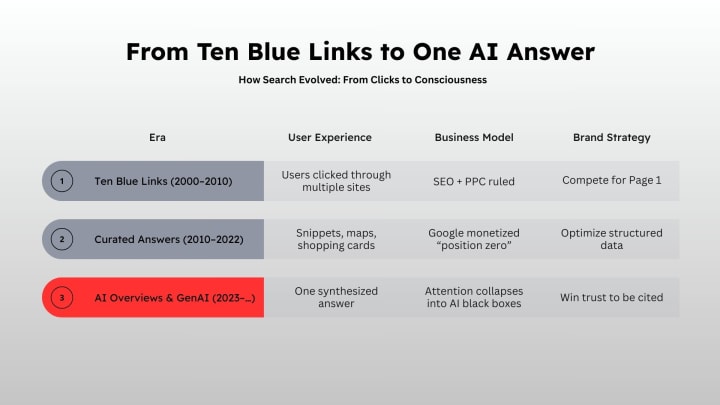
In Age 1, discovery was democratic. In Age 2, competitive. In Age 3, it’s winner-takes-all. If your brand isn’t in the AI-generated answer, you’re invisible.
The Market Impact: Silent Traffic Loss
The AI Dark Funnel doesn’t just reduce visibility — it silently reroutes demand.
Executives are noticing. BrightEdge reported 64% of marketers saw unexplained traffic drops after AI Overviews went live.
For U.S. enterprises, the stakes are massive. Amazon already sees product discovery shifting into AI shopping assistants. UnitedHealthcare is experimenting with AI-driven member guidance that bypasses traditional search. JPMorgan analysts track how AI-generated financial advice influences investor flows.
With marketing budgets averaging 7.7% of revenue (Gartner, 2024), even a 5–10% erosion from the Dark Funnel could reshape industries within two years.
Translation: if AI cites your brand, your branded traffic looks great. If it doesn’t, you disappear before measurement.
Three Strategic Blind Spots Every Executive Must Question
1. The Illusion of Rising Brand Loyalty
On dashboards, branded search is up. Direct traffic is rising. It looks like stronger equity. But often it’s the echo of AI decisions.
Example: a user asks ChatGPT “Best CRM for small businesses?” It cites HubSpot and Salesforce. The user later Googles “HubSpot pricing.” Analytics logs this as branded demand, but the decision was already made.
So what? CMOs can’t take “brand search growth” at face value. Product leaders must ensure positioning is AI-legible. Analysts must recalibrate attribution.
2. The Illusion of a Level Playing Field
For two decades, persistence online could challenge incumbents. That world is gone. Generative AI doesn’t present ten links. It presents one synthesized answer.
In travel, one aggregator dominates AI answers for ski transfers. In fintech, one lender becomes the default recommendation across multiple AIs.
So what? The funnel collapses into a winner-takes-all dynamic. APIs, docs, and datasets are the new distribution. Informational oligopolies are a real risk.
3. The Illusion of Content as a Permanent Asset
Marketers built evergreen libraries. In the AI era, models ingest and redistribute them — often without sending traffic back.
In finance, AI assistants summarize research in seconds. In e-commerce, AI tools distill reviews into “best picks.” The originals are invisible.
So what? Content ROI shifts from traffic generation to AI citation potential. Documentation and structured data become go-to-market levers. Journalism risks being reduced to raw training material.
The Executive Playbook: From Persuasion to Authority
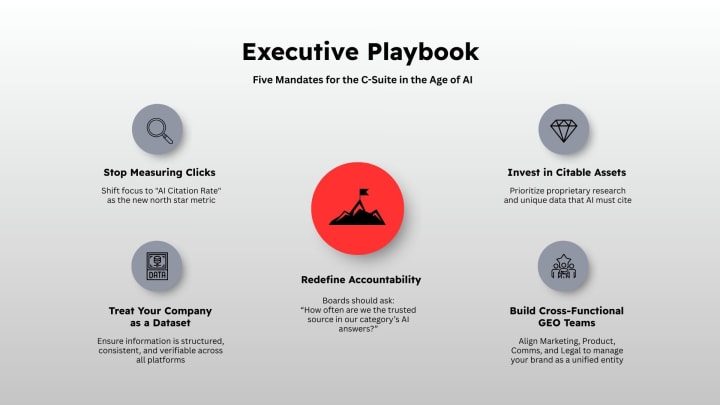
The AI Dark Funnel isn't a problem you can fix with a bigger ad spend. It's a paradigm shift that requires a new playbook.
The goal is no longer to persuade customers with clever marketing. It's to build machine-readable authority so AI systems choose to cite you.
That means shifting focus from clicks to trust, treating your company as a verifiable dataset, and investing in proprietary research that AI can't ignore. It requires aligning your marketing, product, and legal teams around one new metric: How often are we the trusted source in our category's AI answers?
Conclusion: The New Job of a CMO
For the last decade, the CMO’s role was to build and optimize a predictable funnel. The AI Dark Funnel has changed that.
The new mandate is to become the chief architect of machine-readable authority. The winners won’t be the brands that shout the loudest, but those AI trusts as truth.
They won’t win by chasing clicks — but by becoming the foundation of the AI’s answer.
__________
References
McKinsey, The state of AI: How organizations are rewiring to capture value, March 12, 2025
LinkedIn Economic Graph / Work Change Report: Work Change Report: AI is Coming to Work, January 2025
NBER / OpenAI working paper: How People Use ChatGPT, 2025
Search Engine Land: Google’s AI Overviews are hurting click-through rates
BrightEdge: One Year Into Google AI Overviews
About the Creator
Alena Belova
R&D and Data Science
Keep reading
More stories from Alena Belova and writers in Journal and other communities.
The Hidden Economics of Your Vacation: Why a 2-Hour Transfer in the Alps Can Cost More Than a Flight
I've always been fascinated by markets that defy simple logic. Why does a cup of artisanal coffee cost $7? Why is some enterprise software priced per seat, while another is priced per API call? These aren't just arbitrary numbers; they are the surface-level results of deep, often hidden, economic forces. Recently, I stumbled upon a perfect example of such a market in an unexpected place: the private ski transfer industry in the Alps.
By Alena Belova4 months ago in Journal
The Quiet Link Between Evening Light and Restless Sleep
For a long time, I believed my restless sleep was caused by what happened in my head. Too much thinking. Too much stress. Too many unfinished thoughts that followed me into the night. I tried calming routines, earlier bedtimes, and stricter boundaries around work. Some nights improved. Many did not.
By illumipure5 days ago in Journal




Comments
There are no comments for this story
Be the first to respond and start the conversation.