
India’s Strikes on Terror Camps Spark Global Reactions: UN, US, China Respond
India launched precision strikes on terror camps in Pakistan after the Pahalgam attack. Here's how world leaders from the US, UN, China, and others responded to the rising tensions.

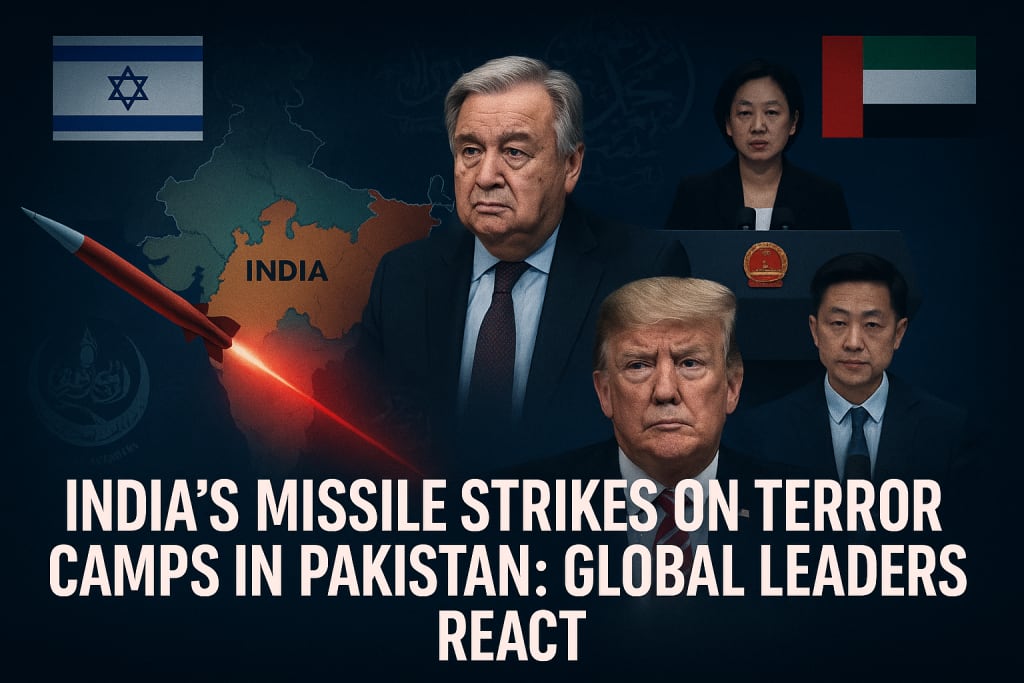
India's Strikes on Terror Camps: Global Reactions and Rising Tensions
In a dramatic escalation of tensions between India and Pakistan, Indian forces carried out missile strikes in the early hours of Wednesday targeting key terrorist camps linked to banned outfits such as Jaish-e-Mohammed (JeM) and Lashkar-e-Taiba (LeT). These operations, focused on sites within Pakistan and Pakistan-occupied Jammu and Kashmir (PoJK), followed a deadly terrorist attack in Pahalgam, Jammu and Kashmir, on April 22, which claimed 26 lives.
According to India's Defence Ministry, the airstrikes were precision attacks designed to neutralize active terror infrastructure while avoiding Pakistani military facilities. “Those behind the Pahalgam attack will face consequences,” the Ministry declared, emphasizing that India remains committed to eliminating cross-border terrorism.
India Identifies Key Targets
Among the locations struck were the JeM headquarters in Bahawalpur and LeT's central base in Muridke, both situated in Pakistan’s Punjab province. Pakistani military sources confirmed to the BBC that these regions were indeed among the areas hit, acknowledging the depth of the Indian offensive.
India has described its actions as "focused, measured, and non-escalatory," stressing that its aim was to deter future terror attacks rather than provoke conflict. Despite these reassurances, the situation at the Line of Control (LoC) has intensified, with artillery exchanges reported overnight. India confirmed that three civilians lost their lives due to retaliatory shelling from Pakistan.
Global Reactions: Calls for Restraint and Support for Sovereignty
United States
Reacting to the rising hostilities, US President Donald Trump expressed concern over the renewed violence. "It's a shame... I just hope it ends very quickly," he said during a press briefing at the White House. His comments underscore Washington’s continued interest in maintaining peace between two of Asia’s nuclear-armed powers.
US Secretary of State Marco Rubio also commented on the situation, stating on X (formerly Twitter) that the US was "monitoring the developments closely" and urged both nations to seek a peaceful path forward. According to the Indian Embassy in Washington, India’s National Security Adviser Ajit Doval briefed Rubio on the rationale and targets of the military operation.
China
China, a strategic ally of Pakistan and a key player in the region, expressed deep concern over the escalation. A spokesperson for China’s Foreign Ministry called for “calm and restraint” from both India and Pakistan. "Peace and stability in South Asia is vital. We urge both sides to avoid actions that may further worsen the situation," the statement said.
Israel
In contrast, Israel lent its support to India's right to defend itself. The Israeli Ambassador to India, Reuven Azar, stated on X, “Israel supports India's right to self-defence. Terrorists must know that they cannot escape justice for their crimes against the innocent.”
United Nations
The United Nations also voiced concern over the developments. Secretary-General António Guterres, through his spokesperson, called on both countries to exercise maximum military restraint. “The world cannot afford a military confrontation between India and Pakistan,” the spokesperson said, urging diplomatic efforts to resolve underlying issues.
United Arab Emirates
The UAE joined other global voices in advocating de-escalation. Sheikh Abdullah bin Zayed Al Nahyan, the country’s Deputy Prime Minister of Foreign Affairs, emphasized that “dialogue and diplomacy are the only effective tools for achieving peace and stability in the region.”
The Bigger Picture
India’s latest operation highlights the persistent threat of terrorism emerging from across its western border and signals a hardened stance against militant networks that operate with impunity. At the same time, the swift and varied international reactions underscore how volatile the India-Pakistan equation remains.
While India insists that its military actions were calibrated to avoid war and focused solely on eliminating terrorism, Pakistan has responded with retaliatory artillery fire, and analysts fear further military or covert responses.
This high-stakes confrontation places global diplomacy to the test, with the international community watching closely. The coming days will determine whether peace can be preserved or if the subcontinent inches closer to a broader military conflict.
What are your thoughts on how global powers are responding to the India-Pakistan conflict? Share your opinion in the comments and follow for more world news insights.
About the Creator
The Town That Banned Wi Fi. A 10 Year Case Study on Electrosensitivity.
A small European town took a radical step. Local leaders banned public Wi Fi. They removed routers from schools, libraries, and offices. Private hotspots faced strict limits. The decision followed complaints from residents who reported headaches, fatigue, and sleep problems. They linked these symptoms to wireless signals. Officials labeled the condition electrosensitivity.
By Wilson Igbasi5 days ago in Journal
Silver Screen Magic with Mae West
American actress and singer Mae West became a popular film actress during the Great Depression. She started entertaining in vaudeville, then performed on Broadway, and finally went to Hollywood. She signed up with Paramount Pictures and made her debut in the 1932 film “Night After Night.” She also starred in musicals, comedies, and crime dramas. The American Film Institute named her one of the best classic Hollywood actresses.
By Rasma Raisters6 days ago in Geeks



Comments
There are no comments for this story
Be the first to respond and start the conversation.