art
The best relationship art depicts the highs and lows of the authentic couple.
The 'Violet Protest' Was An Art Campaign We Needed – Even If Its Audience Hasn't Yet Responded
Thanatophobia: fear of death or dying. Athazagoraphobia: fear of being forgotten or forgetting something. Disposophobia: fear of losing something. Three terms I recently learned. Three terms that have likely crept up behind each of us over the past two years. On some level, most have had to reckon with thanatophobia. Many have felt afraid of forgetting to wash our hands, or not touching our face, or socially distancing. Most of all, perhaps, the fear of losing something precious (and perhaps it's not even a thing)—community, connection, sovereign democratic liberty Herself—has been staring down every American for years now. Each unfolding news cycle brings us ever closer to that final back-breaking hay straw. “This…” we’ve each likely said aloud at some point since January 2020 (whether hyperbolically or in earnest), “...this is what’s going to finally upend the country forever.” With different experiences of the pandemic, the rallies for social justice, and the election fallout—even different truths about them—each of us has been compelled to reckon with a fear of losing America (or integral parts of Her). Sadly, this fear might be one of the strongest unifying factors in our present condition as a country.
By Philip Canterbury4 years ago in Humans
Dog
"I'm the one who comes into your dreams every night and tells you: 'Eyes of a blue dog.'" And she said that she went into restaurants and before ordering said to the waiters: "Eyes of a blue dog." But the waiters bowed reverently, without remembering ever having said that in their dreams. Then she would write on the napkins and scratch on the varnish of the tables with a knife: "Eyes of a blue dog." And on the steamed-up windows of hotels, stations, all public buildings, she would write with her forefinger: "Eyes of a blue dog." She said that once she went into a drugstore and noticed the same smell that she had smelled in her room one night after having dreamed about me. "He must be near," she thought, seeing the clean, new tiles of the drugstore. Then she went over to the clerk and said to him: "I always dream about a man who says to me: 'Eyes of a blue dog.'" And she said the clerk had looked at her eyes and told her: "As a matter of fact, miss, you do have eyes like that." And she said to him: "I have to find the man who told me those very words in my dreams." And the clerk started to laugh and moved to the other end of the counter. She kept on seeing the clean tile and smelling the odor. And she opened her purse and on the tiles with her crimson lipstick, she wrote in red letters: "Eyes of a blue dog." The clerk came back from where he had been. He told her: Madam, you have dirtied the tiles." He gave her a damp cloth, saying: "Clean it up." And she said, still by the lamp, that she had spent the whole afternoon on all fours, washing the tiles and saying: "Eyes of a blue dog," until people gathered at the door and said she was crazy. Now, when she finished speaking, I remained in the corner, sitting, rocking in the chair. "Every day I try to remember the phrase with which I am to find you," I said. "Now I don't think I'll forget it tomorrow. Still, I've always said the same thing and when I wake up I've always forgotten what the words I can find you with are." And she said: "You invented them yourself on the first day." And I said to her: "I invented them because I saw your eyes of ash. But I never remember the next morning." And she, with clenched fists, beside the lamp, breathed deeply: "If you could at least remember now what city I've been writing it in." Her tightened teeth gleamed over the flame. "I'd like to touch you now," I said. She raised the face that had been looking at the light; she raised her look, burning, roasting, too, just like her, like her hands, and I felt that she saw me, in the corner where I was sitting, rocking in the chair. "You'd never told me that," she said. "I tell you now and it's the truth," I said. From the other side of the lamp she asked for a cigarette. The butt had disappeared between my fingers. I'd forgotten I was smoking. She said: "I don't know why I can't remember where I wrote it." And I said to her: "For the same reason that tomorrow I won't be able to remember the words." And she said sadly: "No. It's just that sometimes I think that I've dreamed that too." I stood up and walked toward the lamp. She was a little beyond, and I kept on walking with the cigarettes and matches in my hand, which would not go beyond the lamp. I held the cigarette out to her. She squeezed it between her lips and leaned over to reach the flame before I had time to light the match. "In some city in the world, on all the walls, those words have to appear in writing: 'Eyes of a blue dog," I said. "If I remembered them tomorrow I could find you." She raised her head again and now the lighted coal was between her lips. "Eyes of a blue dog," she sighed, remembered, with the cigarette drooping over her chin and one eye half closed. Then she sucked in the smoke with the cigarette between her fingers and exclaimed: "This is something else now. I'm warming up." And she said it with her voice a little lukewarm and fleeting, as if she hadn't really said it, but as if she had written it on a piece of paper and had brought the paper close to the flame while I read: "I'm warming," and she had continued with the paper between her thumb and forefinger, turning it around as it was being consumed and I had just read ". . . up," before the paper was completely consumed and dropped all wrinkled to the floor, diminished, converted into light ash dust. "That's better," I said. "Sometimes it frightens me to see you that way. Trembling beside a lamp." We had been seeing each other for several years. Sometimes, when we were already together, somebody would drop a spoon outside and we would wake up. Little by little we'd been coming to understand that our friendship was subordinated to things, to the simplest of happenings. Our meetings always ended that way, with the fall of a spoon early in the morning.
By Mintoo kumar Yadav4 years ago in Humans
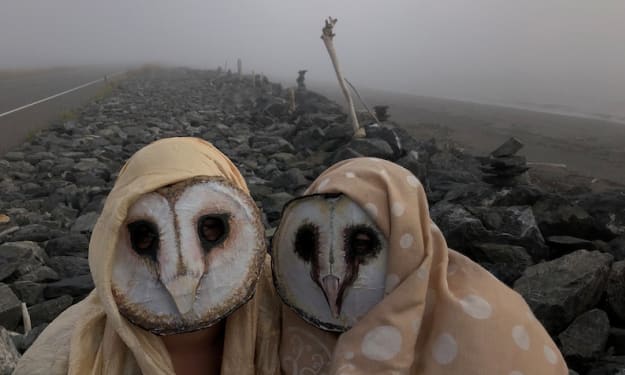
The Wattaquadock Owls
I. The brief ceremony had concluded, and when the party ––no small percentage of our town–– had processed over to the previously anointed spot in the shade of the beloved oak tree on Wattaquadock Hill’s north slope, people were invited to share some words about the deceased. Though it was 11 degrees, and worse with windchill, the crowd showed few signs of dispersing.
By Joseph Giallombardo4 years ago in Humans
Hool
I was at work: in my room, on my chair, at my desk, in a bad posture. I had gotten, during the week, to a sort of casual, accepting, automatic zombie brain: executing tasks, not being very present but also kind of peaceful about it. I was on my phone, I got the news there. The first article or post about it is always the most shocking, those words put together are so unsightly. Not emotional yet, but loud and flashy as an impact. A beautiful singer from my province dies in his thirties. Too young to expect that sort of news from him. I have to take a call, process a task. He was found in his apartment; it looks like a suicide even if nothing is confirmed yet. Everyone is aching, everyone is stunned. Online, I mean, because only a few of my colleagues would share the hurt of the news: I work for a big Canadian company, people are from all over the country, but not everyone in the country knows him. He was too big to be a local artist though. He was specific to his culture. I go about finishing my day.
By Djamila Khellef4 years ago in Humans
Russia’s Blacklist is a Terrorist Watchlist of Artists and Writers
Novosibirsk is Siberia’s most populated city. It is a city in which you will find the bustle of industry, exceptional sports teams, and a history of successful musicians. What you will not find in Novosibirsk is the freedom of artistic expression. In 2018, IC3PEAK, an experimental hip hop duo that finds itself on the Blacklist, was detained without any cause or charges. They were held long enough so that they were unable to perform. So, what is the Blacklist and why did IC3PEAK find themselves on it?
By Kyle Duffy4 years ago in Humans
Millennium Messengers
Our civilization has the capability to achieve just about anything. The simple truth is that we have access to all the tools and resources to accomplish greatness. Surprisingly there's one essential quality missing, which is humanity itself. Throughout the courses of history we have consistently prey among each other. Due to ignorance, and the limited mindset. Such as the superior of one race than the other, religious differences, and political views. Although some might not support such ignorance, this is how I see it; if an individual doesn't speak up against injustice in my opinion they're innocently contributing to it.My organization focuses on raising awareness on spirituality on a profound and global level. You might wonder why spirituality; let me explain, for clarification purposes spirituality is not the same as religion. Spirituality is the journey of self discovery and attainment of a cosmic consciousness. Spiritual awareness sparks a profound search and hunger for knowledge of our existence and a divine connection to everything in our universe.
By Divine-Messengers4 years ago in Humans