
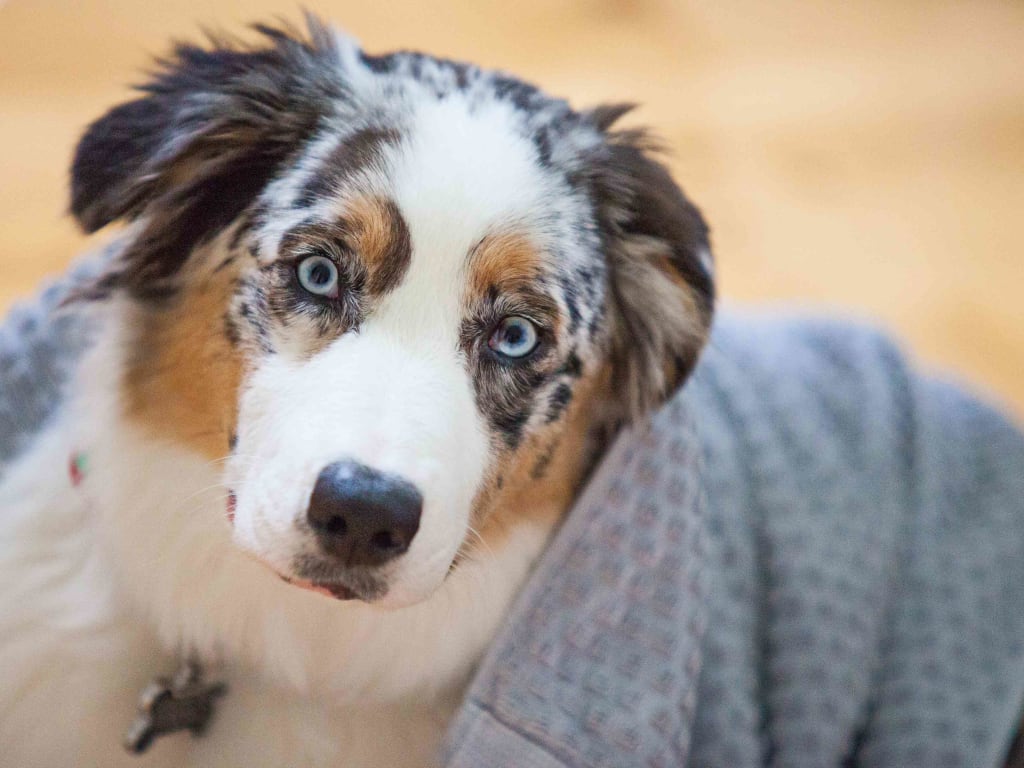
"I'm the one who comes into your dreams every night and tells you: 'Eyes of a blue dog.'" And she said that she went into restaurants and before ordering said to the waiters: "Eyes of a blue dog." But the waiters bowed reverently, without remembering ever having said that in their dreams. Then she would write on the napkins and scratch on the varnish of the tables with a knife: "Eyes of a blue dog." And on the steamed-up windows of hotels, stations, all public buildings, she would write with her forefinger: "Eyes of a blue dog." She said that once she went into a drugstore and noticed the same smell that she had smelled in her room one night after having dreamed about me. "He must be near," she thought, seeing the clean, new tiles of the drugstore. Then she went over to the clerk and said to him: "I always dream about a man who says to me: 'Eyes of a blue dog.'" And she said the clerk had looked at her eyes and told her: "As a matter of fact, miss, you do have eyes like that." And she said to him: "I have to find the man who told me those very words in my dreams." And the clerk started to laugh and moved to the other end of the counter. She kept on seeing the clean tile and smelling the odor. And she opened her purse and on the tiles with her crimson lipstick, she wrote in red letters: "Eyes of a blue dog." The clerk came back from where he had been. He told her: Madam, you have dirtied the tiles." He gave her a damp cloth, saying: "Clean it up." And she said, still by the lamp, that she had spent the whole afternoon on all fours, washing the tiles and saying: "Eyes of a blue dog," until people gathered at the door and said she was crazy. Now, when she finished speaking, I remained in the corner, sitting, rocking in the chair. "Every day I try to remember the phrase with which I am to find you," I said. "Now I don't think I'll forget it tomorrow. Still, I've always said the same thing and when I wake up I've always forgotten what the words I can find you with are." And she said: "You invented them yourself on the first day." And I said to her: "I invented them because I saw your eyes of ash. But I never remember the next morning." And she, with clenched fists, beside the lamp, breathed deeply: "If you could at least remember now what city I've been writing it in." Her tightened teeth gleamed over the flame. "I'd like to touch you now," I said. She raised the face that had been looking at the light; she raised her look, burning, roasting, too, just like her, like her hands, and I felt that she saw me, in the corner where I was sitting, rocking in the chair. "You'd never told me that," she said. "I tell you now and it's the truth," I said. From the other side of the lamp she asked for a cigarette. The butt had disappeared between my fingers. I'd forgotten I was smoking. She said: "I don't know why I can't remember where I wrote it." And I said to her: "For the same reason that tomorrow I won't be able to remember the words." And she said sadly: "No. It's just that sometimes I think that I've dreamed that too." I stood up and walked toward the lamp. She was a little beyond, and I kept on walking with the cigarettes and matches in my hand, which would not go beyond the lamp. I held the cigarette out to her. She squeezed it between her lips and leaned over to reach the flame before I had time to light the match. "In some city in the world, on all the walls, those words have to appear in writing: 'Eyes of a blue dog," I said. "If I remembered them tomorrow I could find you." She raised her head again and now the lighted coal was between her lips. "Eyes of a blue dog," she sighed, remembered, with the cigarette drooping over her chin and one eye half closed. Then she sucked in the smoke with the cigarette between her fingers and exclaimed: "This is something else now. I'm warming up." And she said it with her voice a little lukewarm and fleeting, as if she hadn't really said it, but as if she had written it on a piece of paper and had brought the paper close to the flame while I read: "I'm warming," and she had continued with the paper between her thumb and forefinger, turning it around as it was being consumed and I had just read ". . . up," before the paper was completely consumed and dropped all wrinkled to the floor, diminished, converted into light ash dust. "That's better," I said. "Sometimes it frightens me to see you that way. Trembling beside a lamp." We had been seeing each other for several years. Sometimes, when we were already together, somebody would drop a spoon outside and we would wake up. Little by little we'd been coming to understand that our friendship was subordinated to things, to the simplest of happenings. Our meetings always ended that way, with the fall of a spoon early in the morning.
About the Creator
Keep reading
More stories from Mintoo kumar Yadav and writers in Humans and other communities.
Blue Dog
Now, next to the lamp, she was looking at me. I remembered that she had also looked at me in that way in the past, from that remote dream where I made the chair spin on its back legs and remained facing a strange woman with ashen eyes. It was in that dream that I asked her for the first time: "Who are you?" And she said to me: "I don't remember." I said to her: "But I think we've seen each other before." And she said, indifferently: "I think I dreamed about you once, about this same room." And I told her: "That's it. I'm beginning to remember now." And she said: "How strange. It's certain that we've met in other dreams." She took two drags on the cigarette. I was still standing, facing the lamp, when suddenly I kept looking at her. I looked her up and down and she was still copper; no longer hard and cold metal, but yellow, soft, malleable copper. "I'd like to touch you," I said again. And she said: "You'll ruin everything." I said: "It doesn't matter now. All we have to do is turn the pillow in order to meet again." And I held my hand out over the lamp. She didn't move. "You'll ruin everything," she said again before I could touch her. "Maybe, if you come around behind the lamp, we'd wake up frightened in who knows what part of the world." But I insisted: "It doesn't matter." And she said: "If we turned over the pillow, we'd meet again. But when you wake up you'll have forgotten." I began to move toward the corner. She stayed behind, warming her hands over the flame. And I still wasn't beside the chair when I heard her say behind me: "When I wake up at midnight, I keep turning in bed, with the fringe of the pillow burning my knee, and repeating until dawn: 'Eyes of a blue dog.'" Then I remained with my face toward the wall. "It's already dawning," I said without looking at her. "When it struck two I was awake and that was a long time back." I went to the door. When I had the knob in my hand, I heard her voice again, the same, invariable. "Don't open that door," she said. "The hallway is full of difficult dreams." And I asked her: "How do you know?" And she told me: "Because I was there a moment ago and I had to come back when I discovered I was sleeping on my heart." I had the door half opened. I moved it a little and a cold, thin breeze brought me the fresh smell of vegetable earth, damp fields. She spoke again. I gave the turn, still moving the door, mounted on silent hinges, and I told her: "I don't think there's any hallway outside here. I'm getting the smell of country." And she, a little distant, told me: "I know that better than you. What's happening is that there's a woman outside dreaming about the country." She crossed her arms over the flame. She continued speaking: "It's that woman who always wanted to have a house in the country and was never able to leave the city." I remembered having seen the woman in some previous dream, but I knew, with the door ajar now, that within half an hour I would have to go down for breakfast. And I said: "In any case, I have to leave here in order to wake up." Outside the wind fluttered for an instant, then remained quiet, and the breathing of someone sleeping who had just turned over in bed could be heard. The wind from the fields had ceased. There were no more smells. "Tomorrow I'll recognize you from that," I said. "I'll recognize you when on the street I see a woman writing 'Eyes of a blue dog' on the walls." And she, with a sad smile--which was already a smile of surrender to the impossible, the unreachable--said: "Yet you won't remember anything during the day." And she put her hands back over the lamp, her features darkened by a bitter cloud. "You're the only man who doesn't remember anything of what he's dreamed after he wakes up."
By Mintoo kumar Yadav4 years ago in Humans
My First Time Skiing and I Got Lost, Alone, in the French Alps
Looking back, I can trace some of my life’s biggest adventures to a simple action from my sister. She’d introduced me to Tommy (a very long time ago), a colleague of hers, who had overshared his penchant for Italian-looking women, and I ticked that box.
By Chantal Christie Weiss2 days ago in Humans
5 Signs You Found a Kindred Spirit in an Unexpected Place.
Human connection shapes the direction of many lives. Some relationships grow from family, school, or work. Others appear without warning in places no one plans for. A short conversation with a stranger at a café, a message from someone across the world, or a brief meeting during travel shifts into something deeper.
By Wilson Igbasi7 days ago in Humans




Comments
There are no comments for this story
Be the first to respond and start the conversation.