
Andrew, and the art of it all
perspectives and assumptions

I knew there was something familiar in what Andrew had painted, but I couldn’t put my finger on exactly what. There was something there that I’d seen before, but I couldn’t place it; the use of colours, or the simple, long strokes, or maybe the way the objects were closer to impressions than literal. I just couldn’t quite nail it down, though.
-
Like most of us, I’ve had a few moments without paid work over the years. This one was in Edinburgh, in Scotland, way back in the 1990s.
In this particular patch of time, I’d start my days in Edinburgh Central library, on George IV bridge, for around two hours, reading magazines and journals that I’d normally not have paid much attention to when working. My reasoning? To keep my interest in the world active, rather than drift into hours wasted watching an essentially empty television, or the equivalent of reading only those newspapers that I already 'knew'. I’d then walk to a nearby cafe bookshop for an hour or so, not far from the library, to write in my journal.
Whilst there, I’d scan the noticeboard, and the flyers and leaflets and posters, to see what was going on nearby. Things to do, things to try, including, one day, an ad for a cheap ‘learn to paint’ course. I’d wanted to do something creative for a while, having touched on photography in college and, when I saw the ad, I thought ‘well, why not?’
Getting to the class was a short bus ride, through a couple of nondescript but very pretty Edinburgh neighbourhoods. The class itself was held in a primary school, and was delivered by Jess, a young teacher earning a little extra from work outside her day job.
Andrew, one of the other participants, was a young man with Down's syndrome. In saying that, there’s a danger of then saying things like ‘he was one of the friendliest people I’ve met’ and so forth, but the truth is we were a dozen or so cheerful strangers in the beginning, and had become only slightly closer by the end. The connections and friendships-of-the-moment that arose over the half-dozen weeks of the course didn’t continue past the end of the classes, though we did at least become classmates.
I first started paying attention to Andrew’s work when I overheard Jess making suggestions to Andrew around ways to make his paintings a piece more literal; graded shadows, and colours, to suggest roundness or depth. They were good suggestions, and I had a go at using them myself, from what I can remember.
Looking at Andrew’s work then, I was struck by the recognition on some level that there was something very familiar in it, but I couldn’t see why that would be, or even what exactly it was that was familiar. I hadn’t met Andrew before, and I’d not had so much interest in the world of art, other than wishing I could create, myself. So, what was it that was ringing a bell?
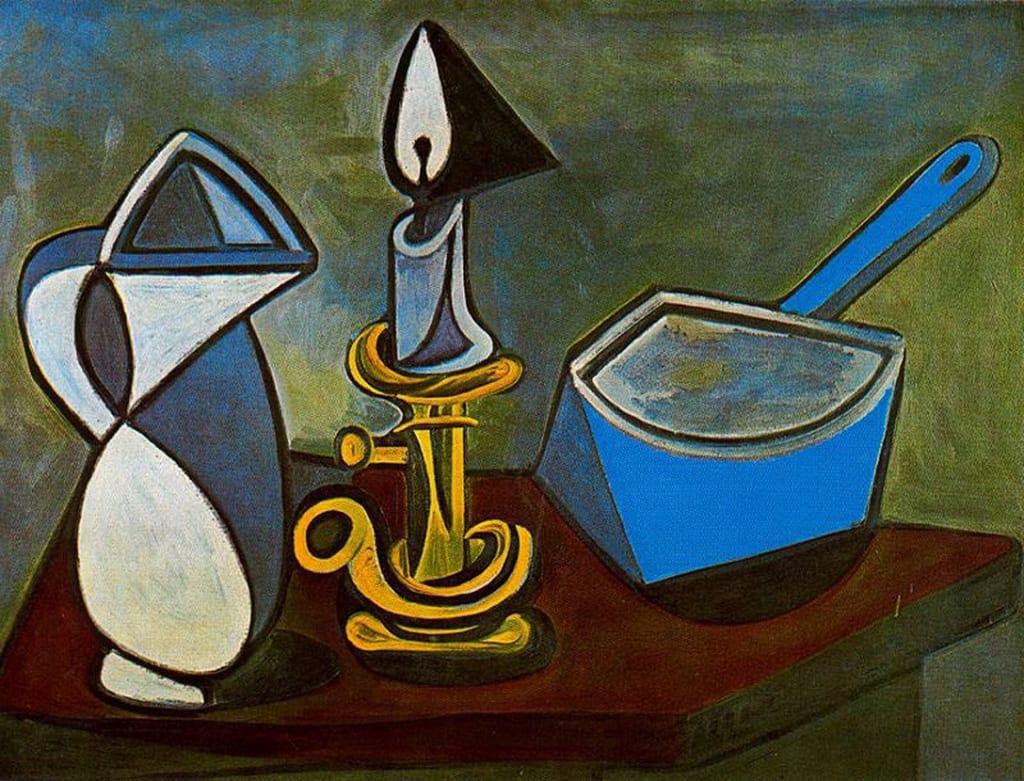
After much grinding of mental gears, I spotted the connection: A Picasso reproduction owned by my mother.
I grew up in a house filled - not just furnished - with the moments of our family’s lives, and most of these moments were — and still are — my mother’s. Chairs, tables, sofa and all those things were, in all honesty, secondary; functional, not informative, not meaningful. Things to sit on, things to sit at, but not a true part of our lives.
The important stuff in the house, in the shared lives of our family-of-three were the ‘things’; purchased, or gifted, and held on to for years after. The markers along the track of the lives my parents - and my mother, particularly - had lived, together and before they met.
One of these markers was by Pablo Picasso. By his popular, expected standards, it’s a fairly sedate piece; solid lines, full blocks of colour, a study mostly in blue punctuated by the bright yellow of a candlestick holder. Structure, and shape, and colour.
Andrew’s painting, to my eye, showed the same things.
His colours were solid for the most part, the outlines hard and distinct. The perspectives were nothing like photographic. Shading was momentary, just touches here and there.
The similarities were strong, and eye-opening.
There are all sorts of trite things I could come out with now: Abstract statements around how we are all artists, subject to impressions but remaining essentially blind to each other; or something about how we all use the same palettes, but the strokes, and the means by which they are delivered by our hands into the world, are different. Trite, and empty, and - sadly - perfect for the social media moment we live in.
What I see now in hindsight is, rather, a human, being; a fellow traveller, trying to mould a moment in the clay of a life; a hand's attempt to grasp a moment in time, a little spot of a few short hours; and maybe, somewhere underneath it all, a shared stream, of colour, of shape, of texture, and of the simple - and difficult - art of attention.
About the Creator
KK Wright
Pieces of a life lived, getting older and understanding I wasn't paying attention while it was all happening. Mountains in the distance, and preparations to be made.
Author’s Advice
If you would’ve asked me 20 years ago did I know I’d become a writer and an author, I would’ve said “nope, ain’t happening”. As fate would have it I did become an author and I can honestly say I’m loving it so far. It really does feel good to be a writer. I’ve learned a lot on this journey and I feel like with even me being as new to this world as I am, there’s some wisdom I need to share with every other aspiring author.
By Joe Patterson3 days ago in Journal



Comments
There are no comments for this story
Be the first to respond and start the conversation.