
Written Language of the Pre Columbian West
Did Natives of the Western Hemisphere Write?

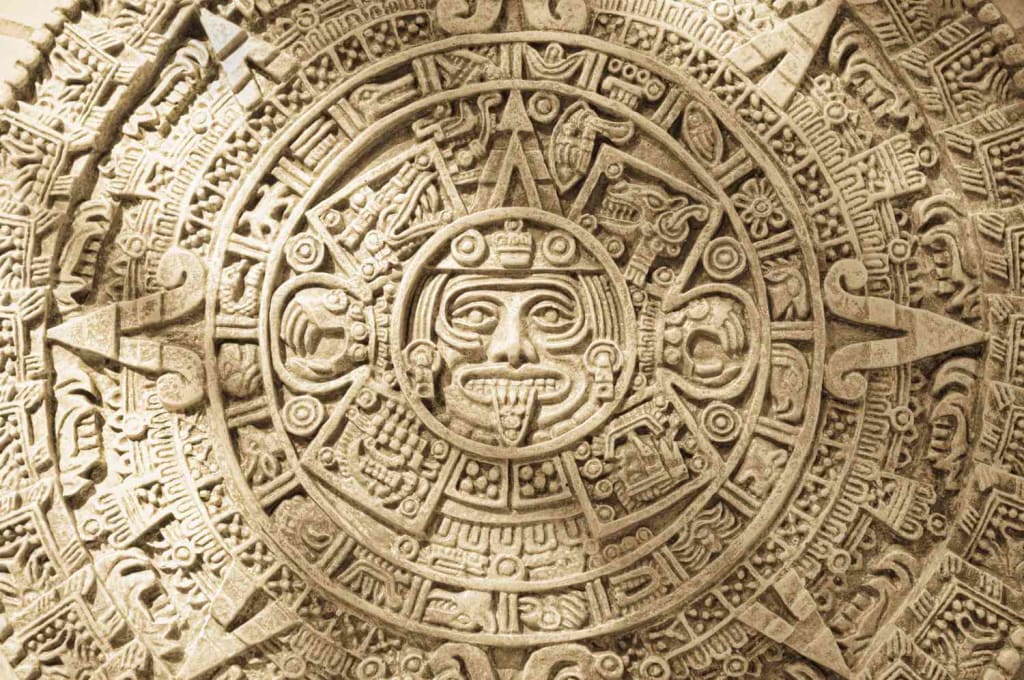
I always wondered if the Native American tribes had written language. Considering the numerable tribes, their cultural differences, their environmental differences, their geographical differences, and the different times during which they occupied various territories, I assumed one tribe or another must have written language, but did they?
The short answer is yes, but many of these languages developed after contact with the Europeans. I wanted to know about the Pre-Columbian natives.
A Google search states that only the Cherokee had a written language, but other searches state the Inuiktitut, and Cree are among the languages that use modern syllabaries.
The Inuit/Nunavut speak Inuiktitut, which is a language, not a tribe, but when was that language written?
The Cree speak a variety of Algonquin dialects, but is it written?
As you can tell by now, there is no simple answer.
Let's start with the Cree. The Algonquin language is over 2,000 years old, but did not develop a syllabery until after colonial settlers came along, so that's out.
As an aside, my search was: which native american tribes had a written language. The result included the term Inuiktitut, and that's how I've been writing it, but a new search: does inuiktitut have a syllabary, answers: Yes, Inuktitut has a syllabary. Notice the spelling is missing that second I?
How's it actually spelled? Are they two different terms? Doesn't matter. The language did not develop a syllabary until 1845, so that's out, too.
What about Cherokee? They developed their syllabary in 1820, so dang. Was all written language due to European contact?
Let's find out!
The Nahuatl language has been spoken in Central Mexico since the 7th century AD. I know the Aztecs spoke it. Did anyone else?
A search revealed the Toltecs, the Huastecs, and Popoluca all spoke a variant of that language--obviously depending on culture, geographical location, and time period.
But when did the language develop a written system? Well...after the 1500's. Spanish priests who sailed along with the Conquistadors decided to use the Latin alphabet to spell out and write Nahuatl.
Far as I can tell, no one in the Western hemisphere wrote their language. Does anyone else think that's strange? The Sumerians wrote, and that was over 5,000 years ago. There were tribes in the Western hemisphere at that time, many of them.
Why was no one writing in the west? Why were people writing in the east?
Found an article by The New York Times entitled: "Writing May Be Oldest in Western Hemisphere"
So let's take a look. I mean read. I gotta create an account?! I'm not doing that. There must be information somewhere else.
Turns out the Olmec had a written language.

According to Journal of Young Investigators:
The Cascajal Block is a slab of stone with writing thought to be the oldest writing system in the Western Hemisphere. The block features linear arrangements of certain characters that appear to be ancient depictions of tribal objects, such as animals, insects, tools and food. A team of researchers announced the find in 1999 in Veracruz, Mexico. Unfortunately, the language on the block was not translatable.
The Olmecs, regarded as America's first civilization, existed from about 1500 to 400 BC. They resided in what is known as "Olman", or the Olmec heartland, situated in Mexico on the southern tip of the Gulf of Mexico. It stretched from Veracruz in the west to Tabasco in the east, occupying the northern part of the Isthmus of Tehuantepec.
That's great, but the Sumerians were writing long before. Anyway....
The Olmec are known for their enormous, stone sculptures, particularly their stone heads. The colossal heads are thought to depict important men, such as rulers, or maybe sports players, and look very realistic. Constructed from boulders, all heads included a different headdress which may have identified the status of the men depicted in the sculpture.
Or maybe they were just pieces of art. This kind of speculation always cheeses my corn. It's like when they uncover statues or depictions of "alien-human" hybrids or "animal-human" hybrids. Like, maybe it was just artwork. You know, like a guy carved a stone sphinx for his son to play with while telling him stories of this fantastical creature. Pre-Columbian cultures also had fiction! Antediluvian cultures as well.
Anyway....
Relatively little was known about Olmec language and writing before the discovery of the Cascajal block. The Olmec certainly had symbols: "It's the first group of people to have elaborate symbolism," explained Houston. In 2002, a roller stamp and fragments of a plaque were found in San Andres, Tabasco, which dated to at least 650 BC. They also had a calendar system, but there is limited evidence to describe the system in detail.
Discovering the Cascajal Block in Veracruz seemed to indicate that the Olmecs were writing long before the San Andres roller stamps existed. "The block is clearly centuries earlier than any other known written artifact," said Houston. "There are some examples from the Maya which date to around 300 BC and the valley of Oaxaca which date to 500 BC."
I suppose this means the Maya were writing as well. Cool, we'll touch on that, too!
The block measures to over a foot in length and is about the size of a small TV but thicker. It features 62 symbols arranged in linear patterns on one side of the slab.
"The indent on top is thought to be similar to an erase-a-sketch," remarked Houston. The researcher's report imagined an Olmec using a rock to grind away the existing writing incisions and start fresh on a smooth piece of rock.
Another theory points to weathering. "Maybe they wanted it to be like that to protect it from being eroded," Houston mentioned. He gave an example of another rock sliding past the written surface but failing to mark any of the writing because of the indent.
The speculation of people, even smart people, even smart, educated people, who are representatives of their field.... It grinds my wheat. Maybe, the old rock just broke a little?? No? Maybe?
Now, going into a little more depth about what's on the stone. Apparently, it had some pictures, like, pictographic, anyhow....
Figuring out what "insect, dart tip, corn, corn" means, is extremely difficult, according to most of the researchers.
"To decipher an ancient writing system, you're best off if you have a bilingual system," said Dr. Michael Coe, a Professor Emeritus of Anthropology at Yale and Curator Emeritus of the Anthropology Department at the Peabody Museum. He cited the example of the Rosetta stone, an ancient slab with the same text written in Greek, Egyptian hieroglyphs, and Demontic.
"[The Cascajal Block] is the only one example that has a text on it. If you've only got one example, you can't decipher it. I don't think it will ever be cracked, people were digging extensively and this is only one that has come up," he said.
Wait...wasn't it mentioned that they had other writing the post dated the block?
The Olmec certainly had symbols: "It's the first group of people to have elaborate symbolism," explained Houston. In 2002, a roller stamp and fragments of a plaque were found in San Andres, Tabasco, which dated to at least 650 BC.
C'mon, fellas. Ya' can't have it both ways. Now, I don't believe a word from Journal of Young Investigators, but that's my take. Going forwards....
Still, the block offers a few new insights about Olmec writing. Houston, who helped decipher Mayan writing, maintains that to make headway of an unknown language, pattern detection is a valuable tool.
"In the Cascajal block, there are patterns that are evident. The Olmecs are clearly being motivated by something grammatically," he said.
Houston also used pattern detection to hypothesize about the nature of the entire set of symbols: "It's not clear to me that it's an economic document because you would expect to find number-like symbols. Identifying numbers is not really a problem, but there was nothing like that, so it's about quantifying things. Some of the signs seem to be ritual implements."
See, now, I like this. You discover a stone of ancient culture. You see a bunch of pictures of corn, and you assume: "They were documenting how much corn they had." At the same time, he's all: "But I don't see numbers, so I have no idea." That's cool. Continuing....
The main controversy lies in the age of the block. It was originally discovered by construction workers that dug through a mound. Several clay shards and small artifacts laid very near the location of the block.
The authors of the report and principle researchers involved with its analysis concluded that it originated between 1100 and 900 BC, based on the fact that clay shards found around the block also date to this time.
Wouldn't Carbon-14 dating come into play here? I'm just asking.
"Generally you rely on context," said Houston. "The problem with this block is that it was not found in controlled excavations. We don't know where it came from in terms of levels of the sites."
Sometimes, scientists vex me.
Professor David Grove, Professor Emeritus of Anthropology at the University of Illinois Urbana-Champaign, finds these facts troubling. He has commented that he doesn't feel the clay shards qualify as contextual evidence and that the block is therefore dated incorrectly.
Hm....
"I feel the block is a couple of hundred years younger than suggested in the Science article. I think it more likely dates to sometime between 700-500 BC," he mentioned. "I say that because in my opinion, some of those symbols only occur late in the Olmec period."
Overall, all researchers involved with Olmec or Mesoamerican study agree that the discovery and existence of the Cascajal Block is of major importance to history of the Olmecs and the history of language in the Western Hemisphere.
Well, I think all that is pretty interesting, but why is no one freaking out about how the Olmec, the oldest culture in the Western hemisphere, had a written language, BUT NO ONE AFTER THEM DID? Or did they???
Let's see what they say about the Maya....
According to World History Encyclopedia:
The Maya hieroglyphic writing system was a sophisticated combination of pictographs directly representing objects and ideograms (glyphs) expressing more abstract concepts such as actions, ideas and syllabic sounds. Maya writing has survived on stone carvings, stucco, various manufactured artefacts, and codices. Examples are found across Mesoamerica. Deciphered in the 20th century, around 75% of surviving texts can be understood.
The hieroglyphic writing system of the Maya may have developed from the less sophisticated systems of earlier Mesoamerican civilizations, such as the Olmec, which used only literal images (pictographs) or it may have developed completely independently; scholars are not in agreement on the point. More certain is when the Maya began their writing system: the second half of the Middle Preclassic period, c. 300 BCE. However, the more sophisticated writing system of this time almost certainly would have had earlier, less complex precedents (antecedents?) present in the preceding centuries of Mayan culture. From the Early Classic period onwards there was a significant increase in stone monuments bearing inscriptions and the language reached full maturity and flourished throughout the Classic period (250-900 CE).
Going on, the article states:
The meaning of a given text has to be interpreted from a triple combination of images which literally represent real objects or actions (pictographs); symbols (glyphs) which symbolically refer to objects or actions (and which can also indicate adjectives, prepositions, plurals, and numbers); and phonetic glyphs which represent sounds (for example a vowel or a consonant and a vowel together), correct pronunciation, pre-fixes, suffixes, pronouns and tense. The Mayan script is, therefore, a combination of signs representing syllables (syllabograms) and words (logograms). Sometimes, concepts could be represented in alternative ways, for example, a jaguar could be indicated by a picture of a jaguar head or by the phonetic glyphs ba-la-ma or by a combination of a jaguar head and the glyph ma.
Now, before you get too excited, this is the "glyph"

Is someone seriously going to sit there and tell me this is "written language"? You've got to be joking. This is a case of "man goes looking for thing. Man finds thing no matter what." I'm just a putz in a recliner, but I will not consider this to be writing. I'd love to see that Cascajal Block, too. This is what Sumerian writing looks like.

That's a pretty effing big difference especially when the Sumerians were writing 5,000 years ago, and the Maya were writing less than 2,000 years ago.
Well, that's all I can handle for now. People in the Eastern hemisphere wrote. Only the Olmecs, from the West, debatably wrote. Anyone think that's weird? Anyone wondering why?
Thanks for reading. Visit StoriesbyDennis.com for moar!
About the Creator
Aaron Dennis
Creator of the Lokians SciFi series, The Adventures of Larson and Garrett, The Dragon of Time series, and more.
Keep reading
More stories from Aaron Dennis and writers in History and other communities.
Eight Honorary American Citizens
Okay, number 4 won't shock you. That was just a little clickbait. A little background: My name is Aaron. I was born in Brescia, Italy. My father was an American in the Air Force and he met, married my mother, and they had me, while they all lived in Italy. Then, they moved to America, and I've lived all over.
By Aaron Dennisabout a year ago in History
Why Attacking Iran Could Be Riskier Than Capturing Maduro
When President Trump said in January that a U.S. “armada” was heading to Iran, he compared it with the kind of force used in the military’s recent lightning operation in Venezuela, saying it was “able to rapidly fulfill its mission, with speed and violence.”
By Wings of Time 5 days ago in History


Comments
There are no comments for this story
Be the first to respond and start the conversation.