
Worst Punishments in Human History
Cruelty on steroids!


Throughout history, humans have devised numerous punishments, some quite horrific. Many people are familiar with common penalties like detention or jail time. However, there are far worse forms of punishment. Examples include hanging, burning, and stoning. These brutal methods show the extremes to which societies have gone in enforcing justice.
One particularly dreadful punishment was Poena Cullei, or Punishment of the Sack, used by the ancient Romans. In this punishment, the victim was placed inside a large canvas sack. Alongside them were various animals, such as a dog, cat, monkey, rooster, and even a snake. The sack was then thrown into a river. As it filled with water, the frightened animals would attack one another. Tragically, the victim often became a casualty in this terrifying ordeal. This punishment was typically reserved for those accused of parricide, which is the act of killing one’s own parents.
Another infamous punishment from ancient Persia was scaphism, also known as the boats. The victim would be force-fed milk and honey and then confined inside a boat, often with another boat placed on top of them. This left only their head, arms, and legs exposed. The sugary contents would lead to severe gastrointestinal distress, attracting insects. Over time, the victim would slowly starve while being consumed by flies and maggots.
In the 17th century, the Dutch utilized rats in a cruel method of torture. A rat was placed on a prisoner’s abdomen, which was then covered with a pot. The pot was heated, forcing the rat to burrow into the victim’s skin to escape. Similarly, in Medieval England, prisoners were subjected to rat-filled dungeons, where starving rats would nibble on them as they lay chained and helpless.
Psychological torture methods were also devised, such as Chinese water torture. This method involved drips of water falling onto the victim's forehead from a bucket. Over time, this relentless dripping became maddening, leading to severe mental distress. The practice is thought to have first emerged in Italy but was later named for its exotic connotation.
Similarly, solitary confinement is another form of psychological torture. It can lead to hallucinations, depression, and disassociation. One extreme variation is white torture, where a victim is placed in a featureless white room with no human contact, creating profound psychological stress and a sense of isolation.
Additionally, historical punishments like tarring and feathering were used as public humiliations rather than lethal methods. Initially employed in the 12th century, this involved covering a person in hot tar and feathers, leading to burns and long-lasting marks.
The use of elephants for execution was practiced in Medieval India. This method, known as Gunga Rao, involved placing a victim’s head on a stake as an elephant was trained to crush them. Meanwhile, King Phalaris of Sicily created the Brazen Bull, where a victim would be locked inside a metal bull and cooked alive over a fire.
Boiling alive was another gruesome form of execution seen in Ancient Rome and during the reign of King Henry VIII in England. Victims would suffer extreme pain as their bodies slowly cooked in boiling liquid.
Lastly, the wooden horse was a medieval punishment that forced victims to straddle a sharp, upright beam, causing excruciating pain and lasting physical damage.
These examples illustrate not only the physical brutality but also the psychological torment inflicted through various means. Humanity's capacity for cruelty in punishing offenders reminds us of the dark aspects of our history. The study of these punishments raises questions about justice, morality, and our own capacity for compassion.
About the Creator
Tafara Sibotshiwe
A versatile authentic writer and passionate storyteller. With a background in, Journalism, Engineering, History, Health & finance, they combine profound insight with creative flair to explore the complexities of the human experience.
Keep reading
More stories from Tafara Sibotshiwe and writers in History and other communities.
Bizarre International Boarders
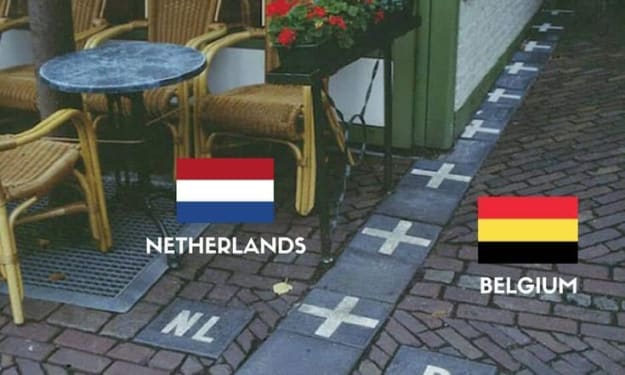
Every border in existence today is essentially a line drawn by humans. This division creates around 200 separate sovereign countries worldwide. Many of these countries have peculiar borders, resulting in complex situations. For example, the villages of Barl Hertog and Barl Nisa epitomize this complexity. Their border interweaves Belgium and the Netherlands, forming a mosaic of enclaves and exclaves. This situation is so intricate that some homes are split by the international boundary. Residents may find they have different nationalities depending on which room they are in.
By Tafara Sibotshiweabout a year ago in History
The Mongol Storm: When Baghdad Fell and a Civilization Trembled
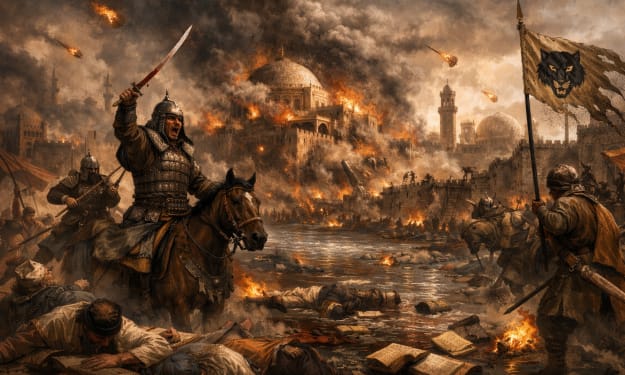
In the winter of 1258, one of the greatest cities on Earth met a catastrophe from which it would never fully recover. Baghdad, once the intellectual and cultural capital of the Islamic world, fell to the armies of Hulagu Khan during the devastating Siege of Baghdad (1258). The invasion marked the end of the powerful Abbasid Caliphate and changed the course of Middle Eastern history forever.
By Irshad Abbasi 6 days ago in History


Comments
There are no comments for this story
Be the first to respond and start the conversation.