
Why Francesco Borromini’s Churches Were Almost Erased from History
How the master architect behind San Carlo and Sant’Ivo was buried in Bernini’s shadow and why it’s time to rediscover his work.

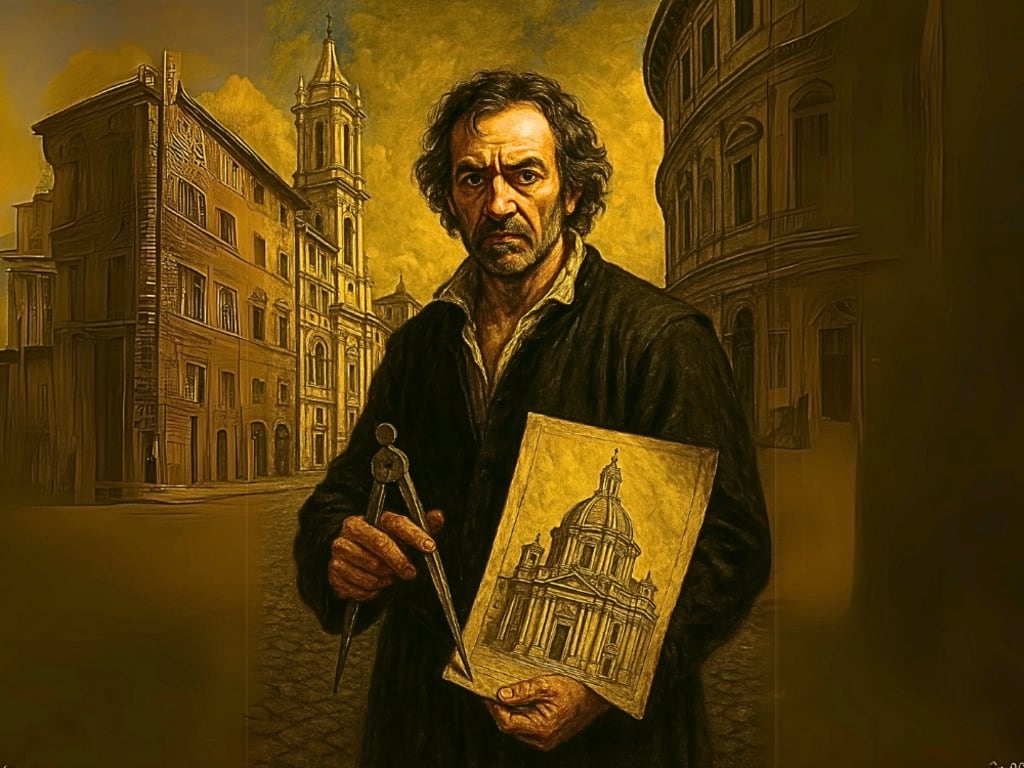
It was August of 1667, and the corridors of San Giovanni dei Fiorentini in Rome, echoed with silence. Francesco Borromini, once the most daring architect in the Italian city of Rome, lay dying from self-inflicted wounds. Though his buildings breathed with imagination and mathematical wonder, his name was already fading. Rome’s piazzas were filled with the applause of his rival Bernini. Borromini’s masterpieces, tucked in narrow alleyways and cloisters, went unnoticed. He had reshaped the soul of Baroque architecture, yet history was writing him out of its pages. Gian Lorenzo Bernini, Borromini's rival, was everything Rome loved: charming, politically astute, and an unrivaled master of spectacle. He was adored, mythologized, and immortalized. Rome became his stage, and he knew how to play it. In contrast, Borromini, with his ascetic temperament and uncompromising vision, refused to perform. And Rome, a city that adored performance, chose the actor over the architect.
Francesco Borromini was not born into glory. Born in 1599 in Bissone, near Lake Lugano in Italy, he trained as a stonemason like his father. From the beginning, he was different, obsessively focused, technically brilliant, and fiercely private. In his twenties, he moved to Rome, where his skills caught the attention of Carlo Maderno, architect of St. Peter’s Basilica in Vatican. Under Maderno, and later under his rival Gian Lorenzo Bernini, Borromini rose through the ranks. But while Bernini was the golden boy of papal courts, charismatic, theatrical, and deeply political, Borromini was intense, solitary, and emotionally volatile.
In the early 17th century, Rome was a city of transformation. Following the trauma of the Protestant Reformation, the Catholic Church sought to reassert its dominance through grandeur. Art and architecture became spiritual warfare. Popes commissioned massive building campaigns to restore the Church’s glory, and architecture became the most visible weapon in the Counter-Reformation. This was the world Borromini entered, a world that rewarded spectacle and punished subtlety.
Borromini’s rivalry with Bernini would define and ultimately derail his life. Bernini, already a favorite of Pope Urban VIII, commanded Rome’s greatest commissions: the Baldacchino in St. Peter’s, fountains, churches, and tombs. He blended sculpture and architecture into theatrical experiences, always eager to impress. Borromini, in contrast, was a purist. He saw architecture not as illusion but as truth, grounded in geometry, sacred proportion, and symbolic form. His ideas were radical, and often, too radical for Rome. Their rivalry was as much personal as it was professional. Bernini commanded the favor of popes and cardinals, receiving prestigious commissions and public acclaim. Borromini, though equally talented, struggled against Bernini’s shadow, often being relegated to less visible projects or forced to work under his rival’s direction. Their conflicting visions, Bernini’s theatrical grandeur versus Borromini’s geometric purity, fueled a bitter competition that would haunt Borromini throughout his career.
Borromini’s buildings defied convention. Where others used symmetry, he employed asymmetry. Where others relied on grand facades, he played with space and light. His masterpiece, San Carlo alle Quattro Fontane, affectionately called "San Carlino", was built on a footprint so small it seemed impossible. Yet the result was a structure that felt vast, fluid, alive. The undulating walls and oval dome pulsed with movement, creating a spiritual experience through pure architectural form.
But Rome did not embrace Borromini’s genius. Many critics labeled him insane. His complex geometries were misunderstood, his personality alienated patrons, and his refusal to flatter the powerful cost him commissions. He was difficult, yes, but also brilliant. And in the politics of papal Rome, brilliance without diplomacy was dangerous. In a city where personal connections often mattered more than innovation, Borromini’s blunt honesty and refusal to engage in courtly flattery isolated him. His confrontations with patrons and peers earned him a reputation for being temperamental and unapproachable. While Bernini maneuvered effortlessly through the corridors of power, charming popes and cardinals alike, Borromini stood apart, an uncompromising artist unwilling to dilute his vision for political gain. This intransigence, while preserving the purity of his work, ultimately narrowed his circle of allies and opportunities.
After the death of his early supporter, Pope Innocent X, Borromini fell out of favour. His commissions dwindled. Meanwhile, Bernini continued to rise, his sculptures gracing every major church and piazza. Though the two architects collaborated briefly, their relationship was strained and ultimately toxic. Bernini’s supporters outnumbered Borromini’s, and their writings shaped the narrative: Bernini the genius, Borromini the madman.
His final years were marked by bitterness and depression. He devoted himself to the completion of Sant'Ivo alla Sapienza, a tour-de-force of geometry and metaphysical design. With its corkscrew spire and star-shaped dome, the church blended science and spirituality in a way no one had dared. But few recognized its brilliance. The commissions stopped. Friends distanced themselves. In the end, Borromini lived alone, tormented by failure, haunted by the grandeur he had built but could not share.
In August 1667, after an argument with a servant, Borromini fell into despair. He demanded that all mirrors be removed from his house and, in a fit of anguish, threw himself onto his own sword. He lingered in agony for a day before dying, unmarried, without children, and largely forgotten.
The erasure of Borromini’s legacy was swift. His name was omitted from inscriptions. His churches were rarely attributed. In architectural histories, he was reduced to a disturbed footnote in Bernini’s shadow. His work, though radical and prophetic, was dismissed as eccentric. His refusal to conform had cost him not just fame but remembrance.
#HiddenHistory #ErasedVoices #HistoryFigures #bernini #borromini
About the Creator
Strategy Hub
Pharmacist with a Master’s in Science and a second Master’s in Art History, blending scientific insight with creative strategy to craft informative stories across health science, business history and cultural enrichment. Subscribe & follow!
Keep reading
More stories from Strategy Hub and writers in History and other communities.
The Book They Tried to Burn: How Galileo’s Final Work Defied the Inquisition
The book should not have survived. In the early months of 1638, under the shroud of secrecy, a manuscript was concealed within a bale of wool, prepared to cross the perilous Alpine passes northward toward Leiden, a sanctuary for intellectual freedom in the Dutch Republic. Its author, Galileo Galilei, blind, frail, and imprisoned by his own Church in Arcetri, near Florence Italy, waited anxiously. It carried not only his life's work but a challenge to those who sought to silence him.
By Strategy Hub9 months ago in History
The Queen of Jhansi : The British Must Never Capture My Body”
In the long history of resistance against colonial rule in the Indian subcontinent, few figures shine as brightly as Rani Lakshmibai, the legendary Queen of Jhansi. Remembered for her courage, leadership, and unwavering determination, she became one of the most powerful symbols of defiance during the Indian Rebellion of 1857. Her story is not only about war but also about dignity, honor, and a final wish that echoed through history: the British must never capture her body.
By Irshad Abbasi about 9 hours ago in History


Comments
There are no comments for this story
Be the first to respond and start the conversation.