
When Hospitals Bleed
How recent airstrikes on medical centers and critical infrastructure are reshaping the war — and the human cost behind each blast

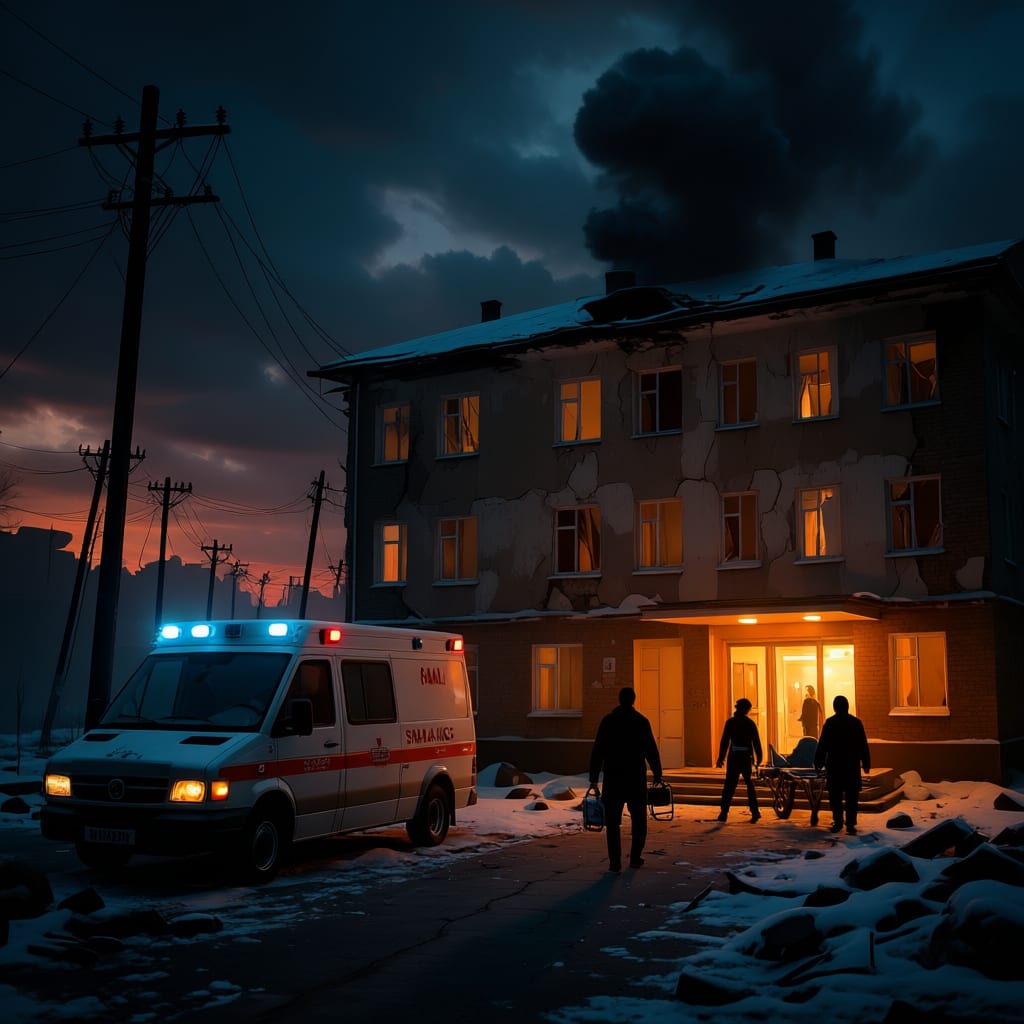
When Hospitals Bleed: Russia’s Assault on Ukraine’s Lifelines
At dawn, Kharkiv woke to sirens, rubble, and frightened whispers. Walls splintered, glass shattered, corridors strewn with debris. A Russian aerial strike had landed squarely on the city’s main hospital. Patients in wards were rushed into stairwells. Doctors scrambled, lights flickering, blood staining floors. In an instant, a facility meant to heal had become a war zone.
The war in Ukraine has always been brutal. But now, hospitals themselves have become strategic targets. The weapon is no longer just bombs — it’s the destruction of lifelines.
The Assault on Medical Infrastructure
On October 14, 2025, a Russian aerial attack using glide bombs and drones struck the Kharkiv region’s hospital, wounding seven people and forcing an evacuation of at least 50 patients. AP News
Ukraine’s officials say that not just the hospital, but the city’s energy infrastructure was targeted as well — cutting power mid-strike. AP News
This is part of a broader strategic shift: Moscow is increasingly focusing on dual blows — combining strikes on civilian infrastructure (hospitals, power grids) with conventional military operations. The effect: terror, disruption, and the collapse of systems meant to protect lives.
Worldwide, attacking medical centers is taboo, forbidden under international humanitarian law. But in modern warzones, norms are bending — or breaking.
The Fallout: How Broken Walls Echo in Everyday Lives
Imagine this:
A woman giving birth is forced into a dim hallway because power is out. A pediatric ward loses critical support machines. Doctors must carry patients in the dark.
Outside, families scramble — seeking basic treatment in makeshift tents. The wounded wait hours because emergency rooms are overcrowded or destroyed.
In Kharkiv alone, over 30,000 residents lost electricity after the strike. The Guardian
This disabled heating systems, disabled water pumps, and plunged whole neighborhoods into darkness.
For many Ukrainians, hospitals are no longer safe havens. They are fragile shelters, vulnerable to the same violence that ravages the streets.
Infrastructure Warfare, Revisited
Earlier, we discussed how Russia is targeting power grids and energy lines. This hospital strike is part of that same architecture of war. Without power, backup generators strain or fail. Medical equipment falters. Medicines spoil. Diagnostics stall.
Meanwhile, Putin’s forces target railways, substations, and energy nodes.
The objective is clear: dismantle Ukraine’s capacity to sustain itself.
One particularly alarming front: the Zaporizhzhia nuclear plant. Work began to restore external power this week after weeks on emergency diesel generators.
The International Atomic Energy Agency (IAEA) is calling for restraint, warning that a failure in cooling systems could lead to disaster.
The conflict is shifting. War is no longer just on trenches — it is in wires, circuits, hospitals.
Resistance Under Fire
Even amidst devastation, resilience emerges.
In Kharkiv, volunteers form mobile medical teams, relocating critical patients to safer zones. In damaged hospitals, doctors carry portable lighting, improvising wards in basements.
Ukraine’s air defense is adapting: new helicopter units are being formed explicitly to counter nightly drone attacks.
Business Insider
These mobile, flexible systems may help protect critical facilities — including hospitals.
But the gaps are wide. The strain on resources is immense. Each act of resilience is a race against time — and shelling.
Global Reaction & Stakes
The international community has condemned the strikes. Humanitarian organizations warn: when hospitals fall, civilians have nowhere safe to go.
Ukraine’s leaders are demanding more support — in particular air defense systems, mobile hospital units, and emergency power infrastructure.
Meanwhile, reductions in military aid to Kyiv (dropping 43% in mid-2025 vs earlier) raise alarms about the sustainability of Ukraine’s defenses.
As Ukraine prepares to ask the U.S. for Tomahawk cruise missiles, the stakes grow higher. AP News
In Europe, leaders are debating whether this war is already spilling beyond Ukrainian borders. Poland’s foreign minister recently revealed a captured Russian Shahed drone and warned that Moscow’s strikes could go deeper into Europe. The Guardian
The logic: if war can cripple a hospital or power plant in Ukraine, what prevents similar attacks elsewhere?
The Human Face of Strategy
The conflict’s cold numbers hide real lives.
In Kharkiv, the mother of a child on life support begged for safe corridors. In a village near the front, a father told reporters: “My son’s hospital is reduced to rubble… I carry him on my back every day.”
These stories emerge from war zones — but they should not remain there. Every destroyed hospital is a symbol: war is dismantling humanity, piece by piece.
A Call to Light in a Blackened World
Our modern world depends on systems: power, health, logistics. When those systems break, people die. Not from bullets — from deprivation.
As Ukraine fights in the sky, underground, in halls, and across circuits, one message rings clear: destroying infrastructure is destroying lives.
We must not normalize attacks on hospitals. We must not treat blackouts as collateral. War must never make medical care optional.
Because in war, having a hospital still standing means everything. Because in darkness, every act of healing is resistance itself.
About the Creator
Wings of Time
I'm Wings of Time—a storyteller from Swat, Pakistan. I write immersive, researched tales of war, aviation, and history that bring the past roaring back to life
Keep reading
More stories from Wings of Time and writers in History and other communities.
🌎 The New World Order
🌎 The New World Order Ten years had passed since the skies of Jerusalem burned. The war that began with a single missile had reshaped everything — borders, beliefs, even the meaning of freedom. Out of the ashes of nations, a new power had risen: The Global Federation, a united government promising peace after the storm.
By Wings of Time 3 months ago in History
Napoleon Bonaparte — From Corsican Outsider to Emperor of Europe
Napoleon Bonaparte was born on August 15, 1769, on the Mediterranean island of Corsica, a land that had only recently come under French control. His family was of modest noble status, and young Napoleon grew up feeling like an outsider—Corsican by culture, yet educated as a Frenchman. This sense of being different shaped his fierce ambition and iron will. From an early age, he showed a sharp mind, a deep love for history, and an unusual talent for mathematics, which later proved essential in warfare.
By The best writer 3 days ago in History
Balloonfest 1986
Balloonfest 1986 was meant to be a joyful celebration. It was planned as a world record attempt and a symbol of hope, fun, and community spirit. Instead, it became one of the most famous examples of how a good idea can go wrong when nature is underestimated.
By shaoor afridi6 days ago in History



Comments
There are no comments for this story
Be the first to respond and start the conversation.