
When Did the Practice of Human Bondage Begin?
Does anybody know when slavery began? The Bible speaks of it in such a matter-of-fact tone, as if it became a part of everyday life ages ago and nobody questioned it!


When did slavery begin? Its practice was commonplace during biblical times as the Bible weaves intricate details into the accounts of daily lives. Bottom line: Slavery did not begin in America, and black people are not the only people who were ever enslaved.
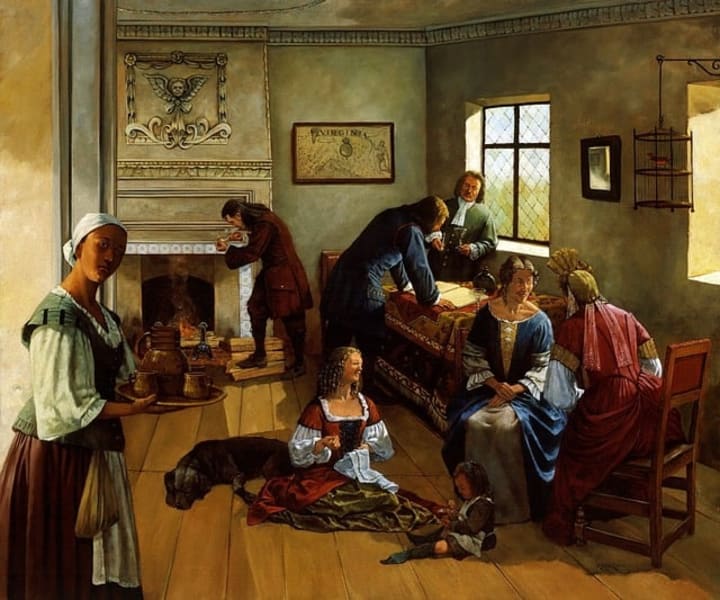
Define Slavery
According to West’s Encyclopedia of American Law, slavery is defined as: “A civil relationship in which one person has absolute power over the life, fortune, and liberty of another.”
The writer takes issue with the use of the words “civil” and “absolute power” contained in the definition. The word “civil” should not be a part of the definition, and the phrase “has absolute power” should be replaced with something generic like “has been granted legal authority.” The fact is, we are all born with free will and it does not cease to exist because people find themselves captives, enslaved, or oppressed. Therefore, nobody should ever have absolute power over another human being, which is why slave insurrections, revolts, or rebellions are historical events just like slavery.
- The most notable historical example that comes to mind being: Spartacus.
Another definition extracted from Nelson’s New Illustrated Bible Dictionary is somewhat more acceptable. Slavery is defined as “A person bound in servitude to another human being as an instrument of labor; one who is no longer (considered by law or governing power) to be free and has no rights (i.e. no longer considered as having legal and/or human rights).”
(NO HUMAN RIGHTS? Don't get me started.)
When Did Slavery Begin?
In ancient times, secular historians recorded that slaves were usually war captives, i.e. “spoils of war”, the war victor claiming the “right” to the “property.” [Note 2] The Bible paints an intricate picture of the history of human bondage by incorporating the details of the practice of slavery as a routine part of daily life during biblical times. The Old Testament (or Jewish scripture), particularly the books of the prophets, has several accounts of Jewish people taken as war captives. But both Jewish and Christian scriptures show that slavery was commonplace and practiced in many different ways.
There were domestic or household slaves (Gen 16: 1), state slavery (Exo 5: 6–19; 1 Kings 9: 20–21), and temple slavery (Num 31: 31: 25–47; Josh 9: 21–27).
Slaves were easily purchased. Joseph was traded into slavery on the spot by his own brothers when they saw a passing caravan of Ishmaelites (Gen 37: 25–28).
Poor people who could not pay their debts, or thieves who could not repay what they had stolen, could sell themselves into slavery (Exo 21: 2–6; Neh 5: 1–5).
Even children could be taken away from their parents to pay bills (2 Kings 4: 1–7).
Also, children born of slave parents were born as slaves (Gen 15: 3; 17: 12 -13).
The Hebrew people (Jews) had specific laws governing how they should treat their slaves, how slaves were to be granted their freedom, and what to do if a slave chose of their own free will to remain as a slave (Gen 24; 39: 1–6; Exo 21; Deut 15; Lev 25).
The Apostle Paul advised Christians who were slaves to try to obtain their freedom if it was possible; however, the slave should not run away or rebel against his or her master but rather submit and serve them. The Apostle also reminded the masters that they had a Master and that they should treat their slave/servant as their brother or sister in Christ, because their Master had no “respect of persons” and they were both accepted as equal in the eyes of their Master (Eph 6: 5; Col 3: 22: Tit 2: 9; Philem 1: 16; 1 Cor 7: 21; Gal 3: 28; Col 3: 11; Gal 4: 7).
Slavery, as a human practice, has existed for thousands of years. Finding a starting point on a timeline for when the practice of human bondage began? Research can be summarized with this statement: “The institution of slavery is as old as civilization.” Civilization? Oh, the irony in that statement. Civilized human beings thought nothing of enslaving other human beings, including innocent children?

♦ Did you know that:
From 1600 to 1827, the slave trade was the primary commerce that made New York the richest city in the world. (Source: Financial Black History Facts — From Wall Street to Compton)
When the British abolished the slave trade in 1807, world financial markets and investors called it “econocide”. (Source: “Eternal Slavery and Why It Endures” By John Anderson)
Slavery was not widespread in Quebec, although it dates from 1629. It was legally abolished in 1834, three decades before it was outlawed in the United States. (Source: “Slavery in Canada” By Rosemary E. Bachelor)
♦ Notes
For additional secular (non-biblical) research, recommended reading:
- Rodriguez, Junius P. Chronology of World Slavery. Santa Barbara, CA: ABC-CLIO, 1999. Print.
♦ References
“Slavery.” West’s Encyclopedia of American Law. 2005. Encyclopedia.com. 5 Mar. 2011.
Youngblood, Ronald F., F. F. Bruce, and R. K. Harrison. Nelson’s New Illustrated Bible Dictionary. Nashville: T. Nelson, 1995.
♦ Thanks for reading.
NOTE: The content was previously published on Read.Cash.
About the Creator
Treathyl Fox (aka cmoneyspinner)
Work-at-home professional since 2007.
*NOTE* My content might contain affiliate links, meaning commissions might be earned if you click through to the vendor’s website.
My socials: * X (Twitter) * Bluesky *
* Blogger * Content Writer *
Keep reading
More stories from Treathyl Fox (aka cmoneyspinner) and writers in History and other communities.
Twelve (12) Women Who Linked Ur to Nazareth and Shaped the Nation of Israel
Introduction to Women in the Ancestry and History of Ancient Israel While Matthew’s Gospel famously highlights five women in the genealogy of Jesus (Tamar, Rahab, Ruth, Bathsheba, and Mary), the wider biblical record introduces many more women connected to Israel’s unfolding story. Some are celebrated matriarchs; others appear only briefly. Yet each woman—whether prominent or obscure—stands as part of a long, complex lineage stretching from Ur of the Chaldeans to a humble Galilean village called Nazareth.
By Treathyl Fox (aka cmoneyspinner)3 months ago in History
The Women Sparta Erased
Imagine: You are twenty-six years old. Just days ago, you watched your husband die defending your city. Now you stand in the ashes of your burned home, children pressed against your chest, trying to make yourself invisible while armed men move among the survivors.
By Literary fusiona day ago in History


Comments
There are no comments for this story
Be the first to respond and start the conversation.