
What Happened To The LOST Colony of Roanoke?
Historical Mysteries

Introduction to the Lost Colony of Roanoke
The Lost Colony of Roanoke is one of America's oldest and most enduring mysteries. Established in 1587 on Roanoke Island, in what is now North Carolina, the colony was an attempt by the English, under the sponsorship of Sir Walter Raleigh, to establish a permanent settlement in the New World. However, by 1590, the entire colony had vanished without a trace, leaving behind only cryptic clues and fueling centuries of speculation and intrigue.
The Establishment of the Colony
In 1587, a group of about 115 English settlers, including men, women, and children, arrived on Roanoke Island. Led by John White, they aimed to establish a thriving community. Shortly after their arrival, White returned to England to gather supplies, leaving behind his daughter, Eleanor Dare, and his newborn granddaughter, Virginia Dare, the first English child born in America.
Difficult Beginnings: The settlers faced numerous challenges from the start, including hostile relations with local Native American tribes, inadequate supplies, and harsh living conditions. These difficulties necessitated White's return to England for more supplies.
Delayed Return: John White’s return to Roanoke was delayed by the Anglo-Spanish War, which consumed England's resources and attention. When he finally returned in 1590, he found the colony deserted, with no settlers to be found.
The Disappearance
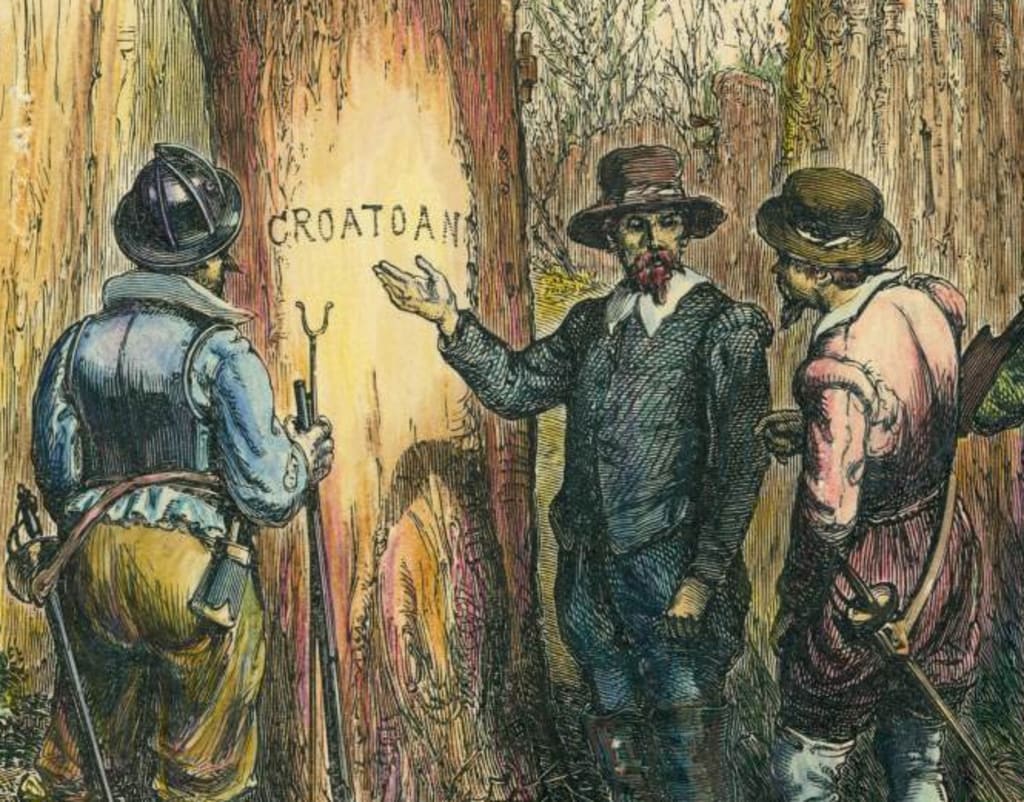
When John White returned to Roanoke Island, he discovered that the colony had been completely abandoned. The only clues to their fate were the word "CROATOAN" carved into a post and "CRO" etched into a tree. There were no signs of struggle or remains, deepening the mystery of what happened to the settlers.
Theories and Speculations: The fate of the Roanoke colonists has been the subject of many theories. Some suggest they assimilated with local Native American tribes, while others propose they tried to relocate and perished in the attempt. More speculative theories include attacks by hostile tribes or Spanish forces, or even supernatural explanations.
Croatoan Island: The word "CROATOAN" pointed towards Croatoan Island (now Hatteras Island), leading some to believe that the colonists moved there. However, no conclusive evidence has been found to support this theory.
Archaeological and Historical Investigations
Over the centuries, numerous archaeological expeditions and historical investigations have been conducted to uncover the truth behind the disappearance of the Roanoke colonists. Despite these efforts, definitive answers remain elusive.
Archaeological Finds: Various artifacts have been unearthed on Roanoke and nearby islands, but none have provided clear evidence of the settlers’ fate. Items such as pottery and tools suggest some level of interaction with local tribes, but the mystery persists.
Recent Discoveries: Recent archaeological efforts have focused on new technologies and methods. Ground-penetrating radar and DNA analysis of remains found in the area are being used in hopes of finding more conclusive evidence.
Theories Explaining the Disappearance
Several prominent theories have been proposed to explain the disappearance of the Roanoke colonists:
Assimilation with Native Tribes: The most widely accepted theory is that the colonists assimilated with friendly Native American tribes, such as the Croatoans. Evidence of European artifacts found in Native American settlements supports this idea, although no definitive proof has been found.
Starvation and Disease: Another theory posits that the settlers succumbed to starvation and disease, common threats in the harsh New World environment. Isolated from their homeland and with dwindling supplies, survival would have been challenging.
Relocation Attempt: Some historians believe the settlers may have attempted to relocate to a more hospitable area but were lost or died in the process. The "CROATOAN" carving might have been a clue left to indicate their intended destination.
Hostile Encounters: There is also the possibility that the settlers were attacked by hostile tribes or Spanish forces. However, the lack of evidence of a violent struggle at the site makes this theory less likely.
Legacy and Cultural Impact
The mystery of the Lost Colony of Roanoke has become a significant part of American folklore and history, inspiring countless books, documentaries, and fictional works. It symbolizes the challenges and uncertainties faced by early settlers in the New World.
Historical Significance: The story of Roanoke is a poignant reminder of the difficulties encountered by early colonists and the harsh realities of establishing a foothold in an unknown land. It underscores the resilience and determination of these early pioneers.
Popular Culture: The Roanoke mystery has permeated popular culture, featuring in television series, movies, and novels. Its enduring enigma captivates the imagination and continues to intrigue new generations.
Conclusion
The Lost Colony of Roanoke remains one of history's most captivating mysteries. Despite extensive research and numerous theories, the fate of the 115 settlers continues to elude historians and archaeologists. The story of Roanoke not only highlights the struggles of early colonization but also serves as a reminder of the enduring mysteries that the past holds. As technology advances, perhaps future discoveries will finally unravel the secrets of Roanoke. Until then, it remains an enduring symbol of the unknown and a testament to the challenges of human exploration.
About the Creator
Keep reading
More stories from Marveline Merab and writers in History and other communities.
The UNSOLVABLE Mysteries of The Voynich Manuscript
Imagine finding a book that no one—not even the world’s brightest scholars—can read. Sounds like something straight out of a mystery novel, right? Well, welcome to the baffling world of the Voynich Manuscript, an ancient book that has stumped linguists, historians, and cryptographers for centuries. It’s packed with strange illustrations of unknown plants, bizarre diagrams, and text written in a language no one has ever deciphered. Oh, and did I mention it’s named after the guy who bought it at a secondhand book sale?
By Marveline Merab2 years ago in History
Why Pastor Collar Shirts Are Essential for Modern Church Leaders
In today’s modern church, appearance matters just as much as message. Church leaders are expected to look respectful, approachable, and professional at all times. Clothing plays a big role in creating this image. Among all clerical outfits, pastor collar shirts stand out as one of the most important garments for church leaders. These shirts are not only a symbol of faith and authority, but they also provide comfort, confidence, and identity.
By Sameera eclergys3 days ago in History
Silver Screen Magic with Mae West
American actress and singer Mae West became a popular film actress during the Great Depression. She started entertaining in vaudeville, then performed on Broadway, and finally went to Hollywood. She signed up with Paramount Pictures and made her debut in the 1932 film “Night After Night.” She also starred in musicals, comedies, and crime dramas. The American Film Institute named her one of the best classic Hollywood actresses.
By Rasma Raisters6 days ago in Geeks



Comments
There are no comments for this story
Be the first to respond and start the conversation.