
❤️The Rhetoric of Love: The Trial of Socrates' Heart ❤️
History of Rhetoric: Choose Truth or Lies?❤️❤️❤️❤️❤️❤️❤️❤️❤️❤️❤️❤️❤️❤️❤️❤️❤️❤️❤️❤️❤️❤️❤️❤️❤️❤️

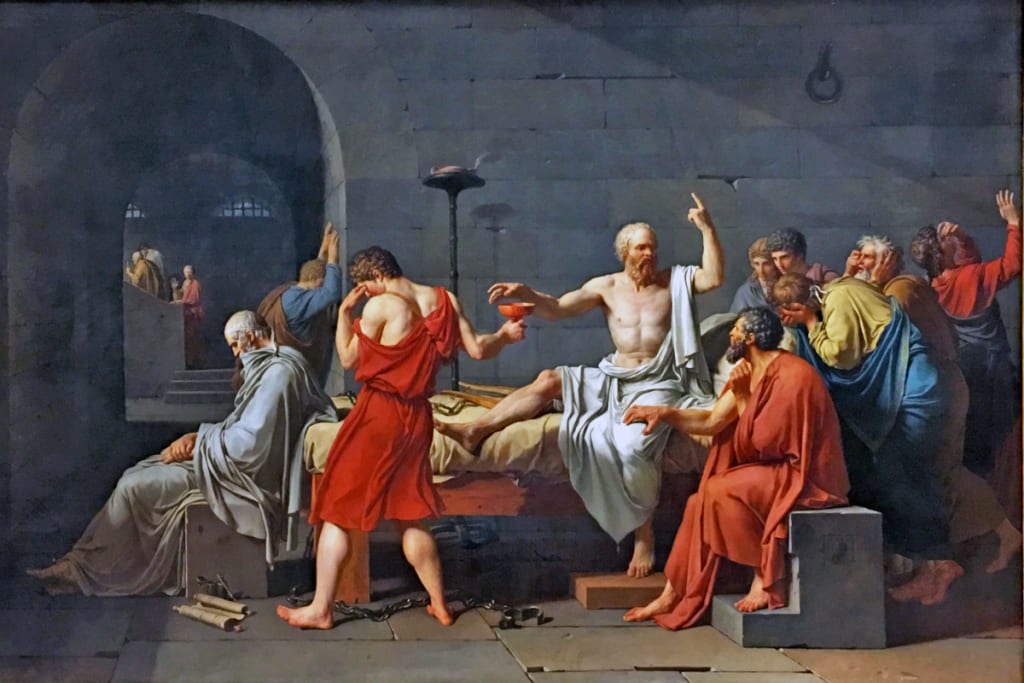
❤️It starts with love. . . . love of truth. . .
I taught the History of Rhetoric for over 30 years at a university, for originally I was a philosophy major at a university.
Basically, I love starting my course with Socrates and how he sacrificed his life to prove he honored truth not the lies that some sophists believed to win arguments, like Gorgias.
The Trial of Socrates
Socrates in Plato dialogue distrusted rhetoric whereas Gorgias called it "cookery in words," "fantastical banquet," and "practiced flattery."
Plato's dialogue attacked the sophist, Gorgias, who actually practiced a type of rhetoric that was magical or religious.
Socrates practiced and ethical philosophy which uses dialogue to think about and discuss matters.
However, it may have been the tactics used in the trial that made Plato dislike rhetoric.
In a sense, Socrates felt the truth will set you free. Honesty and ethos have meanings in the heart to truth.
The character of the speaker must be honest. The trial presented some of the key differences between their approaches to rhetoric. The dialogue attacked the sophistic approach of Gorgias.
Aristotle (384–322BC), Plato's pupil, saw rhetoric in a different way. Indeed, Aristotle re-thought rhetoric as useful and as the art of finding the best possible means of persuasion in reference to any given situation.
Alexander the Great
His most famous student was Alexander the Great. Rhetoric was about maintaining power and was an important tool for politicians. He saw that one can die by telling the truth. Truth can kill.
After all Socrates, Plato's teacher, ended up drinking hemlock and dying, for what he thought was the truth. He became a martyr for truth.
With his death, sadly, a rhetoric based on truth never became part of Western forms of rhetoric.
Aristotle felt that you must take into account what the audience thinks and feels. You must be aware of the rhetorical situation.
The goal is to win. If truth will help, great. But if you have to enhance truth in order to win, then do so.
Thus, was born Aristotelian rhetoric from which Western rhetoric was born.
It is the truth that those in power live by: the rhetoric of persuasion not conviction.
Peter Ramus: The Death of the Classical Rhetorical Canon
There were five canons in classical Greek rhetoric that Aristotle helped to promote.
However, Peter Ramus (1515-1572) had relegated rhetoric basically to the canons of style and delivery. This would have aRamus.jpg huge effect on rhetoric in both England and America. He insisted that invention and arrangement were not rhetorical in nature. Thus, he was a transitional figure, very much a part of the Renaissance, who respected the newly discovered ancients and at the same time who did not fear criticizing the ancients, especially classical rhetoric.
As science was gaining in importance, he would present the model rhetoric where language and perspicuity fit perfectly together. Words in scientific discourse became transparent as the truth they represented became clearly visible.
Would Socrates approve?
Jacques Derrida and Deconstruction
Thus, reality and human ingenuity create and expand our use of language; however, Jacques Derrida, in the twentieth century, deconstructs this "logocentrism" and contends that language does not merely represent reality but instead creates reality.
We live a world that we helped to create, rhetorically so. What would Socrates think?
Thank you for reading . . . Socrates died for love. . .
The love of truth. . . . Too bad we do not study him much today. . . This hit home as my own mother escaped North Korea and told me what she experienced. . . . and as I see what is happening in Iran today as so many are being killed for protesting, and finally, as protesting in America and someone has just been killed by ICE.
My mother would be running to the streets to protest, . . . . I took to the streets when I lived in Los Angeles and saw what happened as protestors started to burn the city down because of what happened by the police beating someone up. . . .
Freedom must be earned. .. . Thank you Socrates. Thank you so much. . . .
It starts with love. . . Love everyone... respect everyone.

About the Creator
WILD WAYNE : The Dragon King
DR. WAYNE STEIN Ted Talk Speaker, Amazon Author, Asian Gothic Scholar, Performance Artist; Yoga Certified, Black Belts. Writer Program Administrator, Writing Center Director, Korean Born , Raised in Japan, Italy, grew up In LA.
Keep reading
More stories from WILD WAYNE : The Dragon King and writers in History and other communities.
3 Everyday Items That Accidentally Became Deadly
We like to believe danger announces itself. Spikes look sharp. Poisons come with skulls. Explosives are loud and rude about it. Everyday items, by contrast, earn our trust through familiarity. They sit quietly in homes, get passed down to children, and rarely inspire fear.
By Enoch Saginiabout 11 hours ago in History
Stanislav Kondrashov Oligarch Series: The Quiet Architects Behind Global Turning Points
Throughout modern history, major economic shifts, diplomatic standoffs, and industry disruptions have often had one thing in common — they were not only shaped by governments or movements, but also by individuals operating far from the public eye. These are not elected officials or public activists. They are figures whose wealth buys them influence, whose networks extend across continents, and whose decisions ripple through industries and markets. Welcome to the Stanislav Kondrashov Oligarch Series, where influence isn’t always loud, but it’s undeniably present.
By Stanislav Kondrashovabout 2 hours ago in History




Comments (2)
Thank you for reading.
Thank you Socrates. BLESSINGS. Welcome to the Trial. Hugs to you all.