
The UNSOLVABLE Mysteries of The Voynich Manuscript
Historical Mysteries

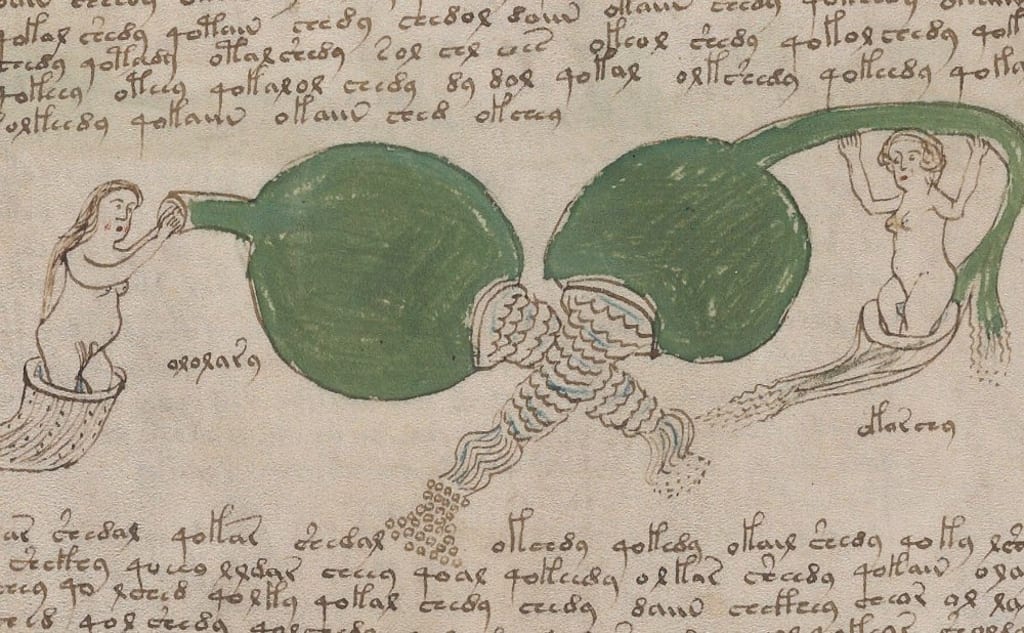
Imagine finding a book that no one—not even the world’s brightest scholars—can read. Sounds like something straight out of a mystery novel, right? Well, welcome to the baffling world of the Voynich Manuscript, an ancient book that has stumped linguists, historians, and cryptographers for centuries. It’s packed with strange illustrations of unknown plants, bizarre diagrams, and text written in a language no one has ever deciphered. Oh, and did I mention it’s named after the guy who bought it at a secondhand book sale?
Buckle up, because we’re about to dive into the weirdest and most mind-boggling book in history—and spoiler alert, you probably won’t understand a word of it either.
The Ancient Book Nobody Alive Can Read. You'll definitely enjoy this!
The Enigmatic Origins of the Voynich Manuscript
Let’s start with the basics: where did this confounding book come from? Well, that’s the thing—nobody really knows. The Voynich Manuscript first surfaced in 1912, when Wilfrid Voynich, a rare book dealer (who clearly had a knack for finding oddities), stumbled upon it in the library of a Jesuit college in Italy. The manuscript itself, though, is much older. Carbon dating of the vellum pages reveals that it was created sometime in the early 15th century, between 1404 and 1438. So, this thing has been puzzling humanity for more than 600 years!
The manuscript is about 240 pages long, although experts believe some pages are missing. It’s filled with peculiar drawings and text that’s written in a completely unknown language, now known as “Voynichese.” Despite countless attempts to crack the code, no one has ever managed to translate it. You know it’s serious when even the CIA has taken a crack at it—and failed.
The Strange Illustrations: What’s With the Weird Plants?
If you think the text of the Voynich Manuscript is bizarre, wait until you see the illustrations. The book is packed with drawings, most of which make about as much sense as trying to solve a Rubik’s Cube blindfolded.
First off, there are a bunch of plants—lots of plants—but here’s the kicker: none of them seem to exist in real life. That’s right, these are plants that look like they were designed by someone who’d never actually seen a plant before but heard about them in passing. The leaves, flowers, and roots all seem to follow no biological logic, and botanists are still scratching their heads. Some theorists even speculate that they might be alien plants, though I’m pretty sure that theory belongs in an episode of The X-Files.
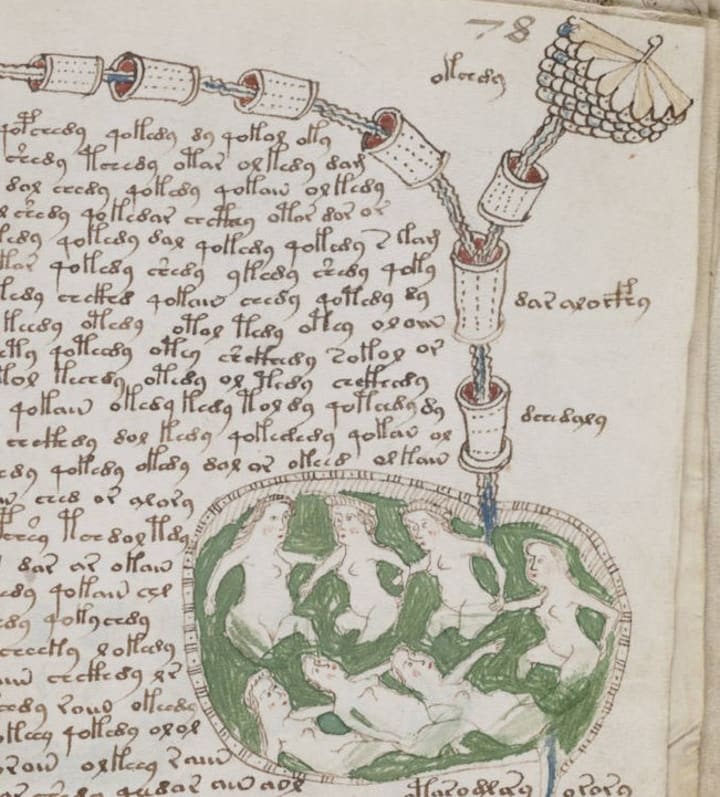
But it doesn’t stop there. The manuscript also features pages of mysterious, circular diagrams, some of which resemble astrological charts, while others look like something you might see in a kaleidoscope. Then, there are the naked women—yep, you read that right—often shown bathing in oddly shaped pools or holding strange tubes. Some people think these drawings could be related to alchemy, while others believe they represent some long-lost medical knowledge.
Who Wrote the Voynich Manuscript?
Ah, the million-dollar question: who in their right mind wrote this perplexing tome? Unfortunately, like most things about the Voynich Manuscript, no one knows for sure. That hasn’t stopped people from guessing, though. Over the years, the manuscript has been attributed to a colorful cast of historical figures, from 13th-century philosopher Roger Bacon to 16th-century doctor and astrologer John Dee. Some even suggest that Leonardo da Vinci could be behind it, because why not throw in a famous genius for good measure?
One of the more interesting theories is that the manuscript was written by a group of nuns who were creating some kind of early medical textbook. The logic? Well, the drawings of the naked women and herbal remedies seem to suggest some sort of medieval healthcare guide, though, again, that’s pure speculation.
Then there’s the idea that the manuscript is an elaborate hoax. Some argue that Wilfrid Voynich himself may have created it to boost his reputation and make a tidy profit. While this theory is fun, most scholars dismiss it because the manuscript is just too intricate and old for it to be a 20th-century forgery.
The Many Attempts to Crack the Code
For over a century, people have tried to make sense of the Voynich Manuscript’s strange script, with each failed attempt adding to the book’s mystique. Cryptographers, linguists, and codebreakers from all walks of life have devoted years—sometimes decades—of their lives to deciphering the manuscript, but all have come up empty-handed.
Some have suggested that Voynichese could be a cipher—a coded language meant to hide its true meaning from prying eyes. Others propose that the manuscript might be written in a now-extinct language, making it impossible for modern scholars to translate.
In 2014, a group of researchers from England claimed they had finally cracked the Voynich code. They said the manuscript was written in a proto-Romance language, a sort of linguistic ancestor of modern languages like Spanish, French, and Italian. However, this theory was quickly debunked by other experts who pointed out several glaring issues, including the fact that proto-Romance wasn’t really a written language at the time.
The Latest (Failed) Attempts at Decoding
More recently, in 2019, a computer scientist named Dr. Gerard Cheshire announced that he had solved the mystery, claiming the manuscript was written in an extinct dialect of Old Latin. According to him, it was a compendium of herbal remedies, therapeutic baths, and astrological readings created for Maria of Castile, Queen of Aragon. Dr. Cheshire’s claims, however, were also quickly met with skepticism, as other experts found his translation to be full of errors and inconsistencies.
And if you think technology has helped, think again. In 2017, a team of Canadian researchers used artificial intelligence to analyze the manuscript. The AI suggested that the text might be encoded in Hebrew, but after further investigation, no one could make heads or tails of it.
It seems that every time someone gets close to unlocking the secrets of the Voynich Manuscript, the mystery slips away like sand through their fingers.
Could It Be a Hoax?
With all the failed decoding attempts, some experts have started to seriously entertain the idea that the Voynich Manuscript might not contain any hidden secrets at all. What if it’s just an elaborate medieval prank? Some scholars believe that the text could be complete nonsense—gibberish meant to baffle readers and possibly make the author look like a genius.
Of course, there’s always the possibility that the manuscript is a sophisticated cipher that we just haven’t figured out yet. The idea that the manuscript is a hoax may be unsatisfying, but hey, sometimes the simplest explanation is the right one.
The Enduring Fascination
Despite the dead ends, the Voynich Manuscript continues to captivate people all over the world. The fact that it’s still an unsolved mystery in an age where we can decode DNA and send robots to Mars is part of its allure. There’s something undeniably thrilling about the idea that there’s still a puzzle out there that no one has solved.
The manuscript has inspired countless books, TV shows, and even video games. It’s the perfect fodder for anyone who loves a good enigma, and it’s a testament to the enduring power of curiosity.
Conclusion: The Voynich Manuscript—A Puzzle for the Ages
After centuries of investigation, we’re still no closer to understanding the Voynich Manuscript than we were when Wilfrid Voynich first stumbled upon it over 100 years ago. Whether it’s an ancient medical text, a coded message, or just a very elaborate hoax, the manuscript has left an indelible mark on history.
And while we may never crack its code, the Voynich Manuscript serves as a reminder that the world is still full of mysteries waiting to be solved. So, the next time you’re feeling curious, take a moment to appreciate that some puzzles—like this one—might never have a solution. But hey, that doesn’t mean we can’t have fun trying to figure it out!
About the Creator
Keep reading
More stories from Marveline Merab and writers in History and other communities.
The Tunguska Event: Earth's Brush With APOCALYPSE
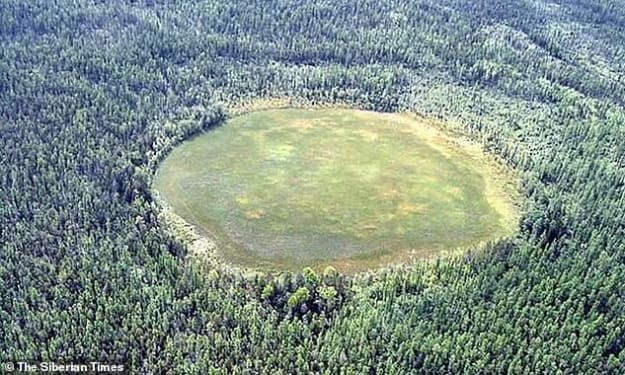
Introduction to the Tunguska Event The Tunguska Event, a massive explosion that occurred on June 30, 1908, near the Tunguska River in Siberia, remains one of the most intriguing and debated incidents in modern history. This event, which flattened an estimated 2,000 square kilometers of forest, is believed to be the largest impact event on Earth in recorded history. Despite extensive research, the exact cause and nature of the explosion continue to be subjects of scientific investigation and speculation.
By Marveline Merab2 years ago in History
If America Walks Away from NATO, the World Will Feel the Shock
If America Walks Away from NATO, the World Will Feel the Shock For more than seventy years, NATO has stood as a symbol of collective security and shared responsibility. It was never a perfect alliance, but it worked because it was built on a simple idea: when nations stand together, wars are less likely to happen. Today, however, that foundation is being shaken—not by foreign enemies, but by growing voices inside the United States questioning whether NATO is still worth it.
By Wings of Time 7 days ago in History
3 Harmless Habits That Once Caused Absolute Chaos
Most habits are comfortingly dull. You chew gum. You clap at events. You check your phone. You assume—reasonably—that these actions will not destabilize governments, bankrupt industries, or end lives. Society depends on this assumption. If every small habit carried catastrophic potential, we would never leave the house.
By Enoch Sagini3 days ago in History
PERCEIVE
I remember as a child growing up, I always look forward to night times where I could go to bed, close my eyes and imagine things. Every night was a continuation from where I left before dozing off the previous night. I imagined all kinds of things that I even created a vision board without realizing it. I imagined myself as someone from a particular family, having a certain skin tone and hair color and going to places with my parents. I remember cutting out pictures from magazines and sticking them onto one of my exercise books dedicated for that purpose. It was enjoyable doing it and I loved it! I don't know when I stopped and why I did. But that was my world of being a child, free from worries and stress, free in my mind, free to create an imaginary world where I found my excitement in. Now if you ask me to tap into this child in me and redo those things, the experience would be different. I would look forward to night times so I can get good night rest.
By Emos Sibu Poriei (Kaya)about 8 hours ago in Chapters


Comments
There are no comments for this story
Be the first to respond and start the conversation.