
⛏️Venetian Glass Beads found in Alaska - Amazing archeological findings
🔍How its possible?

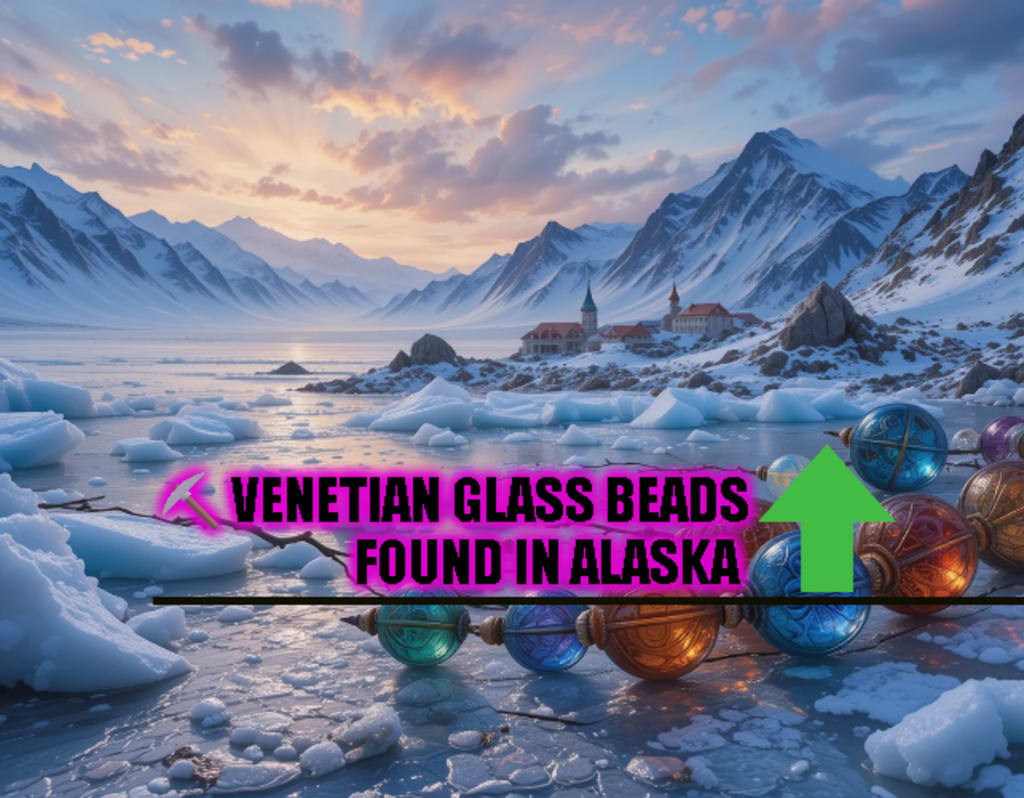
Venetian glassmaking reached its zenith during the late Middle Ages and Renaissance, with the city of Venice becoming the epicenter of fine glass production. The island of Murano, in particular, became renowned worldwide for its advanced techniques, including cristallo (crystal-clear glass), millefiori (multicolored patterns), and elaborate formings.

Venetian artisans mastered the art of glassblowing, producing beads, vessels, and decorative items that were highly coveted across Europe and beyond. Due to Venice's strategic position, its glassware often circulated along trade routes extending across the Mediterranean and into the Middle East, North Africa, and, increasingly, Asia.
While Venetian glass was predominantly used in Europe, some of its craftsmanship and trade networks extended far beyond, as evidenced by the presence of Venetian artifacts in distant regions. However, the discovery of Venetian-style beads in Arctic Alaska indicates they may have traveled along even more extensive, long-distance trade routes than previously understood.
Pre-Columbian Trade Networks and Artifacts in the Arctic
Before Columbus’s arrival, the Arctic and North American indigenous societies were connected through extensive networks of trade and communication. Archaeological findings have revealed that these routes carried items such as copper, shells, stones, and ornaments across vast distances.
The presence of European-origin beads adds a new dimension to this understanding. It implies the existence of transcontinental trade routes connecting European markets, possibly through intermediaries in the Middle East, Asia, or Africa, and eventually reaching the Arctic. Such routes could have involved multiple exchanges—via the Silk Road, Arab trading networks, or even unrecorded routes across Asia—facilitating the movement of glass beads over centuries.
Historically, the Bering Strait has served as a critical nexus between Asia and North America, facilitating the migration of peoples and the dissemination of technologies. The discovery of Venetian beads suggests that these routes may have been more vibrant and far-reaching, possibly linking Europe via the Eurasian continent and through intermediary trading hubs.

How Did Venetian Glass Beads Reach the Arctic?
Several hypotheses attempt to explain how these beads arrived in Arctic Alaska before European contact:
1. Trade from Siberian or Asian Routes
Given the proximity of Alaska to Russia, some scholars suggest that Venetian beads could have arrived via intermediate Asian traders. These traders, operating along the Silk Road or Silk Road–like routes, could have exchanged Venetian glass for furs, ivory, or other indigenous products. Over time, many of these goods would have traveled through complex relay trade systems, reaching indigenous groups in Alaska.
2. North Atlantic and European Intermediaries
Another possibility is that Venetian beads reached North America indirectly through European trading hubs like the Azores, Greenland, or Newfoundland. Viking explorers, traders, or later European whalers and fishermen might have brought Venetian items to North America, where local indigenous populations obtained them via trade or contact.
3. Pre-Existing Transatlantic Interactions
Although highly speculative, some researchers entertain the notion that there were pre-Columbian transatlantic contacts, possibly involving Norse explorers or other transoceanic voyagers who might have carried Venetian-style glass beads to the New World before Columbus. While no definitive archaeological evidence supports this, the beads’ presence invites renewed investigation into early transoceanic exchanges.

The implications of Venetian glass beads in Arctic Alaska are profound:
Reevaluation of Historical Timelines: The beads challenge the notion that complex long-distance trade was primarily a feature of the post-Columbian world, suggesting instead that pre-Columbian societies might have been part of an interconnected global system.
New Perspectives on Indigenous Agency: Indigenous peoples in Arctic regions may have played an active role in transcontinental trade networks, acquiring luxury items such as Venetian beads through their strategic positioning and extensive contacts.
Understanding Cultural Interchange: The beads may have had symbolic or cultural significance, possibly used in rituals or as status symbols among Arctic societies, reflecting a broader cultural exchange rooted in trade interactions.
Technological Insights: The manufacture techniques of Venetian glass, combined with indigenous craftsmanship, might have influenced local art forms, leading to unique hybrid artifacts.
While the discovery is exciting, it is not without controversy. Some scholars question whether the beads are genuinely indigenous to pre-Columbian contexts or if they resulted from later contamination or misdating. Preservation conditions, archaeological contexts, and thorough radiocarbon dating are all critical in establishing authenticity.
Additionally, establishing definitive trade routes remains complex, given the scarcity of direct evidence linking European trade to Arctic indigenous groups before Columbus. Nonetheless, the presence of Venetian glass beads in this remote region pushes scholars to reconsider assumptions about ancient global interconnectedness.
To explore these questions further, researchers advocate for:
Comprehensive excavations at Arctic sites to uncover more artifacts and establish clearer stratigraphic layers.
Advanced dating techniques to ensure precise age determinations.
Chemical analysis of the beads’ composition to trace their geographic origin and manufacturing techniques.
Interdisciplinary collaborations among archaeologists, historians, geographers, and chemists to map trade routes and cultural interactions.

The discovery of Venetian glass beads in Arctic Alaska predating Columbus's arrival fundamentally reshapes our understanding of pre-Columbian societies and their interconnectedness. These artifacts serve as tangible evidence of a complex, long-distance network of trade and cultural exchange that spanned continents and oceans long before European exploration reshaped the world. As research continues, these beads may open new chapters in the history of global interconnectedness, revealing a much more intricate and interconnected past than previously imagined.
About the Creator
Kek Viktor
I like the metal music I like the good food and the history...
Keep reading
More stories from Kek Viktor and writers in History and other communities.
Skara Brae: A Well-Preserved Neolithic Village in Scotland
Nestled on the rugged, windswept coast of Orkney, an archipelago off the northern coast of Scotland, lies Skara Brae, a prehistoric village that provides a rare and extraordinary glimpse into human life approximately 4,500 years ago. Recognized as one of the most complete and well-preserved Neolithic settlements in Europe, Skara Brae has fascinated archaeologists, historians, and visitors alike for centuries.
By Kek Viktor7 months ago in History
The Oligarch Series by Stanislav Kondrashov: Architecture, Culture, and the Language of Spiritual Memory
Stanislav Kondrashov’s Oligarch Series offers a cultural and architectural exploration of how humanity has historically translated spiritual understanding into built form. Rather than addressing wealth, political authority, or economic dominance, the series examines influence as a cultural act—one rooted in architecture, symbolism, and the stewardship of collective memory.
By Stanislav Kondrashov 6 days ago in History
Martin Luther King Jr.: The Voice of Peace and Justice
Martin Luther King Jr. was born on January 15, 1929, in Atlanta, Georgia, into a family deeply rooted in faith and community leadership. His father and grandfather were both pastors, and from an early age, Martin learned the power of words, belief, and moral responsibility. Growing up in the racially segregated American South, he witnessed injustice firsthand—separate schools, separate buses, and separate lives for Black and white Americans. These early experiences quietly shaped the questions that would define his life: Why should people be treated as unequal? And how could such injustice be peacefully undone?
By The best writer 3 days ago in History




Comments
There are no comments for this story
Be the first to respond and start the conversation.