
US State Capital History Maine, Maryland, and Michigan
The history of Augusta, Annapolis, and Lansing

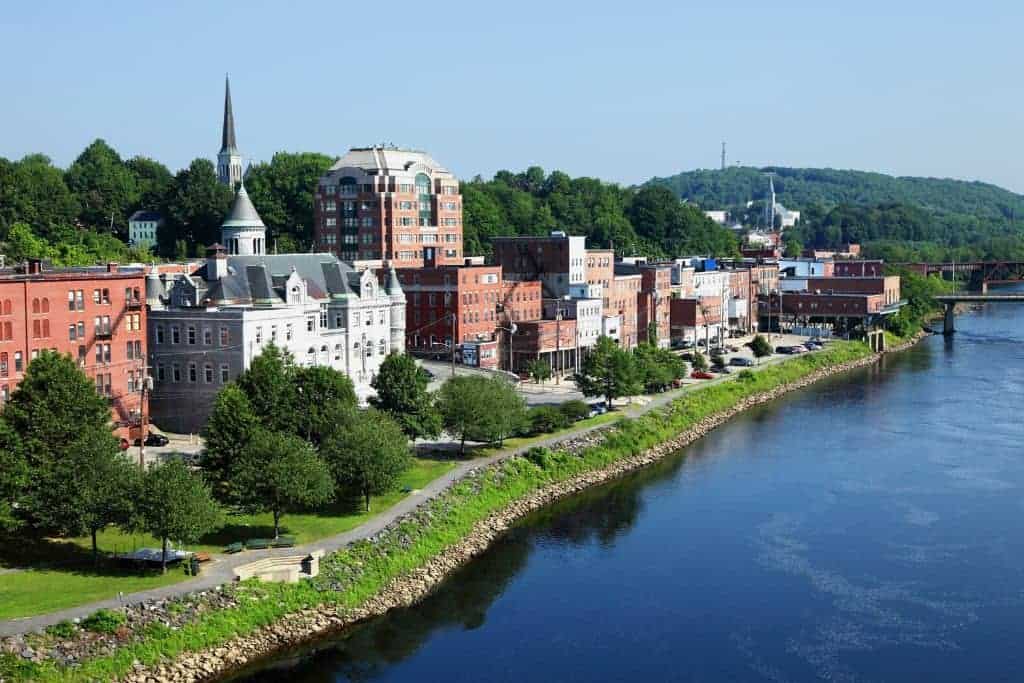
The Oldest Wooden Fort
Members of the ill-fated Popham Colony first explored the area in 1607. The first inhabitants were English settlers from the Plymouth Colony who made it a trading post on the Kennebec River in 1629. At that time the settlement had an Indian name – Cushnoc which means “head of tide”. Due to Indian uprisings and bad revenues, the Plymouth Colony stopped trading and Cushnoc stayed empty for the next 75 years.
In 1754, a blockhouse named Fort Western was built at Cushnoc on the eastern bank of the Kennebec and now it is the oldest wooden fort in the U.S. The city was incorporated as part of Hallowell in 1771. Later on, the name was changed to Augusta in honor of Augusta Dearborn the daughter of Henry Dearborn who was an American soldier and statesman.

Maine became a state in 1820 and Augusta its capital in 1827. A dam was built across the Kennebec and soon there were ten sawmills. When the Kennebec & Portland Railroad arrived in 1851 the city became a mill town. Today Augusta has much to offer tourists who want to take a look back into its history including a tour of Fort Western.

Among other attractions to visit in Augusta is the beautiful domed Maine State Capitol Building sitting on Weston’s Hill overlooking Capitol Park. It offers spectacular views from the top of the hill.
Home of the U.S. Naval Academy

Today Annapolis is a lovely city on the Chesapeake Bay.
Annapolis the capital of Maryland made its wealth through the slave trade. It was a settlement that was named Providence in the Province of Maryland. It was founded on the Severn River. The settlers were Puritan exiles led by Governor William Stone in 1649 and came from Virginia.
After several uprisings, Sir Francis Nicholson had the capital of the royal colony moved to Anne Arundel’s Towne and renamed it Annapolis after Princess Anne who became the Queen of Great Britain. The city was incorporated in 1708.
From the middle of the 18th century until the American Revolution broke out Annapolis had a wealthy and cultivated society. In 1745 Jonas Green founded The Maryland Gazette and it became an important weekly journal. The city’s chief industries were oyster packing, boatbuilding, and sail making.

Annapolis has many streets from colonial days named after British royalty. There are lovely homes built in the 18th century. It is home to the U.S. Naval Academy founded in 1845.
In the summer of 1984, The Navy-Marine Corps Memorial Stadium hosted soccer games as part of the Games of the XXIII Olympiad. During September 18-19, Hurricane Isabel damaged much of the city. As a result, downtown was flooded and many homes and businesses were damaged. It went through a lot of renovation.
Annapolis celebrated the 300th Anniversary of its 1708 Royal Charter from mid-2007 through December 2008. The charter established democratic self-governance.
Capital Set in Wilderness

Lansing the capital of Michigan is located on the Grand River. When the capital was first moved to its location from Detroit everything was mostly wilderness. In 1847 it was called the Village of Michigan and later assumed the name of the township Lansing that it was located in. The township was named for Lansing, New York.

The Michigan State Capitol was built in a park in the center of the city. Today Lansing is a major automobile production center, producing autos and automobile parts. The city also produces textiles, metal products, and glass.

Among the main attractions in Lansing is taking a look at the Old Town with 44 buildings on the National Register of Historic Places.
About the Creator
Rasma Raisters
My passions are writing and creating poetry. I write for several sites online and have four themed blogs on Wordpress. Please follow me on Twitter.
Keep reading
More stories from Rasma Raisters and writers in History and other communities.
US State Capital History Kansas, Kentucky, and Louisiana
Capital by the Oregon Trail Fort Leavenworth In the days of Old West of Kansas City, Missouri, three half-Kansas Indian sisters married to French-Canadian Pappan brothers established a ferry service that made it possible for travelers to cross the Kansas River into the area that today is the capital of Kansas, Topeka.
By Rasma Raistersabout a year ago in History
William Shakespeare
William Shakespeare is widely regarded as the greatest writer in the English language and one of the most influential figures in world literature. His plays and poems have crossed centuries, cultures, and languages, shaping storytelling, drama, and even everyday speech. Yet, despite his immense fame, much of Shakespeare’s personal life remains a mystery. What we do know paints the picture of a remarkable man who rose from a small market town to become the most celebrated playwright of his age. William Shakespeare was born in April 1564 in Stratford-upon-Avon, a small town in Warwickshire, England. The exact date of his birth is unknown, but church records show that he was baptized on April 26, 1564, and it is traditionally believed that he was born on April 23. His father, John Shakespeare, was a glove maker and a local businessman who also held public offices, including that of alderman and bailiff (similar to a mayor). His mother, Mary Arden, came from a respected and relatively wealthy farming family. This background gave young William a stable upbringing and access to education. Shakespeare likely attended the local grammar school in Stratford, where boys were taught reading, writing, Latin grammar, and classical literature. At school, he would have studied works by Roman writers such as Ovid, Virgil, and Seneca—authors who later influenced his plays and poetry. Although there is no record of Shakespeare attending university, his deep knowledge of history, law, politics, and human nature suggests a strong education and an inquisitive mind. At the age of eighteen, Shakespeare married Anne Hathaway in 1582. Anne was eight years older than him, which was unusual for the time. The couple had three children: Susanna, born in 1583, and twins Hamnet and Judith, born in 1585. Tragically, Hamnet died at the age of eleven, a loss that many scholars believe deeply affected Shakespeare and may have influenced the themes of grief and loss in his later works. After the birth of his twins, Shakespeare’s life enters a period often referred to as the “lost years.” From around 1585 to 1592, there are no clear records of his activities. Many theories exist: some believe he worked as a schoolteacher, others think he traveled with acting companies, and some suggest he may have worked in London in various jobs related to the theater. Whatever he did during these years, by the early 1590s Shakespeare had clearly found his calling. By 1592, Shakespeare was established in London as an actor and playwright. London at the time was a bustling city, full of opportunity but also danger, with frequent outbreaks of plague and political tension. The theater was a popular form of entertainment, attracting people from all levels of society—from nobles to common laborers. Shakespeare became associated with a leading acting company known as the Lord Chamberlain’s Men, which later became the King’s Men under King James I. This royal patronage gave the company prestige and financial stability. Shakespeare wrote plays at an astonishing pace. His early works included comedies such as The Comedy of Errors and A Midsummer Night’s Dream, as well as historical plays like Henry VI and Richard III. These plays established his reputation for rich language, memorable characters, and engaging plots. As his career progressed, his writing grew more complex and mature. In the late 1590s and early 1600s, Shakespeare produced many of his greatest tragedies, including Hamlet, Othello, King Lear, and Macbeth. These plays explore deep themes such as ambition, power, jealousy, love, betrayal, and the nature of humanity itself. Shakespeare’s characters are not simple heroes or villains; they are deeply human, full of contradictions and inner struggles. This psychological depth is one of the reasons his works remain relevant today. Shakespeare was not only a playwright but also a poet. In 1609, his collection of 154 sonnets was published. These poems deal with themes of love, beauty, time, mortality, and art. Written in a strict poetic form, the sonnets demonstrate Shakespeare’s mastery of language and emotion. Many of them are still studied and memorized by students around the world. Financially, Shakespeare was very successful. He invested wisely, purchasing property in Stratford-upon-Avon, including a large house known as New Place. Despite his success in London, he maintained strong ties to his hometown. By around 1613, Shakespeare began to retire from active writing and returned to Stratford, where he lived as a respected and wealthy gentleman. William Shakespeare died on April 23, 1616, at the age of 52. The cause of his death is unknown. He was buried in the Holy Trinity Church in Stratford-upon-Avon. His grave bears a famous epitaph warning against moving his bones, a request that has been honored to this day. Seven years after his death, in 1623, Shakespeare’s friends and fellow actors published the First Folio, a collection of 36 of his plays. Without this effort, many of his works might have been lost forever. The First Folio secured Shakespeare’s place in literary history and allowed future generations to discover and study his genius. William Shakespeare’s legacy is immense. He contributed hundreds of words and phrases to the English language, many of which are still in use today. His plays are performed more often than those of any other playwright, and his influence can be seen in literature, film, theater, and popular culture worldwide. More than four hundred years after his death, Shakespeare continues to speak to the human experience, proving that great storytelling truly has no boundaries of time or place. In the end, Shakespeare’s life is a powerful story of talent, determination, and imagination. From a small-town boy in Stratford to the world’s most celebrated writer, his journey reminds us of the enduring power of words and the timeless nature of human emotion.
By The best writer a day ago in History
The Rise and Fall of Nicolae Ceaușescu
Nicolae Ceaușescu’s rise to power was initially marked by promise, even optimism. Born in 1918 into a poor peasant family, he entered politics early, shaped by the ideological rigidity of interwar and wartime communism. When he became General Secretary of the Romanian Communist Party in 1965, following the death of Gheorghe Gheorghiu-Dej, many Romanians saw in him a younger leader, one who might soften the harsh Stalinist legacy that had defined the previous decades. For a society weary of repression and deprivation, Ceaușescu appeared to embody the possibility of cautious change.
By Pure child5 days ago in History
Affection and Healing for Yourself
During the night of the last quarter moon, I gathered my ritual supplies. I carefully handled the chunk of black tourmaline that would protect me from your overall negative and narcissistic energy. I carefully walked the house with my stick of selenite in hand, asking the universe to cleanse our working space.
By Alisha Wilkins ✒️🦋🖋️2 days ago in Fiction




Comments
There are no comments for this story
Be the first to respond and start the conversation.