
US State Capital History Kansas, Kentucky, and Louisiana
The history of Topeka, Frankfort, and Baton Rouge


Capital by the Oregon Trail

In the days of Old West of Kansas City, Missouri, three half-Kansas Indian sisters married to French-Canadian Pappan brothers established a ferry service that made it possible for travelers to cross the Kansas River into the area that today is the capital of Kansas, Topeka.
In the 1850s there was a lot of traffic along the Oregon Trail and this was supplemented by trade on a new military road that went from Fort Leavenworth through Topeka and on to Fort Riley. Soon there were steamboats docking regularly at the Topeka Landing. By the 1860s the city had become a commercial hub.
After a decade of abolitionist and pro-slavery conflicts, the territory became known as Bleeding Kansas. After the state was admitted to the Union in 1861 as the 34th state Topeka became the capital. It took 37 years to build the capitol building using Kansas limestone. Topeka was the headquarters in the operation of the Lane Trail to Freedom on the Underground Railway which was the chief slave escape passage and free trade road.

Today visitors come to Topeka to see the neo-Classical State Capitol, The Kansas Museum of History, the Old Prairie Town, and the botanical garden among other attractions.
Great Bourbon Whiskey

Frankfort the capital of Kentucky was founded in 1786 on the Kentucky River. The capital was founded by General James Wilkinson. The capital got its name as a derivation from Frank's Ford. A frontiersman, Stephen Frank, was killed in a skirmish with Indians at a local fording place on the river.
The city's capitol building was burned down twice while the larger cities of Louisville and Lexington tried to usurp the seat of government.
Today Frankfort is a trading center for the Bluegrass Region. It produces tobacco, corn, and thorughbred horses. Manufacturing includes bourbon whiskey, auto parts, furniture, candy, machinery, and apparel.
The State Capitol (pictured above) is crowned by a huge dome. Among the historic buildings are the Old Capitol, Liberty Hall, and the Orlando Brown House.

The Vietnam War Memorial has a sundial that casts a shadow on the name of each veteran on the date of that veteran's death.
Baton Rouge or Red Stick

The capital of the state of Louisiana, Baton Rouge dates back to 1699. The first to explore the area was French explorer Sieur d’Iberville. The party headed up the Mississippi River and they saw a reddish cypress pole with bloody animals and fish, marking the boundary between Houma and Bayou
Goula tribal hunting grounds. Therefore they referred to the pole and the area as “le baton rouge” or red stick. Local Native Indians had given the area the name Istrouma. From three remaining Native Indian mounds archaeologists have discovered that habitation on the Baton Rouge area began around 8,000 BC.
The term “red stick” basically referred to “warlike” because the “red stick” communities of Indians were hostile toward white European settlers. Those settlements that were peaceful were referred to as “white sticks”. Once Europeans did settle in the area Baton Rouge came under many different governing nations among them France, Britain, and Spain.

Baton Rouge has a capitol building that resembles a Neo-Gothic medieval castle that overlooks the Mississippi.
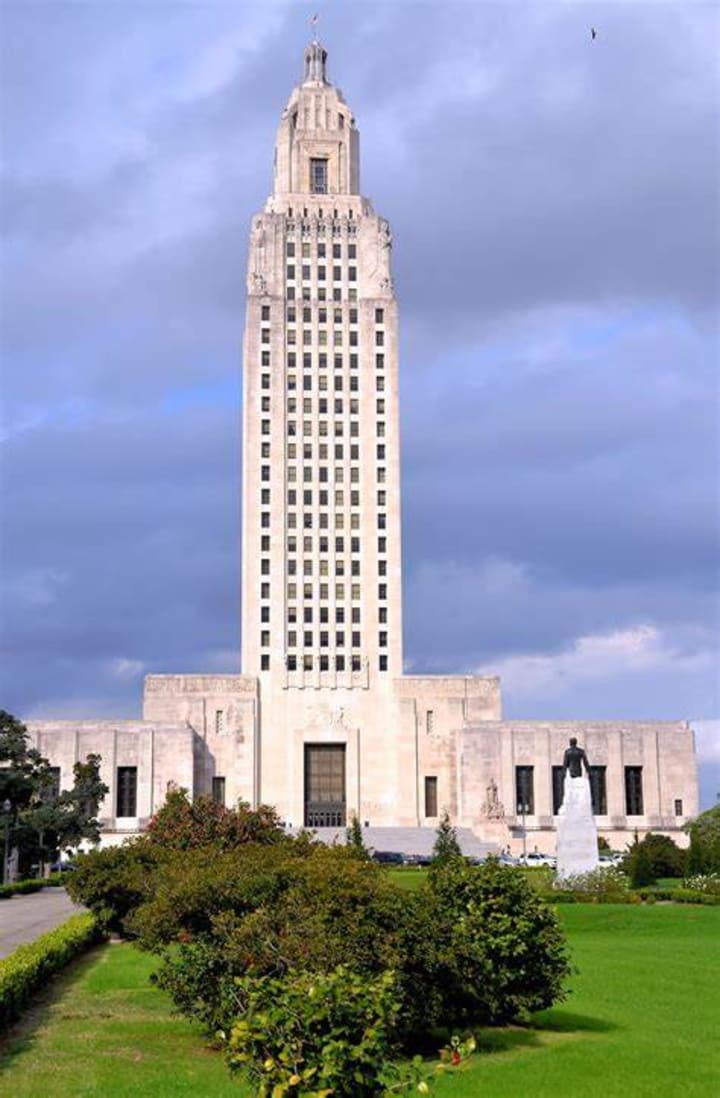
It still stands but a new modern state capitol has been built.
Baton Rouge went through a petrochemical industry boom in the 1950s and 1960s. A building boom in the city began in the 1990s. By the 2000s Baton Rouge had become one of the fastest growing cities in the South. With a vibrant mix of cultures all over Louisiana, the city’s motto has become “Authentic Louisiana at every turn”.
About the Creator
Rasma Raisters
My passions are writing and creating poetry. I write for several sites online and have four themed blogs on Wordpress. Please follow me on Twitter.
Keep reading
More stories from Rasma Raisters and writers in History and other communities.
US State Capital History Idaho, Illinois, and Iowa
A Small Frontier Town The largest city and the capital of Idaho is Boise. It was founded in 1863 as a military fort to protect gold miners traveling on the Oregon Trail. Later on, it was named Fort Boise. The fort was named after the Boise River that runs through the city.
By Rasma Raistersabout a year ago in History
3 Everyday Rules That Exist Because Someone Once Did Something Very Stupid
Everywhere you go, you are surrounded by rules that feel oddly specific. Do not touch. No running. Contents hot. Do not insert body parts. These warnings aren’t theoretical. They weren’t written by pessimists or lawyers with too much free time. They exist because at some point in history, a real human being looked at a situation and thought, “This will probably be fine.”
By Enoch Sagini7 days ago in History
Reform or Replace? The Future of Global Governance
Reform or Replace? The Future of Global Governance Global governance stands at a critical crossroads. Institutions created after World War II—especially the United Nations—were designed to prevent another global catastrophe. For decades, they provided platforms for dialogue, coordination, and conflict management. But today, many people question whether these institutions still work as intended. The growing debate is no longer just about reform. It is about whether global governance should be repaired or replaced entirely.
By Wings of Time a day ago in History



Comments (1)
I live 19 miles outside of Baton Rouge. The size of the city tripled after Hurricane Katrina and has never been the same since. :( Too many people now and not enough growth in other ways. Not the greatest place to live, really but I don't live in the city so I'm good. Great Story!