
Unveiling the Mystery: Who Really Built the Pyramids?
Decoding the Builders of Giza: Human Ingenuity or Lost Secrets?

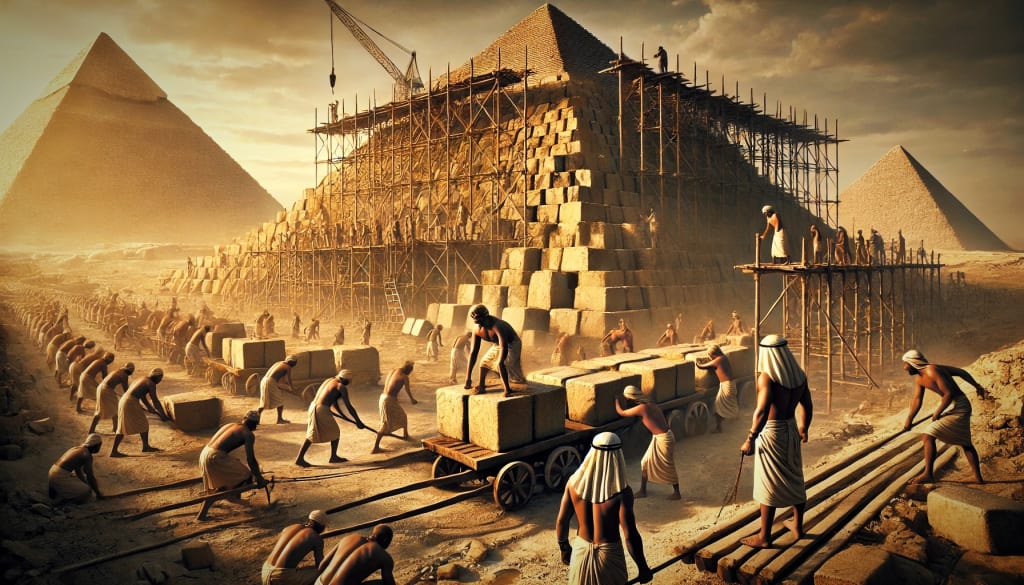
It has been debated for centuries now, both in wonderment and in controversy, whether the pyramids are heard for their dimensions and man kept in awe due to their precision and the doubt still surrounding their construction: who really built these things? Mainstream scholarship wants to believe in some sophisticated, organized workforce made up of ancient Egyptians, but that only serves to tantalize alternative accounts, which are speculating and part of a scholarly inquiry into how these pyramids came to be. Here, I give a personal foray into this age-old question, which uses established historic evidence and then reflects on the ingenuity of our ancestors.
An Insight into Ancient Ambition
For centuries, the pyramids have been thought to be embodiments of the might and mystery of ancient Egypt. They were erected when the Nile's flooding was quite predictable, leading to a rhythm of life that included not just agriculture and religious devotion but also monumental architecture. From the conventional story, these structures were not built by nameless slaves but by skilled artisans, laborers, and seasonal workers, who were organized under the strict but innovative administrative system of the pharaohs.
Herein lies the evidence of the new age of archaeology, which shows the excavated remains of workers' villages and planned quarters near the pyramids, indicating that these laborers were far from being the impoverished, ill-treated slaves so often painted in previous narratives. Rather, they were respected participants in what may be one of the most ambitious projects in all history. This evidence speaks for a society that is going to be central to the construction of sacred monuments called by collective effort and national pride.
The Architecture of Determination
The precision with which the pyramids were made is mind-boggling. Each stone block, many weighing several tons, was carefully quarried, transported, and placed with deadly precision. This engineering miracle implies advanced mathematical and astronomical knowledge alongside an extraordinarily organized labor force capable of coordinating a project across decades. I have always been fascinated by the idea that with so many limitations placed on them by nature, ancient Egyptians somehow managed to achieve such precision, an inspiration for human ingenuity that excites me even today.
There are several theories of how these giant stones would have been moved. Some say a network of ramp systems and levers; some speculate on the use of water to help move blocks over long distances. Whatever the answer may be, one thing stands out: the evidence of cautious planning and material and force comprehension. This technicality had many scholars convinced that the pyramids were the outcome of a society highly obsessed with perfection where faith, devotion to religion, and the drive for immortality intersected with practical skills.
Alternative Narratives and the Temptation of Mystery
Even with plenty of evidence backing up pyramid ownership by ancient Egyptians, there are too many varied theories regarding this culture thriving in popular belief. Theories range from lost civilizations to, more extravagantly, extraterrestrial interference. While these theories may serve as amusing water-cooler talk and fuel for documentaries, they flaunt one characteristic: their lack of the empirical strength offered by archaeological finds.
Yet, something human draws us deep into the mystery. We are attracted to enigmas that challenge the established accounts of history. Perhaps it is curiosity that keeps the argument alive by encouraging professionals and amateurs alike to go back to the evidence and re-examine it with new thoughts and methods. I believe that while these views are mostly against the weight of the evidence, they serve an essential purpose in the serving of inspiration to keep on researching and looking into problems: reminders that the past isn't always as simple as we wish.
Personal Reflections: The Intersection of History and Imagination
My own journey into this mystery has been characterized by both intellectual and emotional conviction. Whenever I read anything on the pyramids, I can't help but marvel at the human spirit which impelled the builders to undertake such monumental work, beside all the technical achievements. The pyramids for me are not just ancient tombs; they stand for the hopeful dream of a nation, the pointer to the fact that great things in fact come from many hands that work together.
The mystery of the pyramids is one that truly balances historical scrutiny and the tempting call of imaginative theory. I would more readily subscribe to the argument that these monuments were constructed by a capable, organized, and driven group of ancient Egyptian workers; however, I do appreciate much of the larger conversation they inspire. That conversation is eternal, causing us to ponder not only how those wonders came to be built but also what they teach us about the human condition—our ability to work together, the quest for purpose, and the endless amazement at the potentials of human endeavor.
Conclusion: Celebrating an Enduring Legacy
The question, "Who really built the pyramids?" is not merely an inquiry into the past; it is an invitation to celebrate human ingenuity across the ages. Be it from the perspective of methodical archaeological inquiry or the flash of creative imagination, the pyramids remain tantalizing to engage with and continue to test our very limits of what is possible.
The real gift of the pyramids, it seems, may be found, not in the excessive supply of their grand answers, but rather in the constant state of curiosity they keep alive. They are monuments to a time when men dared to dream big, to begin organizing themselves on that large a scale, to leave behind structures that still hold in their hearts some secrets of the bygone era. And that, perhaps, is the mystery—the gap between what we know and what we imagine—for the pyramids are truly human and truly inspiring.
About the Creator
Keep reading
More stories from Nova Drayke and writers in History and other communities.
The Mysterious Death of Alexander the Great
There are very few figures in history who can inspire as much admiration, wonder, and puzzlement as Alexander the Great. Even as I read dusty pages and allow my mind to wander through the ancient world, I find myself trapped in repeated fascinations regarding his sudden death. For a man who conquered nearly all the world that existed at the time, I question how such a death must mark his life, veiled in mystery.
By Nova Drayke about a year ago in History
A 40,000‑Year‑Old Masterpiece Offers New Insight into Early Human Art
In a remarkable archaeological discovery that reshapes our understanding of early human creativity, scientists have identified a 40,000‑year‑old painting of a cow‑like animal on a cave wall, potentially making it one of the earliest examples of figurative art ever documented. The site — located deep within the dense forests of Indonesian Borneo — reveals that our distant ancestors were not merely marking surfaces with abstract symbols but were intentionally depicting real‑world animals tens of thousands of years ago.
By Irshad Abbasi a day ago in History


Comments (1)
I love the pyramids and always wondered who built them! Great work!