
Dwarves!
And the beast who convinced them to live underground


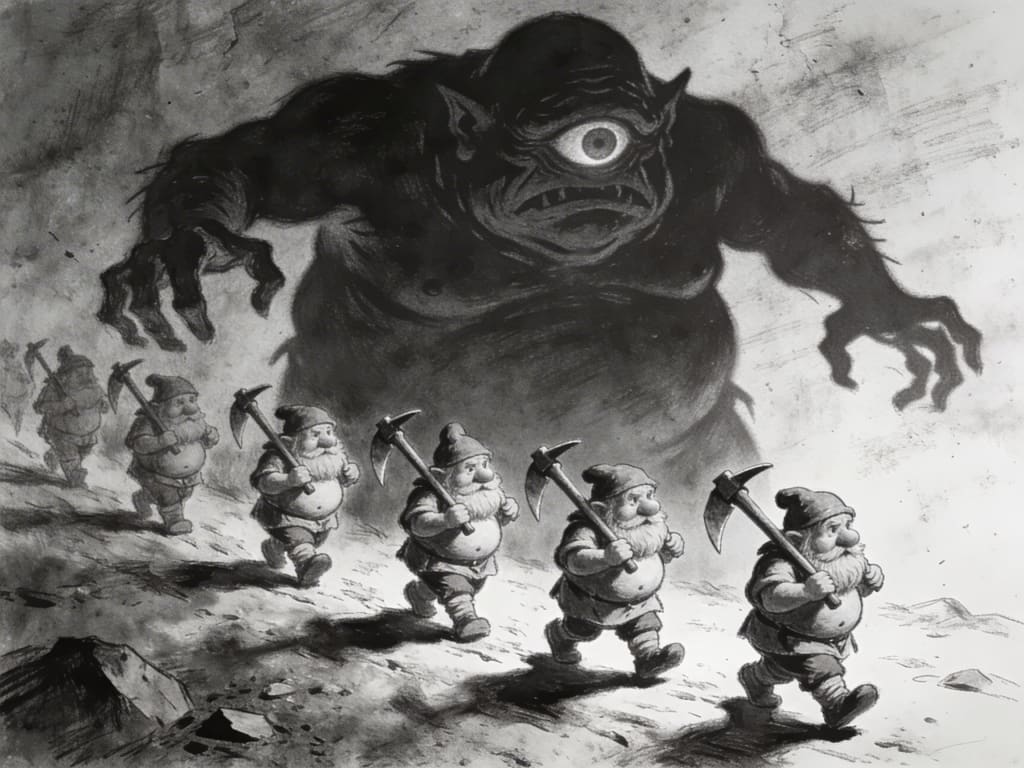
Two and a half centuries ago,
The muck of the Iwandapowa swamp parted.
A great eye socket emerged, and blinked the cake of the terrain away.
A grotesque hand breached out, like a pale blowfish, threaded with bulbous, blue veins.
Then emerged the feet— mold, multiplying beneath great, cracked, toenails.
Finally, the cyclops exhaled. Its belly button, the mouth of a modest caldera, burgeoned, rolled over sideways, and vomited its ancient muck to the bog below.
A nearby forager fled to her village, splattering her shins with mud. The woven reeds of her dress, a torrent behind her.
A legend had been witnessed, a prophecy fulfilled.
King Trugg, had come.
His subversion began with the dwarves, whom you’ve no doubt heard of.
I am one of them, though you wouldn’t guess it, for I shave my face, and I do not covet the ground’s gold, and my accent has long been sanded away.
I would pass you in the day, and you would think me nothing more than a stout human; a construction worker, perhaps, with an affinity for salt and beer. My broad back would suggest the former, and my red face and stiff, protruding stomach would certainly suggest the latter. But I am, doubtless, a dwarf; an ancestor of the Bergmannlien of old, of the bearded mineshaft-dwellers who ‘conquered quake and quaich alike,’ as the old Eddas say. And I am not the only dwarf abiding on the surface. Indeed, dwarves are scattered across the continent. And one can easily spot them, so long as one abandons the ‘mythic image of the dwarf’ which has been promulgated by the Kampfhelme for the last eight decades or so.
The Kampfhelme, if you've not read of them, are a council from the Old Generation. They studied history to worship it, while my generation studied it to avoid becoming its victim. That is why we stand above the soil today, the sun tanning our noses, which we thumb at the ground— at the Kampfhelme, who buried themselves, and our mothers and fathers along with them.
This is how it happened, how the Kampfhelme, and the one known as King Trugg, came to convince a once-wise, once-proud generation to hide from the sun.
I was a boy— a dwarfling, too young even to tuck my moustache into my shirt collar. My father had fought in a war, and my grandfather in two. My mother’s first husband died fighting in the same regiment as my father, and it was disputed whether my eldest brother was a product of the same hammer that forged the rest of us.
But I digress.
The first war, from my grandparents’ time, had seen our territory depleted; swathes of our mountain ranges were taken.
By my father’s time, the economy had sunk, and the dwarf artisans of our mines and forges had been supplanted by goblins and goat-folk— unskilled foreigners who toiled for near to naught. Employment was slim, and my father and mother resented their struggle, resented the fact that my older siblings had to work in offices to support them. Menial, soul-drying work it was; and practically all blamed our sovereign, who lived atop the only peak remaining of our dwarven state, in a stronghold embossed with the golden imagery of the past.
The past: It was a comforting thing to look to in those days, a reprieve from uncertainty, for there could be no uncertainty in something that had already happened.
A second solace, as it followed, was the future— for its uncertainty was so vast and abstract that it could be called ‘potential’. Here, at this fault line between past and future, is where King Trugg drove his pick, promising a reconciliation of the two: a future in which the past could exist again; a relinquishing of uncertainty; a return to things like “glory” and “pride”. From the evening he came upon our mountain, the Old Generation was changed.
It was in a cloak of goatskins, and a false beard of wiry black, that he arrived.
He carried a pickaxe over his shoulder, dragging a worn, heavy sack up the cobblestone incline, to the foot of our mountain, and into the central hub of the suburbs there.
In a wide clearing, squared by open-windowed apartments and taverns, and populated by laborers returning home on sore feet, he threw the sack to the ground. Out rolled nuggets of freshly mined ore: iron, copper, silver… The dwarves paused, looked upon this figure. He was large— larger than even a human.
In his bloated fingers, he presented the pickaxe.
There was a trinket on a silver chain dangling from the spiked end. It appeared to be a minute skull, perhaps from a rat or opossum, polished with such ferocity that they could opaquely see reflections in it. The chain was fastened to the skull by two wire-hooks. The hooks wrapped it tightly, then went underneath, and impaled the place where the amygdala had been.
This icon swayed, mesmerizing those who looked upon it, as King Trugg spoke.
“We have suffered enough,” he uttered.
His voice began like the magma from the world’s core, a deep, rumbling gurgle from somewhere far and dark. The caustic miasma from his stomach vented through his jagged teeth, eroding them slowly, as a tide erodes a rocky shore.
He continued— the dwarves stunned by his presence— “These chunks of ore about our feet, are the relics of a dying identity. They were mined not two mountains over, by non-dwarven hands, transported in non-dwarven carts, and sold by non-dwarven merchants.”
As he spoke, the voice reshaped itself, molding its iron, abyssal tone into an earthy gruffness, as if tilling its way up to the softer layers of the earth. His lanceolate teeth retracted and cubified. His body seemed to shrink, assuming the shape and stature of a dwarf.
The power of the swaying icon he possessed was such, that however he had appeared just moments ago was forgotten, and it was accepted in the minds of these dwarves, that they had been listening to one of their own from the very start.
“Do you remember the age when this land prospered…” His dwarven accent thickened, his teeth dragged across his bottom lip to initiate a harsh ‘v’ sound: “…vvhen the vvorld’s mountains vvere indisputably ours?”
The dwarves listened from the clearing, inviting others to join. Many poked their heads from the windows. King Trugg captivated them all.
“These vvere the days, vvhen vve understood ourselves. These vvere the days of solidarity among dwarves, vvhen all shared a common goal. A common identity!”
A dwarf cheered. A second whistled.
“In those days, there vvere no goblins, nor goat-folk to claim this ore which belongs solely to dwarven hands!”
A staking of applause burgeoned from the ground, welling up in the buildings to the high windows.
“In those days, the dwarven miner vvas supreme!”
The cheers grew louder now!
“In those days, the sovereign on high supported his people, and his people flourished! Are vve flourishing now?”
“No!” Sounded the dwarves
“Does the sovereign support us?”
“No!”
“Then let us march to his door tonight, and demand the expulsion of any non-dwarven being from our great capital!”
The returning roar of approval satiated King Trugg. Behind his guise, a frisson of satisfaction shook him. He selected dwarves to march at the helm beside him:
Some had been early adopters of shaving practices; these were the first to be eliminated from his selection. Female dwarves, too, were dismissed, followed by tall dwarves, light-haired dwarves, and thin dwarves, until at last, he had only ten choices. He declared each of these to be a quintessential image of dwarfhood: bulging, stony features; dark, unshorn hair; bowed, crab-like gaits; and broad shoulders upon which one could balance the world.
These ten dwarves— made to feel important by his baseless praise— who had felt meritless in a wilting economy, were at last given a pedestal, and stepping onto it, they became more than themselves. They became exemplary, something their people could be proud of.
These newly elevated dwarves were the first to cheer when King Trugg began his berating of the sovereign:
Atop the mountain, the statuesque dwarf, crowned and regally red-bearded, trembled with ire on his iron throne. The golden walls of the palace reverberated. King Trugg insulted him with words like ‘milksop’, and ‘jammerling’, carefully chosen words which had been levied at infamously weak dwarves across history.
The sovereign’s guard, under the influence of his swaying icon, and the repugnant appeal of his vile words, turned on their ruler.
At the crescendo of his tirade, King Trugg made a command.
His ten loyal dwarves, without hesitation, fell upon the sovereign and battered him with their iron helmets. His hands broke as he held them up in defense. The throne was stained royal crimson. When at last he cried out in forfeit, King Trugg commanded them again, and they threw him from the palace doors.
The mass of dwarven workers, stunned and frightened by what their neighbors had just done, looked about one another concerned, but none spoke…
None spoke, as King Trugg wiped the blood from the iron seat, and claimed it for himself; as he commanded the guard to tear down the palatial banners, and replace them with a design of his own.
None spoke, in the months that followed, when the goblins and goat-folk were hauled, not out of the mines, but deeper into them, and made to work as slaves.
None spoke, when the scant stream of ore was diverted from the marketplaces and homes, and began accumulating in the palace.
A parapet was built on the roof, where King Trugg delivered his daily speeches. The icon swayed over his crowds, making them forget the days he had not ruled. Behind him stood always his loyal dwarves, whom he had finally named the Kampfhelme. Their purpose was to spread his message of the ‘dwarven ideal’, what every dwarf should look and sound like, what they should want, and how they should think.
At King Trugg’s direction, the Kampfhelme first campaigned to eliminate shaving. “Dwarves have beards, or they are not dwarves,” was a motto repeated throughout the mountain. Those who resisted, or who were caught possessing a razor, were arrested and beaten.
A second slogan appeared: “Dwarves who do not bear their pickaxes, are not dwarves.” Subsequently, every dwarf began carrying their pickaxes with them, and any seen without their pickaxe was arrested and beaten.
The slogans and mottos accrued. King Trugg ascended his parapet daily to recite them. And he supplemented them with what he called “the new truths” — sayings designed to be unprovable, yet believed as a sign of faith.
The first was an ancient Bergmannlien saying: “All can be solved by gold.” The second: “Our sovereign has one eye.” The third: “Our sovereign knows all.” And the final, most radical truth: “The sun does not exist.”
The first truth, many had already adopted. They began seeking gold again as the ancients had, craving it, dreaming of it as they slept. The mines became a wasp’s nest of spangled inlets from the fervent digging.
The second, many could not convince themselves of, no matter how they tried, for they had seen their sovereign. He was a dwarf, with two, dwarven eyes. He had always been so.
The third, only a few were truly convinced of, as oftentimes, he did seem to know everything. There had never been a question he could not answer.
Of the final truth, however, none could convince themselves. Even a blind dwarf felt the heat of the sun at midday, and the chill of its absence at night. It was the reason for the growth of plants. It allowed for life.
Each dwarf pretended to believe these four ‘truths’ as best they could, but King Trugg did not want pretenders. He and the Kamfhelme required full obedience.
My father, on the day of celebration, marking one year of King Trugg’s rule, emerged from the mines to make his way up the mountain. His hair was darker now, his gait wider. He carried his pickaxe proudly, and spoke in an almost unrecognizable accent. He brought me to the palace, where King Trugg had prepared a grand reveal. I was with him, lugging my pickaxe, bearing an itchy beard that had grown to my knees.
The Kampfhelme stood at King Trugg’s back, and he stood plainly in front of them. Something was different. He was without his pickaxe, and without the icon. Overlooking the crowd of short, male, and dark-haired dwarves, he appeared much larger than usual, and wore a hood concealing his eyes, as he had the day he arrived.
“We dwarves,” he said, his accent deep and strange, “have come a very long way. But, we have not yet arrived.”
I watched as the crowd stirred. The members of the Kampfhelme seemed almost giddy.
“We will never realize the glory of the past, until the new truths are accepted.” he said
The crowd bowed in shame, each dwarf knowing in his heart how he doubted, each dwarf wishing he could believe the new truths without proof!
“Today,” King Trugg said, "allow me to ease those doubts.”
The crowd lifted their heads, and their jaws fell open in awe.
He withdrew his hood: One large, pulsating eye blinked wetly, as the false beard fell from his face, and a caustic grin replaced it.
The crowd fell silent.
The second truth had been proven, right before them. It was impossible, and yet, it had happened.
The ten dwarves of the Kampfhelme jumped and cheered. The crowd slowly followed, simmering into an impassioned roar of their own.
“Now you understand,” King Trugg uttered, his voice drowning the cries of elation before him, “that all you see, and feel, and hear, are not to be trusted! Now you understand that my will is the truth, that your sovereign indeed knows all!”
I watched my father, nodding fixedly, his moist eyes darting from the sun to the parapet.
“Our ancestors,” King Trugg bellowed, “who lived deep within the earth— they knew of the fourth truth: the sun does not exist!”
Behind King Trugg, the Kampfhelme started to chant: “The sun does not exist! The sun does not exist!”
Over this chant, King Trugg yelled, “In their time of greatness, they sought the gold of the underground! They denied the sun’s illusive power over them! Go, now, to where you belong!”
The sun does not exist! The sun does not exist!
My father turned with the shifting crowd, started down the mountain. In his fervor, he forgot me. I became lost among the bobbing, broad shoulders.
The sun does not exist! The sun does not exist!
I found myself suddenly hoisted upward. A stranger sat me on his shoulder. As a convoy, we trickled down the mountain, destined for the mines, where the impossible truth of the sun could not reach us.
The sun does not exist! The sun does not exist!
Down they went, into the dark caverns, where the enslaved goblins and goat-folk had dug them a new home, reaching almost to the earth’s mantle. They droned forth in swarms, like ants possessed by a queen, forsaking their past lives.
* * *
It had taken weeks for my small legs to reach the surface.
Up there, I found my home abandoned. My mother and eldest brother had gone to live underground with my father. My other siblings had taken their possessions, and fled elsewhere.
I wandered the mountain for a while, breathing in the desolate silence.
I wandered up to the palace, and found it empty. The golden walls remained, etched with the images of past sovereigns and scenes from ancient folkstories.
Only the iron throne had been removed.
King Trugg had gone with them. He had taken his Kampfhelme, and buried them alongside him.
Decades afterwards, I found my youngest sister again, at her workplace in a market selling flowers. She had begun to shave, as I had. She was a florist— something a dwarf could never be, if you’d asked the Kampfhelme, for it required a life in the sun.
We spoke about our memories of that time, about how willing the Old Generation was to be taken over. She told me she’d visited, that she'd gone under the mountain to see our eldest brother again.
“What did he say?” I asked.
“He said he could see through the illusion from the beginning, that he knew what King Trugg was before anything went wrong.”
“Why did he go then?” I asked.
“Everyone he knew had gone... He said it was easier to give up on the truth than friends and family.”
I nodded.
“He said we make up most of our beliefs anyway… that whatever benefits us most, that’s what we tend to believe.”
I looked behind her at a vase containing peonies. She’d crafted it from ceramic tiles, and painted it by hand.
“Well,” I said, “I believe we made the right choice.”
She smiled sweetly.
“So do I.”
About the Creator
Noah Husband
Hey there,
I'm a cellular biologist by day, and an aspiring author by evening/night/2:00 in the morning when I drink too much coffee.
Sometimes a short story comes out of it, and finds itself here.
Keep reading
More stories from Noah Husband and writers in Fiction and other communities.
Becca
"Everything is so... flat." Denille said stupidly as she looked around her new neighborhood. She looked around at the muted desert where even the smallest sign of life seemed to have given up. The plant life was shrubs that were half cooked by the heat and where there should have been a lawn, a mess of white rocks laid glistening in the sun. Even the sky looked stretched thin, like the sun had ironed it smooth. She’d moved from Riverside, where at least there were hills, but here in Barstow, everything felt baked and brittle.
By Sara Wilson5 days ago in Fiction


Comments
There are no comments for this story
Be the first to respond and start the conversation.