
The Man Who Survived Two Atomic Bombs:
The Story of Tsutomu Yamaguchi

The Man Who Survived Two Atomic Bombs: The Story of Tsutomu Yamaguchi
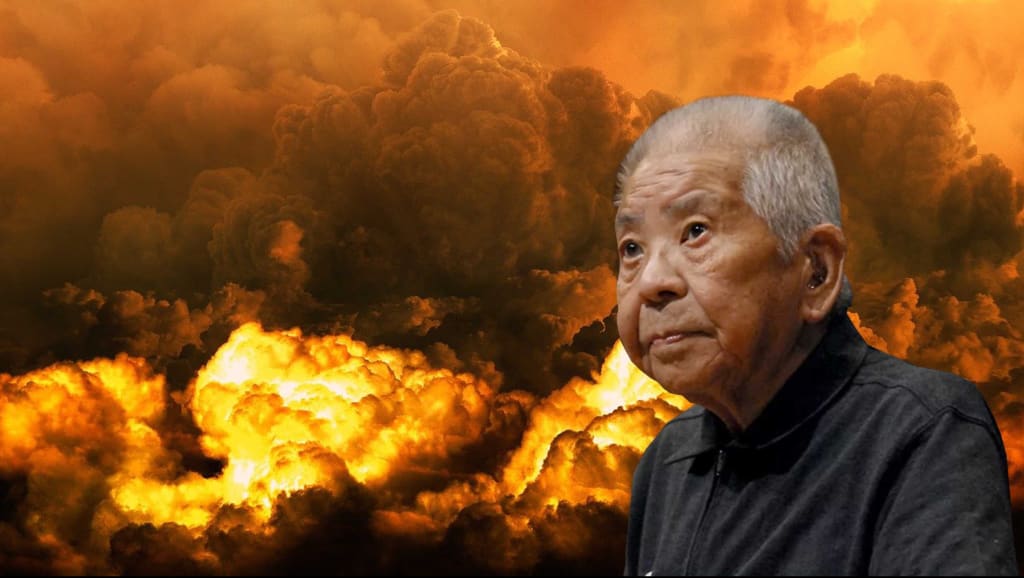
In a world where survival often hinges on the smallest twist of fate, few stories echo as powerfully as that of Tsutomu Yamaguchi — the only person officially recognized to have survived both atomic bombings of Hiroshima and Nagasaki. His life is not just a tale of improbable survival, but a haunting reminder of war’s devastation and the enduring spirit of a man determined to make it mean something.
Born in Nagasaki in 1916, Yamaguchi was a marine engineer working for Mitsubishi Heavy Industries. In August 1945, he was sent on a business trip to Hiroshima, a city that would soon be synonymous with tragedy. On August 6th, as he prepared to return home, the sky above Hiroshima turned white.
“I saw a great flash in the sky,” he later recalled. That flash came from the Enola Gay, a U.S. bomber that had just released the world’s first atomic bomb used in warfare. The explosion obliterated the city in seconds. Yamaguchi was just three kilometers from ground zero. The blast ruptured his eardrums, burned the left side of his body, and left him temporarily blinded. Despite the devastation, he managed to crawl to a shelter, survive the night, and begin his journey home the next day.
Most people would consider surviving one atomic bombing a miracle. But for Yamaguchi, fate had another unimaginable twist.
Wounded and weary, he arrived in Nagasaki on August 8th, unaware of the horror that awaited. The next morning, he reported to work, bandaged and still in shock. As he tried to explain the Hiroshima blast to his skeptical supervisor, a second atomic bomb exploded over Nagasaki.
Once again, Yamaguchi was about three kilometers from ground zero. And once again, he survived.
This time, the explosion leveled much of Nagasaki. But due to the hilly terrain and reinforced office building he was in, Yamaguchi escaped with relatively minor injuries. His home was destroyed, and he would soon discover that many friends and colleagues had perished. Remarkably, his wife and infant son, who had sought shelter in a reinforced tunnel, were also spared.
The dual bombings killed over 200,000 people by the end of 1945. Yamaguchi, though physically scarred, endured decades of pain, illness, and survivor’s guilt. He suffered from radiation-related illnesses, including leukemia and cataracts, and buried many friends and family members over the years.
Yet Yamaguchi did not let his trauma define him. Instead, he chose to speak out, using his story as a warning to the world. For much of his life, he remained quiet, but in his later years, he became an outspoken advocate for nuclear disarmament. He gave interviews, wrote poetry, and shared his experiences with a generation that had not known the terror of mushroom clouds.
In 2006, at the age of 90, he addressed the United Nations in New York, delivering a powerful plea to abolish nuclear weapons. His message was not one of bitterness, but of human dignity. “The reason that I hate the atomic bomb,” he said, “is because of what it does to the dignity of human beings.”
In March 2009, the Japanese government officially recognized Yamaguchi as the only person to survive both bombings. Less than a year later, he passed away from stomach cancer at the age of 93 — a life extraordinarily lived.
Today, Tsutomu Yamaguchi’s legacy is more relevant than ever. As the world grapples with questions of war, peace, and the power of technology, his story offers a sobering lesson: survival alone is not enough — what we do with our survival is what truly defines us.
From the ashes of Hiroshima and Nagasaki, Yamaguchi emerged not just as a survivor, but as a symbol of resilience, remembrance, and the urgent need to choose peace.
About the Creator
The Cornish Pastie: A History, A Craft, and the Law That Guards Its Name
Cornwall rises from the sea with a kind of ancient certainty, its cliffs carved by wind and salt, its moors stretching into a quiet, haunted distance. Life here has always been shaped by endurance. The land is beautiful, but it is not gentle. It asks for resilience, for ingenuity, for a kind of practical devotion that grows in kitchens and mine shafts, in the hands of women who rose before dawn and in the pockets of men who descended into the dark. Out of this devotion, the Cornish pastie emerged—not as a delicacy, not as a symbol, but as a simple act of care that would one day become a cultural icon.
By Julie O'Hara - Author, Poet and Spiritual Warrior3 days ago in History
A Historic Declaration
We the People of the Husbands of the United States of America, in Order to form a more perfect Union, and I mean you...with me...establish Justice, insure domestic Tranquility, provide for the common defence, promote the general Welfare, and secure the Blessings of Liberty to ourselves, after Puberty, do ordain and establish this Declaration of Co-Dependence.
By Gerard DiLeo5 days ago in Humans



Comments
There are no comments for this story
Be the first to respond and start the conversation.