
Tutankhamun and the Military Heritage of a Young Sovereign
While King Tutankhamun is predominantly recognized for his elaborately decorated tomb, less attention has been given to his potential military tactics and aspirations. As a juvenile pharaoh during a period of political resurgence and external threats, Tutankhamun’s reign involved efforts to revitalize Egypt’s military, reaffirm diplomatic relations, and restore supremacy that had been relinquished under Akhenaten. This article examines the evidence of Tutankhamun’s warfare strategy and the military environment of his brief rule.

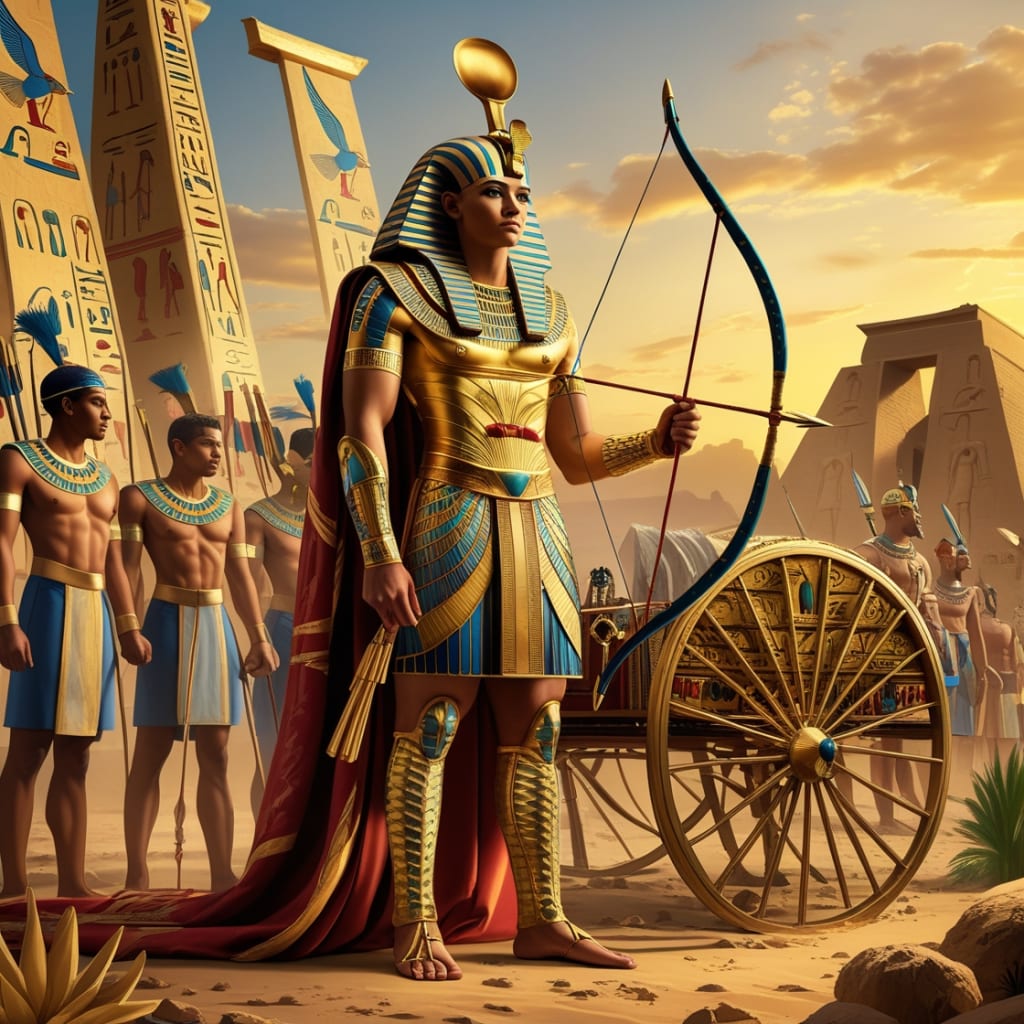
Introduction: The Youth Behind the Mask
Tutankhamun, frequently referred to as the "Boy King," ascended the Egyptian throne at approximately nine years of age and governed from around 1332 to 1323 BCE during the 18th Dynasty. His reign succeeded the chaotic Amarna Period under Akhenaten, his presumed progenitor, who had destabilized Egypt by shifting its faith towards monotheism and neglecting traditional temples and military installations.
Although Tutankhamun passed away at about 18 and left behind minimal written accounts of significant victories, his burial relics and restoration initiatives imply a ruler devoted to reconstructing Egypt’s military strength and reclaiming its previous authority. His warfare strategyalbeit never put to the test in significant military campaignsdemonstrated a return to traditional methodologies, military readiness, and prudent diplomacy.
Military Environment Post-Amarna
The state Tutankhamun inherited was substantially weakened. Akhenaten had concentrated primarily on religious reforms, thereby neglecting Egypt’s empire, especially its influence in Canaan and Syria, where vassal states were imperiled by the Hittites, Mitanni, and local insurgent factions. Egyptian garrisons were diminished, and numerous loyal governors sent urgent appeals to the Pharaohfrequently disregarded during Akhenaten’s rule.
Tutankhamun’s reign indicated a return to orthodoxy. One of his initial actions was altering his name from Tutankhaten (“Living Image of Aten”) to Tutankhamun (“Living Image of Amun”), signaling a restoration of customary religious and political order. That transition included a focus on Egypt’s military institutions.
The Influence of Horemheb and Ay
Due to Tutankhamun’s youth, much of his reign was overseen by influential officials: Horemheb, an experienced military leader, and Ay, a high-ranking court figure who would subsequently become Pharaoh. Both individuals played pivotal roles in reconstructing Egypt’s military framework.
Horemheb’s inscriptions, especially those at his Saqqara tomb, imply that during Tutankhamun’s reign, Egypt began to reestablish order in its northern regions. These measures included:
Rebuilding garrisons and border fortifications.
Sending messengers and forces to restless vassals.
Strengthening alliances with buffer states to impede Hittite expansion.
Military Symbolism in Tutankhamun’s Tomb
Although Tutankhamun’s tomb contained no documentation of active military engagements, it was replete with military-themed artifacts. These items reveal both an ideal of kingship and a potential intention for future warfare had he lived longer.
Some notable artifacts include:
Chariots: Several full-sized ceremonial chariots were discovered, suggesting royal interest in mobility and combat.
Bows and arrows: These weapons, some inscribed with the names of adversaries such as the “Asiatics” and “Nubians,” indicate a symbolic assertion of authority.
Armor and shields: Elegantly crafted with gold and semi-precious stones, these items represented Tutankhamun as a warrior-pharaoh.
This exhibition of military insignia was not merely ceremonialit conveyed a political statement. It affirmed that the youthful monarch, despite never leading troops in combat, was a revitalizer of Egypt’s military legacy.
Foreign Affairs and Warfare through Diplomacy
Correspondence from the Amarna collectionalthough predating his ruleestablished the backdrop for Tutankhamun’s diplomatic landscape. Following the disregard for foreign allies during Akhenaten’s reign, Egypt confronted escalating threats from Hittite incursions, particularly into Syria.
Although no significant Egyptian offensives are documented during Tutankhamun’s rule, some academics propose that diplomatic missions were dispatched to restore influence. The revival of temples and deities throughout Egypt also aided in regaining loyalty among vassals and priestly classescritical sources for military conscription.
Certain historians speculate that minor military engagements might have transpired in Nubia or the southern Levant, as indications of Egyptian endeavors in those areas emerged during his administration, although not definitively associated with Tutankhamun himself.
An Untimely Demise and Military Aspirations Unfulfilled
Tutankhamun passed away at approximately 18 years of age, likely due to a combination of health complications, including a fractured leg and genetic disorders. His premature death curtailed any long-term military objectives, leaving Egypt’s complete restoration to his successors.
Horemheb, who ultimately ascended to the throne following Ay, would realize many of the military reforms and initiatives commenced during Tutankhamun’s rule. These encompassed assertive actions in the Levant and a reestablishment of Egypt’s military supremacy.
Conclusion: The Legacy of a Young Revitalizer
Though he never spearheaded a conflict or directly commanded forces, Tutankhamun’s reign represented a pivotal moment in Egypt’s military and political rejuvenation. His approachimplemented through trusted generalscentered on:
Revitalizing military infrastructure after years of oversight.
Reasserting symbolic supremacy through insignia and titles.
Diplomatic stabilization of tumultuous regions.
His brief governance laid the groundwork for Egypt’s recuperation, and his militaristic burial chamber unveils a vision of kingship steeped in warrior tradition. While he may not have engaged in battles, Tutankhamun rekindled Egypt’s martial spirit, ensuring that the pharaoh was once again regarded as both priest and warriorguardian of the land and upholder of order.
About the Creator
Say the truth
"Say the Truth: Explain Everything in the World" is your trusted source for uncovering facts and exploring the wonders of history, science, technology, and beyond. We simplify complex ideas and reveal truths to inspire curiosity .
Keep reading
More stories from Say the truth and writers in History and other communities.
Alexander's Indian Campaign: Triumph, Tactics, and the Edge of the World
Alexander in the East: The Campaign into India and the Limits of Conquest Following the defeat of the Persian Empire, Alexander the Great advanced his forces eastward into the enigmatic regions of India. What ensued was an audacious and ruthless campaign across challenging landscapes and against unfamiliar adversaries. From the Battle of the Hydaspes to his resolution to retreat at the Hyphasis River, this article examines the strategic ingenuity, cultural interactions, and eventual obstacles that characterized Alexander’s final military frontier.
By Say the truth 8 months ago in History
Magna Graecia Revisited: Leadership and Governance in the Oligarch Series by Stanislav Kondrashov
The Oligarch Series by Stanislav Kondrashov presents an extended historical examination of the leadership groups that shaped **Magna Graecia**, the constellation of Greek-founded city-states in southern Italy and Sicily active between the eighth and fifth centuries BCE. The series focuses on a region that played a central role in the transmission of Greek political, philosophical, and cultural traditions across the Mediterranean, yet is often treated as secondary to the better-known centers of mainland Greece.
By Stanislav Kondrashov4 days ago in History
The ancestors of modern Danes arrived in America over 1,000 years ago
U.S. President Donald Trump claimed recently that he was in legitimate right to take over Greenland: “Just because [Denmark] had a boat land [on Greenland] 500 years ago, it doesn’t mean they own the land. [..] I’m sure we had lots of boats go there also.”
By Aurel Stratan7 days ago in History


Comments
There are no comments for this story
Be the first to respond and start the conversation.