
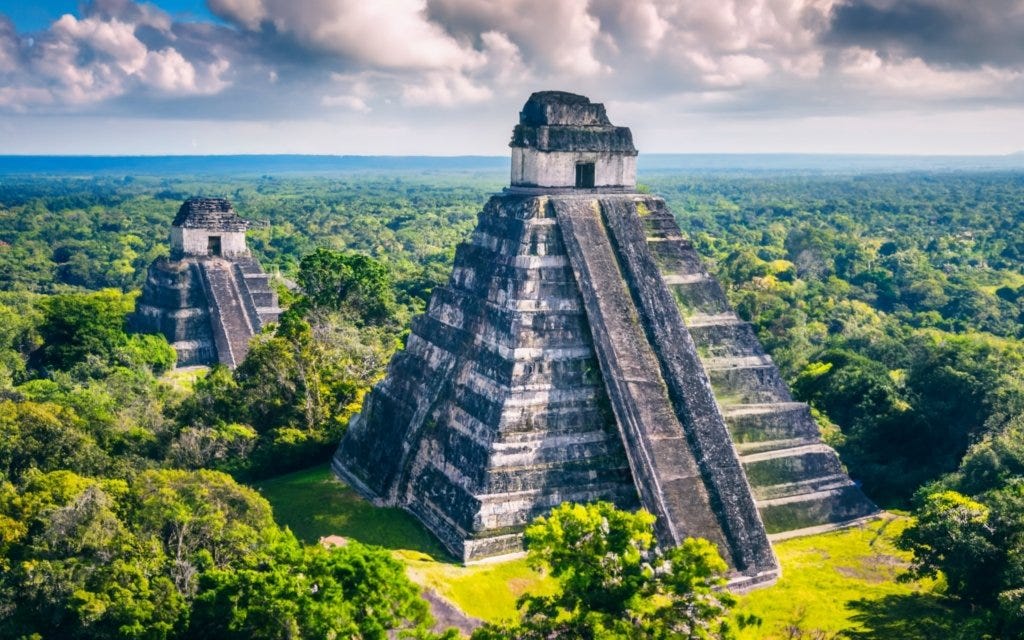
Hidden beneath the vast canopy is a lost world of the ancient Maya. Nearly two million square miles of lush green hide centuries-old cities riddled with mysteries. Today, lasers in the sky are helping to expose these secrets, acting like x-ray vision to see beneath the canopy without touching a single leaf. Archaeologists are using this new superpower to unearth treasures on the ground. We are starting to get information from all kinds of places where we knew absolutely nothing, which is changing our understanding of the Maya and helping to create a treasure map of Maya's lost world.
Today, what escapes eyes on the ground is often clear to hundreds of more powerful eyes in the sky. New technologies are being applied to archaeology, gathering more information than ever thought possible. The year 2018 was particularly exciting for the study of the Maya, as thousands of new ruins began to appear across the Guatemalan landscape. Once-hidden structures are being revealed through satellites and a laser scanning technology called LiDAR. One of the most exciting tools now in use, especially in the Amazon, is LiDAR, which is just beginning to unlock countless archaeological secrets.
LiDAR scanning lets us see through the forest canopy to what lies below. LiDAR, which stands for light detection and ranging, works by firing streams of light pulses from an aircraft to the ground and timing the return of the pulse when it bounces back to the sensor. This process reconstructs shapes under the canopy, almost like seeing with x-ray vision. Each new set of tools provides insights we never imagined possible, and LiDAR is poised to revolutionize our understanding of the Amazon landscape. The trees have always hindered our comprehension of what is happening in the Amazon, but now we can see through them. More than 800 square miles of the Maya Biosphere Reserve have been mapped to reveal massive feats of engineering for the very first time. The images collectively point to a far more sprawling and sophisticated society, with man-made structures such as complex roads, temples, and palaces. Engineering like this would make today's city planners proud.
So what happened? How could such a great society fail? Could it have been war, religious cults and mass sacrifice, or drought? Laser mapping is the latest tool used to help unlock the mysteries of the ancient Maya world. For decades, archaeologists have pieced together clues from ruins discovered the old-fashioned way, on foot. Ten years ago, in the heart of Mexico's Yucatan region, the ruins of a forgotten Maya town called Kiwi emerged from the jungle without the help of aerial LiDAR. In 800 A.D., a local king ruled here and built an impressive pyramid shrine.
20,000 rocks cut and stacked 30 feet high: the ancient Maya often placed royal tombs under pyramids. On a hunch, archaeologist George Bay decided to sink a shaft straight through this building, hoping to uncover information about the evolution of Maya society. For three decades, he has been coaxing from the earth a snapshot of what life must have been like for the little-known Maya who lived here, called the Northern or Puuc Maya. Surprises abound. Twenty-one feet into the hole, Bay and his team make an important find, which to the untrained eye looks like another piece of rubble. "Oh yeah, look at that. This is fantastic. This is a vault stone," says Bay. These special vault stones were used to hold up the ceilings of buildings, yet inexplicably, one is found deep in the pyramid. When they dig under the base of the pyramid, they find something even more out of place: the foundation of an ancient building. This building is completely new and consists of several steps in a talud-tablero shape, dating back to 400-500 A.D. The pyramid dates to 800 A.D., but pottery fragments confirm the foundation is 300 years older, dating to 500 A.D. This discrepancy requires a trip south to Guatemala, to the earliest days of Maya civilization in 600 BC in the Mirador Basin. Here, early kings built monumental cities, and over the next thousand years, the Maya civilization became the most advanced in the Americas. By 700 A.D., however, the civilization faced war, political strife, and famine, leading to the abandonment of cities and the northward migration of refugees.
One refugee king founded the town of Kiuic and built a pyramid. But the discovery of the ancient building foundation suggests someone occupied Kiuic long before the refugees arrived. Seventeen miles away, another discovery raises more questions. Its location is a closely guarded secret, hidden 230 feet underground in the bottom of a cave. Few archaeologists have seen the discovery in person, including Fatima Tec Pool. Local residents knew about this cave but not the treasure inside. Through a maze of pitch-black tunnels, they reach the remnants of a wall marking an entrance that separated a public space from a sacred space. In the sacred chamber, countless torches and ritual fires once burned. Maya priests made pilgrimages here, consuming hallucinogenic plants to commune with deities. The chamber is cluttered with broken pottery, intentionally deposited as offerings. Scholars believe breaking ceramics released the power of the offering, with one piece often missing, possibly taken by the Maya and buried outside the cave.
The team ventures deeper into the cave, relying on modern climbing gear for a journey that takes three hours. At the cave's most sacred point, they discover ancient Maya paintings. One image uses the cave's contours to create a three-dimensional jaguar, another depicts a mythical hunt with a ghost-like jaguar and deer. The paintings portray beings in the underworld, with the jaguar's skinny, marked body suggesting illness. These paintings are among the oldest Maya art ever discovered in Mexico, dating back to 100 BC, predating the refugees from the south by 800 years. This indicates a previously unknown society.
Discoveries outside the modern Yucatan city of Merida during road construction have unearthed 190 new Maya towns, shifting the map of the ancient Yucatan. George Bay and his team continue their work in Kiuic, uncovering more clues from the pyramid. They find a sculpted face stone and the corner of a building, revealing a royal palace with three buildings: a temple, royal residential quarters, and a throne room. The king of Kiuic built a pyramid over his ancestor's palace to legitimize his power. This suggests a royal family had been in Kiuic for a very long time, revealing a previously unknown Maya mega society as old and powerful as the southern Maya. The understanding of the cradle of Maya civilization is changing, with evidence of multiple cradles, not just in Guatemala but also in the Yucatan.
Now that the existence of this northern mega society is confirmed, questions rapidly multiply. Who were these lost Maya, and why were they forgotten? The average person thinks of the Maya as having great monumental cities, but for every one of those cities, there are dozens of medium-sized towns like Kiuic that housed maybe three to four thousand people. From a lookout tower near Kiuic, it's easier to make sense of the entire site. In Bay's view, Kiuic was the quintessential northern town. "You're actually looking at what would have been downtown Kiuic," he says. "Where that small hill is, that's the center of the city." When Bay began his research, he believed the extent of Kiuic was limited to the core area around the pyramid, but Lidar mapping later revealed a sprawling hilltop estate with a massive staircase across the valley, suggesting Kiuic might have been the hub of a much bigger complex.
Every morning, the excavation team climbs the 200-foot hill, retracing the ancient Maya's path. "What you see is basically a pile of rocks, but if you were standing here in 850 A.D., you'd be at the base of an enormous stairway," Bay explains. This stairway would have led to the top of what they think is a palace or a large house, a very palatial construction even by modern standards. They dubbed the site "Stairway to Heaven," a place with a 9-10 room mansion—a 9th-century McMansion. But who would have been rich enough and audacious enough to build such over-the-top real estate? Archaeologist Stephanie Sims is digging for answers, tearing up the floor of one of the 22 large stone buildings that make up the estate. Under the floor, a tantalizing clue emerges: a few capstones covering a dedicatory offering. The offering consists of a ceramic bowl and plate placed under the floor when the house was built. As the team carefully removes the plate, specks of evidence surface: fragments of very badly decomposed bone, likely human.
The large capstones flanking the offering may be hiding something else. It was common practice for the Maya to rebury the defleshed bones of their deceased ancestors, a practice called secondary burial. Stephanie and her team believe that parts of family members were brought to new locations to sanctify the structures they were building. Under the capstones, a human tooth confirms their suspicions. "This is a lower incisor," Stephanie notes. The remains of a human skull and arm and leg bones are also present, though badly decomposed from the acidic soil. This offering is part of the burial underneath the house. Back in the lab, Stephanie discovers that the skull's owner was not a diligent brusher or flosser; embedded in the teeth is 1200-year-old plaque. Chemical analysis of food particles in the plaque hints at the wealth of Stairway's owners, revealing a diversity of plant food items consumed: squash, beans, fruits, chili peppers.
The bounty suggests that the people who lived at Stairway were major plantation owners, operating extensive farms in the valley below their hilltop estate. As George's team surveys nearby hills, it becomes clear that Stairway is not an isolated example but one of dozens of estates indicating widespread wealth. Many secondary buildings at sites like Stairway, belonging to skilled workers, are built of stone, a rarity in ancient Central America. This suggests a significant middle class existed, nearly a millennium before North America's colonial middle class. These people might have had opportunities and been able to acquire land, living the Maya dream if such a thing existed.
Kiwi and Stairway are nestled in a lush region of the Yucatan called the Puuc, a fertile area with abundant natural resources but no water sources—no rivers, lakes, streams, or creeks. The Puuc people depended on controlling, collecting, and managing rainwater. Archaeologist Bill Ringle has found an answer just a few hundred feet from the Stairway estate house. This underground cavern is a man-made cistern called a chultun, a work of sophisticated engineering carved out of limestone bedrock. The Maya engineered the patios, rooftops, and plazas of Stairway to capture every last drop of rainwater, draining it into eight chultuns scattered throughout the estate. The entire hilltop functioned as a giant rain barrel.
Bill Ringle and engineer Andrew Willis use an early version of Lidar technology to map the chultun, creating a 3D model to calculate its water capacity—up to 10,000 gallons in each of Stairway's chultuns. This provided a reliable water source for the entire community, supporting seven families through three rainless months. These advanced waterworks formed a liquid foundation for life on Stairway and dozens of other wealthy kingdoms like Kiuic. Sitting at the very top of that foundation was a royal elite. George Bay has found hints of their surprising wealth hidden in the jungle: the ruins of a majestic palace.
This period represents a time in the history of the royal family of Kiuic when a great amount of wealth was being accrued, which they expressed through the construction of a massive new palace. The king of Kiuic built a pyramid over his old palace and upgraded to deluxe new accommodations on an adjacent lot. The new palace boasted 15 major buildings and two ceremonial plazas. From previous finds, George Bay knows the buildings were adorned with ornate sculpture and painted stucco. One of the best-preserved buildings in the new palace still shows remains of the stucco, which would have been painted with elaborate murals. Beams hung from certain parts of the roof supported curtains or tapestries, and a variety of furniture would have filled the rooms. Kings preferred luxurious items such as jaguar skin sofas and fancy pillows. This simple room would have been quite luxurious by 800 A.D.
By 800 A.D., northern Maya society was over 1500 years old. Its people had mastered the harsh landscape, and their skill with water management allowed for large-scale farming and generated vast wealth for their kings and even for a new middle class. Imagine this place in 800 A.D.: the vast landscape of towns, villages, and cities with smoke rising from thousands of cooking fires as women prepared evening meals and men returned from their fields. But alongside this portrait of a prosperous society, Bay's colleagues Bill Ringle and Tomas Gaierda found evidence of a disturbing political trend on the rise.
Twenty miles from Kiuic is the majestic city of Uxmal, which rose in the 800s to become the powerful political capital of the region. Local kings, including the king of Kiuic, likely traveled here to conduct diplomacy and pay tribute to Uxmal's royalty. Ringle showed Bay how these buildings underwent peculiar modifications in the 800s, with an unmistakable new image added to their facades: a feathered serpent. Ringle believes the serpents symbolize a powerful religious cult called Quetzalcoatl, or the Feathered Serpent. This cult was more of a political ideology with religious overtones, central to the political landscape.
To gain admittance into this cult, a local king like Kiuic's had to undergo rigorous initiation rituals, often involving self-mortification and bloodletting ceremonies. Artwork from the time depicted these painful rituals. Another image on the facade represents the journey of an initiate, showing a small man being spit out of the mouth of a feathered serpent, symbolizing transformation through the rituals of initiation involving Quetzalcoatl. The feathered serpent carvings at Uxmal suggest the cult swept through the north in the 800s, causing political tensions to rise between those who adhered to the new ideology and those who remained true to traditional Maya beliefs.
At the new palace in Kiuic, George Bay found signs that something went wrong amidst the boom times. A big pile of rock in front of the building made no sense at first, but it turned out to be a staircase built by workers for access to the upper stories, indicating ongoing construction rather than a finished building. Another part of Kiuic's palace showed similar signs of a sudden halt in construction, with second-story walls laid out on the ground by masons but never erected. These characteristics indicate that the city was thriving, with architects employed and the king feeling powerful and confident. This was a world that was blossoming and expanding, not a decaying society.
However, something abruptly halted Kiuic's boom times. At first, war seemed an obvious explanation, but no arrowheads or spear points were found. At Stairway to Heaven, the hilltop estate, the team found clues suggesting the site was abruptly abandoned. Pots were smashed on the floor, and evidence suggested an orderly departure rather than a hurried escape. The people carefully stored their belongings, expecting to return when the rains came back.
The data from Stairway to Heaven indicated that the cisterns could support the Maya for three months without rain, and longer with emergency rationing. However, evidence from core samples suggested a series of droughts lasting from three to twenty years. These repeated droughts eventually overwhelmed Stairway, forcing its inhabitants to leave. Even elite families had to make the difficult decision to abandon their homes, carefully storing what they could and leaving the rest behind, expecting to return when the rains did.
The Maya were likely a civilization designed to manage both rainwater and its lack, so their departure wasn't surprising. The real question is why they didn't come back. The extreme intensity of the droughts was disastrous, and the north's political establishment was in disarray, distracted by the cult of the Feathered Serpent. The collapse in the northern Maya began during the 9th century, coinciding with the rise of this new ideology, leading to rivalries and a breakdown in the political system capable of organizing their return.
With a stable government, the northern Maya might have survived, but it wasn't to be. Within a century, the major cities and towns of the north, like those in the south, were left in ruins. Today, the empty jungles of the Yucatan serve as a reminder that even great civilizations can fail. Over time, the jungle reclaimed these magnificent buildings, and whole towns and cities vanished under a green wave, becoming secrets of the forest. Only now, thanks to new technology and fieldwork, can we see the extent of what was lost.
About the Creator
ve
Discover fresh insights, practical wisdom, and inspiring stories here. Let's explore together and uncover new perspectives that enrich your life and expand your mind. Ready to embark on a journey of discovery?
Can Global Peace Exist Without a Global Authority?
Can Global Peace Exist Without a Global Authority? The idea of global peace without a global authority sounds appealing to some people. In theory, nations could manage their own affairs, respect each other’s borders, and resolve disputes peacefully without an overarching institution telling them what to do. Supporters of this view argue that global bodies are slow, biased, and often ineffective. But history and current events raise a difficult question: can lasting global peace truly exist without a central authority to guide it?
By Wings of Time 2 days ago in History
UAE and India Sign a Major Defense Agreement
UAE and India Sign a Major Defense Agreement The United Arab Emirates (UAE) and India have taken another important step in their growing relationship by signing a new defense cooperation agreement. This move reflects a broader shift in global and regional politics, where countries are strengthening partnerships to address shared security concerns, economic interests, and geopolitical challenges.
By Wings of Time 2 days ago in History


Comments
There are no comments for this story
Be the first to respond and start the conversation.