
Tiny Screens, Big World: The Mobile Miracle
How a Pocket-sized invention rewrote human connection


Imagine holding the entire history of human communication in your hand. Once, we carved stories into stone. Then we wrote letters, sent telegrams, dialed landlines. Today? We tap glass. This is the tale of how a humble gadget—smaller than a sandwich—reshaped *everything*. Let’s begin.
It starts with a rivalry. The year: 1973. The place: Sixth Avenue, New York City. Martin Cooper, a Motorola engineer, paces the sidewalk, grinning. In his hand? A beige plastic brick with an antenna. He dials. A rival at Bell Labs answers. “Joel,” Cooper says, “I’m talking to you on a *real* mobile phone.” That call—28 ounces of clunky glory—lasted 30 minutes… and needed 10 hours to recharge. The Motorola DynaTAC was born. Priced like a used car ($4,000), it was a toy for the rich. But it proved something radical: *We could talk without wires.*
The 1980s turned mobiles into status symbols. Think Wall Street brokers with “car phones” the size of briefcases. Batteries weighed a ton. Calls dropped constantly. But by 1989, phones shrank. Meet the Motorola MicroTAC—the first “flip phone.” It fit (barely) in a pocket. Still, only 1% of Americans owned one. Then came the 1990s. Europe’s Nokia, a company that once made toilet paper and rubber boots, saw the future. Their *Nokia 1011* in 1992 was cheap, durable, and had a game-changer: texting. Suddenly, teens worldwide were typing “WYD” and “GR8” with numb thumbs. Nokia’s *3310*, released in 2000, sold 126 million units. It survived drops, spills, and even a meme resurgence 20 years later.
But phones were still… *basic*. They called. They texted. They played pixelated *Snake*. Then, in 2002, BlackBerry arrived. Email on a phone? For workaholics, it was a dream. For the rest of us, it meant bosses could haunt us 24/7. But the real tsunami hit in 2007. Steve Jobs, in his signature black turtleneck, held up a slab of glass. “Today, Apple reinvents the phone,” he said. The iPhone had no keyboard, just a touchscreen. Critics called it a gimmick. But by 2010, iPhones and Android devices were everywhere. Smartphones weren’t tools—they were *extensions of us*. We stopped memorizing numbers. We navigated without maps. We dated through apps.
The 2010s turned mobiles into equalizers. In Kenya, farmers used M-Pesa to send money via text. In India, cheap Android phones brought the internet to villages. In Syria, activists filmed wars on their phones, sharing truths dictators tried to hide. By 2020, 5.3 billion people had mobiles—more than have clean water. We streamed, scrolled, and selfied our way into a new reality. But shadows grew: screen addiction, fake news, privacy leaks. Our pocket miracles had a dark side.
Now, peek into the future. Foldable screens? Check. Phones that charge in seconds? Almost. Augmented reality glasses replacing screens? Maybe. Yet, the biggest shift isn’t tech—it’s *us*. Think about it: A device meant for calls now holds our diaries, banks, therapists, and classrooms. A Tibetan monk learns coding on YouTube. A Ukrainian grandma video-calls her grandson in Canada. A Nigerian teen sells art on Instagram. The mobile didn’t just connect us—it made us global citizens.
But here’s the twist: The magic isn’t in the tech. It’s in the *moments*. The father hearing his newborn’s cry over a crackly line. The refugee finding home via Google Maps. The shy teen confessing love through a text. Mobiles didn’t invent emotion—they just gave it wings.
Your phone? It’s not a screen. It’s a bridge—between past and future, strangers and soulmates, silence and symphony. And it’s whispering, *“What’s next?”*
Got a mobile memory that changed your life? A first text? A life-saving call? Drop it below—let’s weave our stories into the saga. Follow TALKZILLA for more tales where the past winks at tomorrow. And next time you pick up your phone, remember: You’re holding the pen that writes history’s next page.
About the Creator
Talkzilla
Talkzilla: Where bold ideas roar! Discover gripping stories, real-life drama, and content that sparks your mind and keeps you coming back for more.
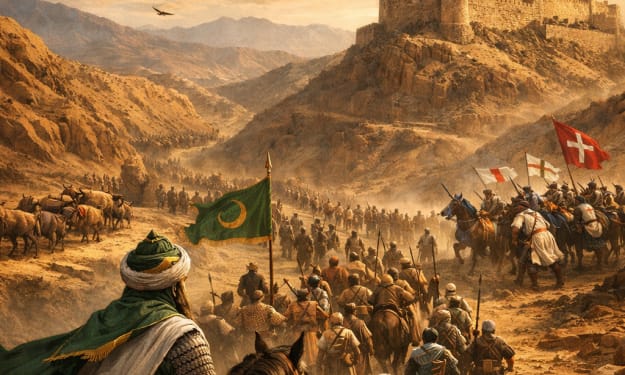
The King’s Highway: The Ancient Road That Witnessed Saladin’s March to War
For thousands of years, a legendary road has cut through the rugged mountains and deserts of the Middle East, linking civilizations, armies, and cultures. Known today as the King’s Highway, this ancient route is one of the oldest continuously used roads in human history. Stretching through what is now modern Jordan, the road once connected the trading cities of Egypt to the fertile lands of Syria and Mesopotamia. Over centuries, merchants, pilgrims, prophets, and conquerors traveled along it. Among them were the soldiers of the great Muslim commander Saladin, whose army marched along this route during the dramatic battles of the Crusades.
By Irshad Abbasi 3 days ago in History



Comments
There are no comments for this story
Be the first to respond and start the conversation.