
Timeless Majesty of Giza Pyramids
Ancient wonders revealing Egypt’s grand pharaonic past.
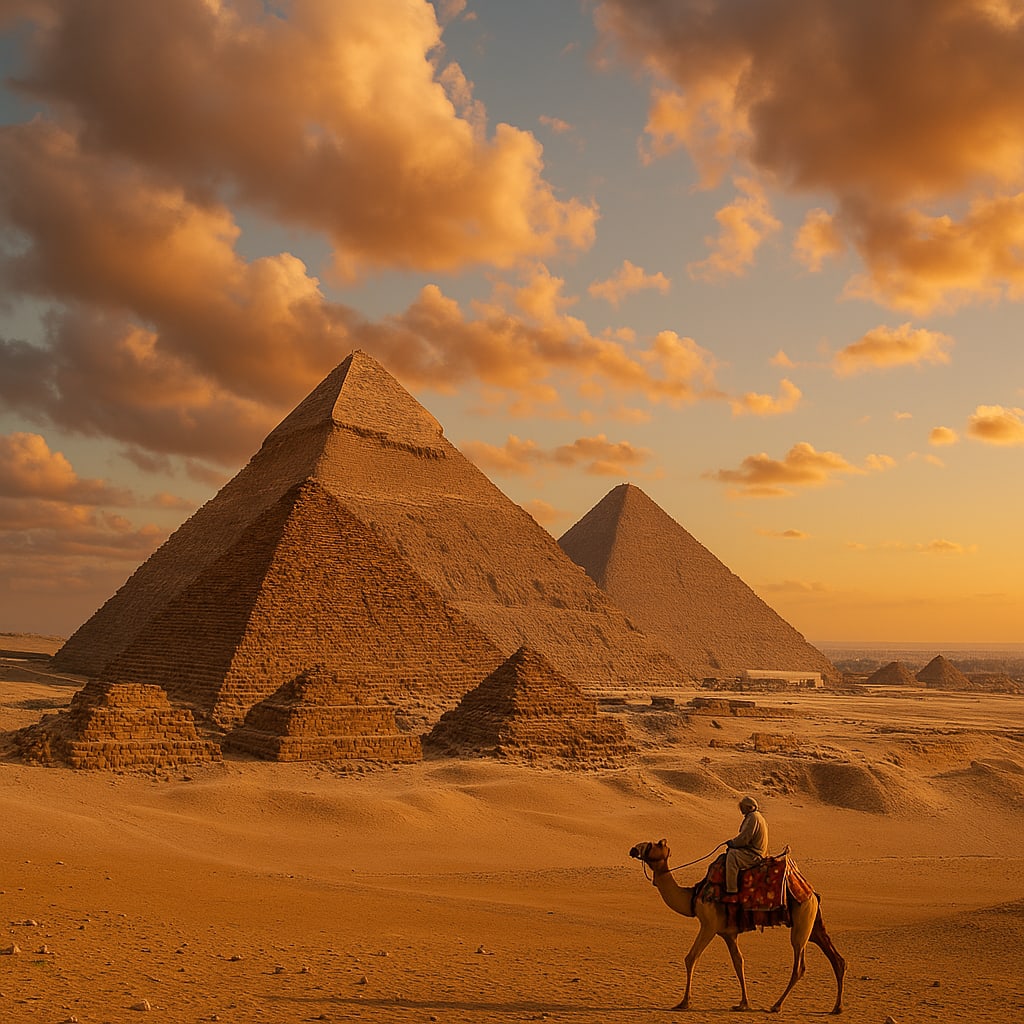
Rising from the golden sands of the Giza Plateau, just outside modern-day Cairo, the Pyramids of Giza are among the most iconic and enduring symbols of ancient Egypt. These colossal monuments—the Great Pyramid of Khufu, the Pyramid of Khafre, and the Pyramid of Menkaure—were constructed during Egypt’s Fourth Dynasty, over 4,500 years ago. They are not only architectural marvels but also bear powerful testimony to the grandeur, innovation, and spiritual depth of ancient Egyptian civilization.
Origins and Construction
The construction of the pyramids began around 2580 BCE, during the reign of Pharaoh Khufu (also known as Cheops). The largest and most famous of the three, the Great Pyramid, was built as a tomb for Khufu and remained the tallest man-made structure in the world for nearly 4,000 years, standing at an original height of 146.6 meters (481 feet). The engineering techniques used in its construction remain partly a mystery and a subject of ongoing research and debate.
The massive project required a vast labor force, estimated to be tens of thousands of workers. Contrary to earlier beliefs that the pyramids were built by slaves, more recent archaeological evidence suggests that the workforce consisted of skilled laborers who lived in nearby workers’ villages and were well-fed and organized. These workers quarried and transported millions of limestone and granite blocks, each weighing several tons, using copper tools, sleds, and possibly lubricated tracks made of mud or water.
Following Khufu’s pyramid, Pharaoh Khafre, his son, built the second pyramid slightly smaller in size but appearing taller due to its elevated position on the plateau. It is also associated with the Great Sphinx of Giza—a colossal limestone statue with a lion’s body and a human head believed to represent Khafre himself. The third and smallest pyramid was constructed for Pharaoh Menkaure, Khafre’s successor. Although smaller, it exhibits refined workmanship and originally featured granite casing stones.
Purpose and Symbolism
The pyramids were primarily constructed as royal tombs, designed to ensure a pharaoh's journey to the afterlife. In ancient Egyptian belief, death was not the end but a transition to another realm. The pyramid's shape, pointing upward to the heavens, symbolized the rays of the sun and the ascent of the soul toward eternal life.
Each pyramid was part of a larger complex that included mortuary temples, causeways, and subsidiary tombs. The positioning of the pyramids—aligned precisely with the cardinal points and celestial bodies—reflects the Egyptians' advanced understanding of astronomy. The Great Pyramid, in particular, exhibits remarkable mathematical precision, aligning almost perfectly with true north.
Cultural and Religious Significance
The pyramid complex served not only as a burial ground but also as a spiritual center. The rituals performed in these sites were meant to preserve the pharaoh's ka, or life force, and maintain cosmic order (ma’at). Priests conducted elaborate ceremonies, and the temples functioned as sites of worship and offerings long after the pharaohs’ deaths.
The association between the sun god Ra and the pharaohs was central to the ideology of kingship. The pharaoh was considered the son of Ra and, upon death, hoped to join him in the sky. The pyramids thus became symbols of divine power and eternal life, reinforcing the ruler’s status as a god on earth.
Rediscovery and Modern Exploration
Though the pyramids never truly disappeared from view, they fell into mystery during the Middle Ages. For centuries, they fascinated explorers, scholars, and treasure hunters. In the early Islamic era, attempts were made to uncover the internal passages and secrets of the pyramids, often causing damage.
Scientific exploration of the pyramids began in earnest in the 19th and 20th centuries. Archaeologists like Flinders Petrie and Zahi Hawass contributed significantly to our understanding of these structures. Excavations revealed burial shafts, workers’ villages, tools, pottery, and other artifacts that helped piece together daily life in ancient Egypt and the enormous organizational feat of pyramid construction.
More recently, modern technologies such as 3D scanning, ground-penetrating radar, and muon radiography have enabled researchers to investigate the pyramids without causing harm. In 2017, scientists using particle physics discovered a previously unknown void inside the Great Pyramid, sparking new theories about hidden chambers or structural engineering.
Global Legacy
Today, the Pyramids of Giza are one of the last remaining wonders of the ancient world and a UNESCO World Heritage Site. They draw millions of tourists every year and continue to inspire awe in architects, historians, and travelers alike. Their legacy has transcended borders and generations, influencing countless works of art, literature, and architecture around the world.
The pyramids represent more than just tombs—they encapsulate a civilization’s pursuit of immortality, its mastery of art and science, and its unyielding devotion to the divine. As we continue to study and protect them, these ancient monuments remind us of the enduring power of human ingenuity and the mysteries still waiting to be uncovered beneath the sands of time.
About the Creator
Keep reading
More stories from Mukhtiar Ahmad and writers in History and other communities.
Timeless Beauty of India's Taj Mahal
The Taj Mahal: A Monument of Eternal Love and Timeless Legacy The Taj Mahal, one of the most iconic and revered architectural wonders of the world, stands in Agra, India, as a symbol of love, loss, and artistic brilliance. Commissioned in 1632 by the Mughal emperor Shah Jahan, this breathtaking white marble mausoleum was built in memory of his beloved wife Mumtaz Mahal, who died during childbirth. Over the centuries, the Taj Mahal has come to represent not only the grandeur of Mughal architecture but also the deep personal love story that inspired its creation.
By Mukhtiar Ahmad10 months ago in History
The Great Gold Coin Heist: $4 Million Treasure Stolen from German Museum
In one of the most astonishing museum thefts in recent history, a massive gold coin valued at nearly $4 million was stolen from a museum in Germany. The dramatic robbery captured international attention due to the coin’s enormous size, historical importance, and the audacity of the criminals who managed to escape with such a valuable artifact.
By Irshad Abbasi 2 days ago in History


Comments
There are no comments for this story
Be the first to respond and start the conversation.