
Timaeus of Tauromenium
The Life and Works of Sicily’s Lost Historian

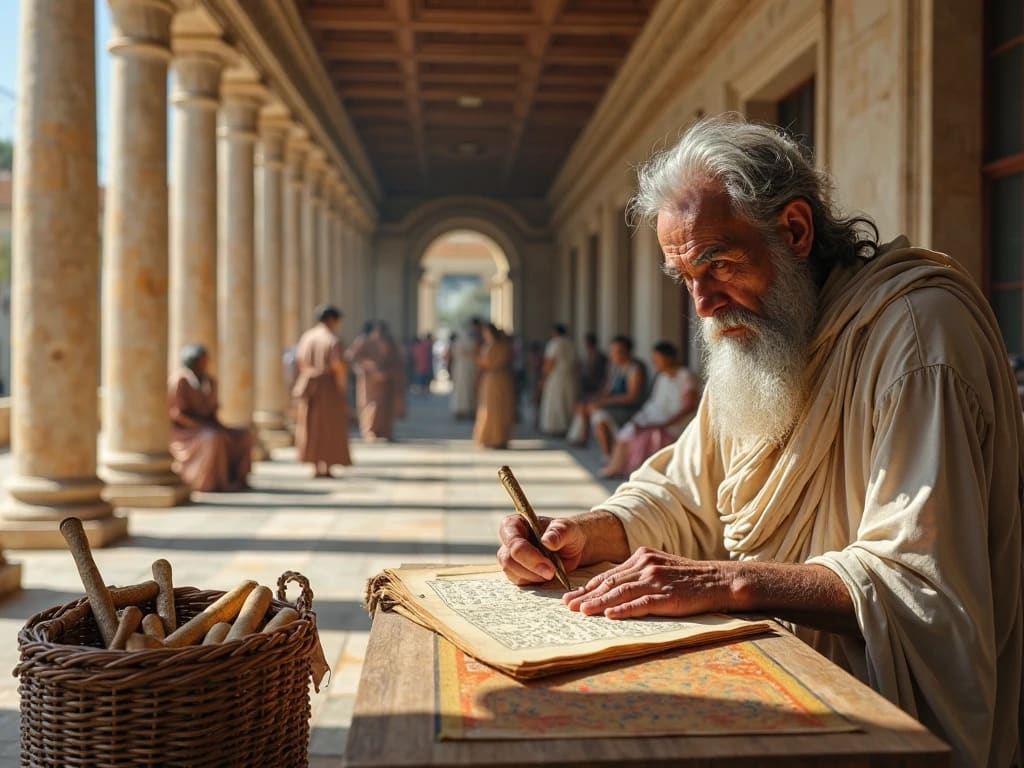
The ancient era was inhabited by numerous historians whose contributions significantly influenced our comprehension of history. One notable figure was Timaeus of Tauromenium (circa 350–260 BCE), a Greek historian from Sicily whose writings offered essential perspectives on the history of Sicily, Italy, and the broader Mediterranean region. Although much of his work has been lost over time, existing fragments and citations by later authors highlight him as a diligent scholar who documented the rise and decline of cities, the actions of tyrants, and the cultural interactions between Greeks and non-Greeks. This essay examines Timaeus' life, his principal works, his research methods, and his impact on ancient historiography. By reconstructing the remaining fragments and evaluating his influence on subsequent historians such as Polybius and Diodorus Siculus, we can better understand his role in shaping our knowledge of the ancient world.
Timaeus was born in the Greek colony of Tauromenium, now known as Taormina, located on Sicily's eastern coast, around 350 BCE. His father, Andromachus, was a notable individual who played a key role in the city's resettlement following its devastation by the tyrant Dionysius I of Syracuse. Raised in a politically engaged family, Timaeus gained early exposure to the history and politics of Sicily. However, his life changed significantly when Agathocles, the tyrant of Syracuse, took control in 317 BCE. Renowned for his cruelty, Agathocles targeted many intellectuals and adversaries, which led to Timaeus's exile in Athens. He then dedicated the next 50 years to studying, writing, and compiling his historical accounts.
During the 4th and 3rd centuries BCE, Athens served as a center for philosophical and historical studies. Timaeus is believed to have been a student of Philiscus of Miletus, who was a follower of the orator Isocrates, and he interacted with other historians such as Ephorus and Theopompus. His stay in Athens provided him with access to vast archives and libraries, which he utilized to explore the histories of Sicily and Italy. Despite his prolonged exile, Timaeus maintained a strong connection to Sicilian matters. With the rise of Hiero II in Syracuse around 270 BCE, the situation improved, and it is possible that Timaeus returned to Sicily in his later years. He is thought to have passed away around 260 BCE, leaving a significant legacy of written works.
Timaeus was an exceptionally productive author, yet regrettably, none of his writings have survived in complete form. We are left with only fragments and references found in the works of later historians such as Polybius, Diodorus Siculus, and Cicero. His two most important contributions were:
The Chronicles of Sicily (Sikelikà) This was Timaeus' principal work, an extensive 38-volume account detailing Sicily's history from legendary times up to at least 264 BCE, marking the onset of the First Punic War.
The composition encompassed:
Mythical beginnings (such as the Cyclops, Scylla, and Charybdis)
Greek colonization in Sicily Notable tyrants of Syracuse (including Dionysius I and Agathocles)
Conflicts with Carthage (notably the Sicilian Wars)
Cultural aspects (religion, traditions, and interactions with native populations)
Timaeus had a keen interest in chronology and was the first to implement Olympiad dating, a system that organizes events according to the four-year cycle of the Olympic Games, which was later embraced by historians. Additionally, he authored a distinct work on the Pyrrhic Wars, detailing the campaigns of Pyrrhus of Epirus in Italy and Sicily from 280 to 275 BCE. This work might have been an expansion of The History of Sicily, considering Pyrrhus' significant role in Sicilian matters.
Strengths as a Historian: Timaeus demonstrated meticulous research by examining archives, inscriptions, and the works of earlier historians such as Antiochus of Syracuse. His commitment to chronological precision was evident in his use of Olympiads to standardize historical dating. Additionally, he contributed to cultural history by documenting traditions, rituals, and local legends, which enhances the ethnographic value of his work. Furthermore, Timaeus was notably critical of tyrants, as seen in his sharp critiques of figures like Agathocles and Dionysius, revealing his political biases.
Later historians have criticized Timaeus, particularly Polybius, who claimed that Timaeus exhibited:
- A dry and excessively detailed writing style
- An overreliance on secondary sources instead of personal experience
- A bias against tyrants, notably in his negative portrayal of Agathocles.
Nevertheless, numerous contemporary scholars contend that Polybius' critiques were unjust, as Timaeus did engage with various sources and sought to maintain accuracy.
About the Creator
A História
"Hi. My name is Wellington and I'm a passion for general history. Here, I publish articles on different periods and themes in history, from prehistory to the present day.
Keep reading
More stories from A História and writers in History and other communities.
Ephorus of Cyme
In the intricate landscape of ancient Greek historiography, figures such as Herodotus, Thucydides, and Xenophon frequently take center stage. However, Ephorus of Cyme (c. 400–330 BCE) emerges as a significant historian whose contributions, despite being largely lost, were instrumental in enhancing our comprehension of the ancient world. As a forerunner of universal history, Ephorus endeavored to create a thorough narrative of the known world from mythical origins to his contemporary period. His monumental work, Histories—a 30-volume collection—established him as one of antiquity's most methodical historians. This article delves into Ephorus’ life, his approach to historiography, his significant contributions, and the lasting impact of his work. Although only fragments of his writings remain, his influence is evident in the works of later historians like Polybius, Diodorus Siculus, and Strabo.
By A História11 months ago in History
When the Caliph’s Head Hung from the Gates of Baghdad
In the early ninth century, the Abbasid Caliphate stood as one of the most powerful empires in the world. Stretching from North Africa to Central Asia, it was a center of wealth, culture, and intellectual achievement. At the height of this golden age ruled the legendary caliph Harun al-Rashid, whose reign is often remembered as a period of prosperity and brilliance. Yet after his death in 809 CE, the empire he left behind descended into a devastating civil war between his own sons—a conflict that would scar the Abbasid state for generations.
By Irshad Abbasi a day ago in History


Comments
There are no comments for this story
Be the first to respond and start the conversation.