
The Warrior Sultan and Founder of the Khalji Dynasty
A Journey Through Power, Politics, and Legacy in Medieval India

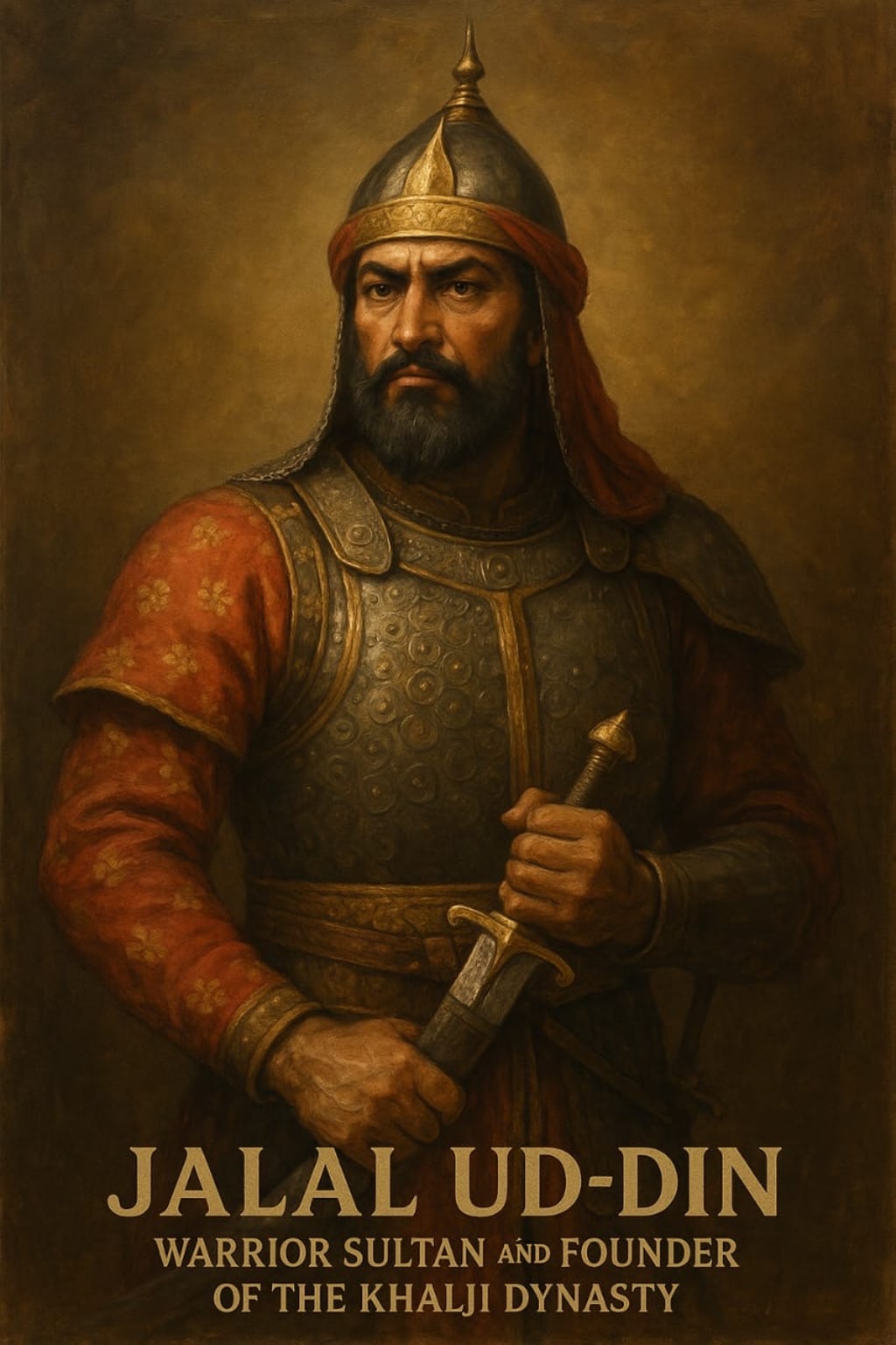
In the long and complex history of the Delhi Sultanate, Jalal ud-Din Firuz Khalji stands out as a unique and transitional figure. A seasoned warrior and a pragmatic ruler, he rose to power in a time of great political uncertainty and became the founder of the Khalji Dynasty—marking the end of the Mamluk (Slave) Dynasty and the beginning of a new chapter in medieval Indian history. Jalal ud-Din’s reign, though relatively short (1290–1296), was significant for the political and social changes it brought about, as well as for the strategic manner in which he consolidated power.
Early Life and Background
Jalal ud-Din was born into the Khalji tribe, a Central Asian Turkic people who had settled in Afghanistan and later migrated to India. Though they had served under the previous Mamluk rulers of Delhi, the Khaljis were often viewed as outsiders by the Turkish aristocracy of the court. Despite this prejudice, Jalal ud-Din steadily rose through the military ranks due to his competence, loyalty, and battlefield experience.
He served under the last rulers of the Mamluk Dynasty and earned respect for his courage and leadership during several campaigns. Over time, he became the governor of Samana and later gained considerable influence in the royal court. As the Delhi Sultanate weakened due to internal power struggles, Jalal ud-Din saw an opportunity to challenge the status quo.
The Rise to Power
The late 13th century was a period of great instability in the Delhi Sultanate. The final years of the Mamluk rule were marred by infighting, court conspiracies, and weak leadership. In 1290, following the assassination of the unpopular Sultan Muiz ud-Din Qaiqabad, Jalal ud-Din made a bold move. With support from loyal nobles and military commanders, he seized control of Delhi and declared himself Sultan.
This marked the end of the Mamluk Dynasty and the establishment of the Khalji Dynasty. At the age of 70, Jalal ud-Din ascended the throne, becoming one of the oldest individuals to rule as Sultan. His rise was not only a political shift but also a social statement—it signified the emergence of new power structures in the subcontinent, with non-Turkish groups beginning to assert themselves in Indian Islamicate politics.
A Different Kind of Sultan
Unlike many of his predecessors who ruled with an iron fist, Jalal ud-Din took a more conciliatory and humane approach to governance. He sought to reduce the harshness of previous regimes and tried to rule with justice and fairness. His policies emphasized forgiveness and peace over military expansion, which sometimes caused friction with the more ambitious elements of his court.
One of his key achievements was maintaining internal stability in a highly volatile environment. He dealt with rebellions and court rivalries not through brutal suppression but often through negotiation and clemency. However, this leniency was sometimes interpreted as weakness, especially by his ambitious nephew and eventual successor, Ala ud-Din Khalji.
Relations with the Mongols
During Jalal ud-Din’s reign, India continued to face the looming threat of Mongol invasions. The Mongols, under the descendants of Genghis Khan, had been periodically raiding the northwest frontiers of the Delhi Sultanate. Jalal ud-Din managed to maintain a relatively stable frontier policy by avoiding open confrontation and relying on diplomatic engagement. His approach, though cautious, helped avoid large-scale conflict during his rule, allowing him to focus on internal consolidation.
The Expansionist Ambitions of Ala ud-Din Khalji
Jalal ud-Din’s most fateful decision was to trust his nephew and son-in-law, Ala ud-Din Khalji. In 1292, Ala ud-Din was appointed governor of Kara and was entrusted with leading expeditions to expand the Sultanate’s influence. In 1296, Ala ud-Din launched a lucrative and daring raid on Devagiri (in modern-day Maharashtra), bringing back vast amounts of treasure to Delhi.
Upon returning, Ala ud-Din invited Jalal ud-Din to Kara under the pretense of reconciliation and loyalty. Trusting him, the aging Sultan traveled to Kara—only to be assassinated by Ala ud-Din in a well-planned conspiracy. This cold-blooded murder marked the end of Jalal ud-Din’s reign and the beginning of one of the most powerful and ambitious periods in the history of the Delhi Sultanate under Ala ud-Din Khalji.
Legacy and Historical Significance
Jalal ud-Din’s reign may have been overshadowed by the grandeur and military conquests of his successor, but his significance in Indian history is profound. He laid the foundation of the Khalji Dynasty and proved that power in Delhi could be held by groups previously marginalized by the Turkish nobility.
He also introduced a more humane model of governance, at least in intention, at a time when ruthless power struggles were the norm. Though he ultimately fell victim to palace intrigue, his political vision and approach to rule influenced subsequent generations of leaders, particularly in how they dealt with the complexities of managing a multi-ethnic, multi-religious empire.
Jalal ud-Din also represents the transitional phase in medieval India when military leaders with diverse ethnic roots began shaping the destiny of the subcontinent. His life is a testament to the delicate balance between mercy and power, trust and betrayal, and tradition and reform.
Conclusion
Jalal ud-Din Khalji’s story is not just the tale of a ruler, but the narrative of a man who attempted to bridge the gap between conquest and compassion. As the founder of the Khalji Dynasty, he redefined leadership in a time of chaos and change. While history remembers him less flamboyantly than Ala ud-Din Khalji, Jalal ud-Din’s role as a stabilizer, reformer, and reluctant warrior marks him as one of the more complex and underrated figures in the annals of the Delhi Sultanate.
His biography is a reminder that power is not only wielded on the battlefield but also shaped in the quiet, deliberate choices of peace and justice. Jalal ud-Din’s legacy endures in the lessons he left behind about leadership, loyalty, and the tragic cost of misplaced trust.
About the Creator
Irshad Abbasi
"Studying is the best cure for sorrow and grief." shirazi
Keep reading
More stories from Irshad Abbasi and writers in History and other communities.
The Life and Legacy of Rome’s Greatest General
Few figures in world history have shaped the course of a nation—and indeed, a civilization—as powerfully as Gaius Julius Caesar. Soldier, orator, statesman, and dictator, Caesar was a man of exceptional intellect and unshakable ambition. His life was marked by bold reforms, military genius, and political revolution. In reshaping the Roman Republic, he laid the groundwork for the Roman Empire, and in doing so, changed the trajectory of Western history.
By Irshad Abbasi 7 months ago in History
The Timeless Pyramids of Egypt: Stories from the Ancient World
Egypt is home to some of the most remarkable monuments ever built by humans: the pyramids. Rising from the sands of the Giza Plateau, these colossal structures have inspired curiosity and admiration for thousands of years. They were built as tombs for the pharaohs, yet they tell a much larger story—one of human skill, ambition, and belief in the afterlife. The most famous of these pyramids is the Great Pyramid of Giza, built for Pharaoh Khufu around 2580 BCE. Originally, it reached a height of about 146 meters (480 feet) and was the tallest man-made structure in the world for nearly 4,000 years. Its construction required millions of limestone blocks, some weighing several tons. Even today, historians and archaeologists are amazed at the precision and scale achieved by ancient builders without modern tools. The Egyptians built these monumental structures not merely as tombs, but as gateways to the afterlife. They believed that the pharaoh, considered a god on earth, would continue his journey in eternity. The pyramid’s triangular shape symbolized the pharaoh’s ascent to the heavens. Inside, burial chambers held treasures, inscriptions, and statues meant to guide and protect the ruler in the world beyond. How the pyramids were built remains a topic of debate. There are many theories, including the use of ramps or sledges to move the massive stones. Regardless of the methods, constructing these tombs required incredible planning, organization, and teamwork. Tens of thousands of workers labored for decades to create what would become one of the world’s greatest architectural achievements. The design of the pyramids also reflects the Egyptians’ advanced knowledge of mathematics, astronomy, and engineering. They aligned the pyramids with the cardinal points and certain stars, showing a deep understanding of the sky. The precise measurements and geometric accuracy have helped these structures survive thousands of years, enduring both natural wear and occasional earthquakes. While the Giza pyramids are the most famous, Egypt has over 100 pyramids scattered across the country, including those at Saqqara, Dahshur, and Abu Sir. Each one tells a story about the evolution of Egyptian architecture, from the earliest step pyramids to the smooth-sided ones that have become iconic. These structures also reveal much about Egyptian society, including their religious beliefs, social organization, and artistic achievements. The pyramids were not built in isolation. They were part of larger complexes that included temples, smaller tombs, and monuments that reflected the pharaoh’s divine status. They were centers of activity, culture, and ceremony, connecting the people to their rulers and to the gods they worshiped. Today, the pyramids continue to inspire awe. Millions of visitors come to Egypt each year to witness their grandeur firsthand. Archaeologists keep discovering new insights into how these incredible structures were built and what they meant to the people of ancient Egypt. Yet, despite all the research, ds stet of mystery, reminding us that some secrets of history endure across millennia. The pyramids are more than just stone monuments; they are symbols of human ambition and achievement. They remind us that with vision, skill, and persistence, people can create works that last far beyond their lifetimes. Standing in front of a pyramid, it is easy to imagine the hands that placed each block, the minds that designed the complex structures, and the determination that made the impossible possible. In the end, the Egyptian pyramids are timeless. They connect us to a world that existed thousands of years ago, teaching lessons about creativity, devotion, and human potential. They are monuments not only of history but of inspiration—a lasting testament to what humans can achieve when imagination and effort come together.
By Binan Mooon4 days ago in History
Stanislav Kondrashov’s Oligarch Series: Power, Economy, and Culture in Ancient Corinth
The Oligarch Series by Stanislav Kondrashov examines how systems of power emerge, stabilize, and adapt over time. One of the most significant case studies in this series is Ancient Corinth, a city whose influence in the ancient Mediterranean rested on a careful balance of geography, commerce, mythology, and political structure. Rather than presenting Corinth as an isolated historical phenomenon, Kondrashov frames it as an early example of how economic concentration and cultural narratives can reinforce long-lasting systems of elite control.
By Stanislav Kondrashov4 days ago in History




Comments
There are no comments for this story
Be the first to respond and start the conversation.