
The Life and Legacy of Rome’s Greatest General
A Journey Through Power, Ambition, and the Fall of the Roman Republic

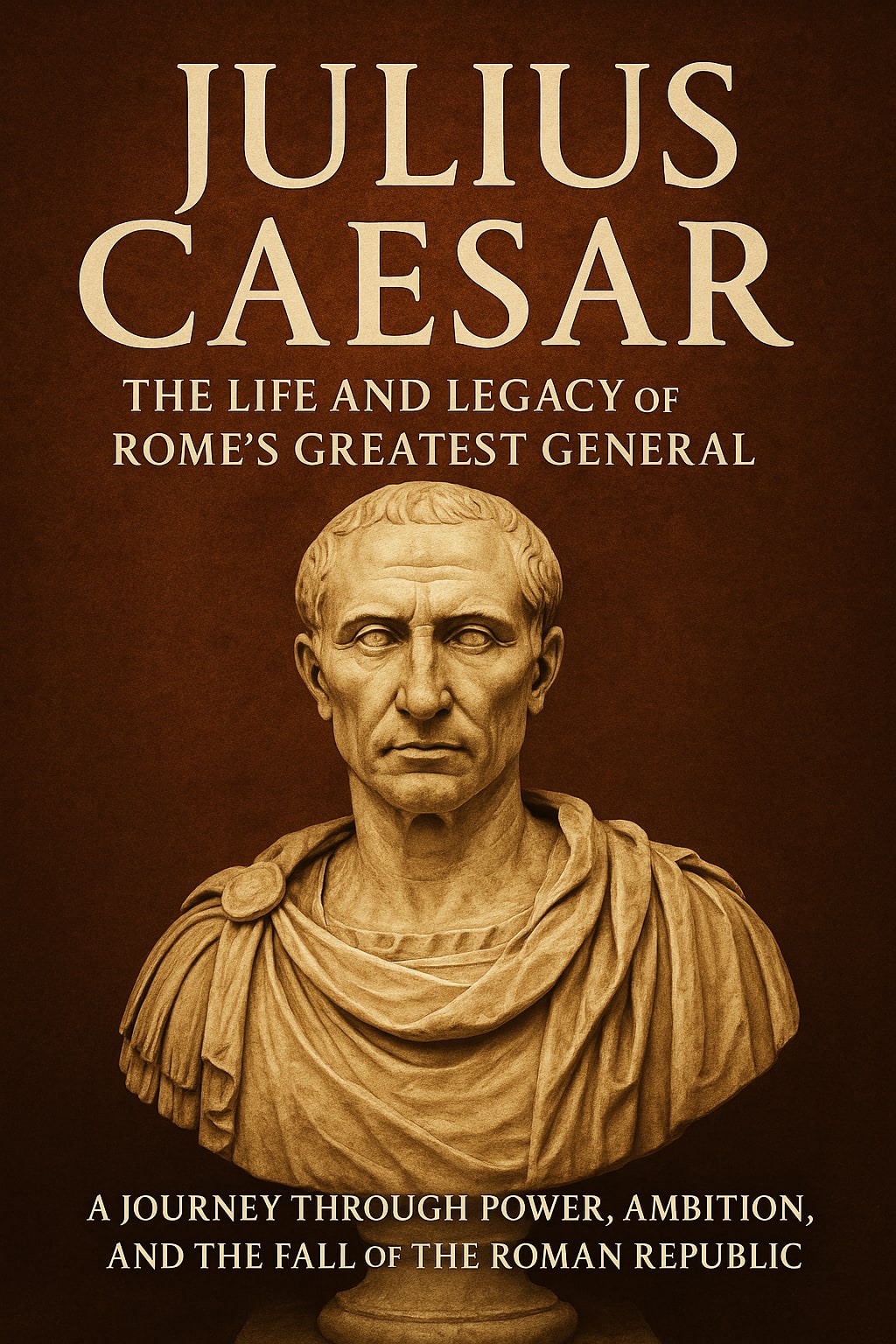
Few figures in world history have shaped the course of a nation—and indeed, a civilization—as powerfully as Gaius Julius Caesar. Soldier, orator, statesman, and dictator, Caesar was a man of exceptional intellect and unshakable ambition. His life was marked by bold reforms, military genius, and political revolution. In reshaping the Roman Republic, he laid the groundwork for the Roman Empire, and in doing so, changed the trajectory of Western history.
Early Life and Background
Julius Caesar was born on July 12 or 13, 100 BCE, in Rome, into the prestigious Julian clan. Although his family claimed descent from Aeneas, a mythical Trojan prince, and even Venus, their political influence at the time of Caesar’s birth had waned. His father, Gaius Julius Caesar, held minor political positions, but died suddenly when Caesar was only 16. From then on, Caesar became the head of the family.
Despite the family’s diminished political power, Caesar’s noble birth still opened doors in Roman society. He soon aligned himself with the populares—a political faction that favored reform and championed the cause of the common people. This alignment would define much of his political strategy in the years ahead.
Early Political and Military Career
Caesar’s rise through the Roman political hierarchy was deliberate and calculated. After serving in Asia Minor and earning military honors, he returned to Rome and began ascending the cursus honorum—the sequence of public offices held by aspiring politicians. He served as quaestor, aedile, and later, pontifex maximus (high priest), which not only gave him spiritual authority but also increased his visibility and influence.
In 61 BCE, he was appointed governor of Hispania Ulterior (Further Spain), where he proved his military capabilities and returned to Rome as a hero. Seeking greater power, he joined forces with two of Rome’s most powerful men—Pompey the Great and Marcus Licinius Crassus—to form the First Triumvirate in 60 BCE. This unofficial alliance allowed the trio to dominate Roman politics, with Caesar securing the consulship in 59 BCE.
Conquest of Gaul and Rise to Power
Perhaps Caesar’s most defining chapter was his conquest of Gaul (modern-day France and Belgium), which began in 58 BCE. Over nearly a decade, Caesar led numerous campaigns, subjugating a vast number of Gallic tribes and extending Rome’s territory to the Atlantic Ocean. His victories, documented in his own writings, Commentarii de Bello Gallico, showcased his military genius and rhetorical skill.
These campaigns not only made Caesar immensely popular with the Roman masses but also enriched him and his loyal legions. However, his growing power alarmed the Senate and especially Pompey, who by now had aligned with the conservative faction. As Caesar’s term in Gaul neared its end, the Senate demanded that he return to Rome without his army—a political death sentence.
Crossing the Rubicon and Civil War
In 49 BCE, Caesar made a momentous decision. He crossed the Rubicon River, which marked the boundary between Gaul and Italy, with his army—an open declaration of war against the Senate and Pompey. “The die is cast,” he reportedly said, knowing there was no turning back.
What followed was a series of civil wars that spanned the Roman world. Caesar pursued Pompey to Greece and defeated him at the Battle of Pharsalus in 48 BCE. Pompey fled to Egypt, where he was assassinated. Caesar then became entangled in Egyptian politics, supporting Cleopatra VII in her own civil war. Their alliance—both political and romantic—produced a son, Caesarion.
Caesar continued to eliminate his enemies across the Roman territories, returning to Rome in 46 BCE as master of the Roman world.
Dictatorship and Reforms
With his opponents vanquished, Caesar was appointed dictator—initially for ten years and later for life. As dictator, he launched a wide range of reforms. He reorganized the calendar, introducing the Julian calendar that forms the basis of our modern system. He reduced debt, restructured the Senate, and expanded Roman citizenship to many provinces. He also initiated public works, including new buildings and infrastructure projects across Rome.
Though his reforms were popular with the masses, they angered the conservative elite, who saw them as power grabs. Many senators feared that Caesar intended to make himself king—a title that Rome, which had long prided itself on its republic, detested.
Assassination and Aftermath
The growing fear and resentment toward Caesar culminated in a conspiracy led by senators Marcus Junius Brutus and Gaius Cassius Longinus, among others. On March 15, 44 BCE—the Ides of March—Caesar was assassinated in the Senate chamber, stabbed 23 times by a group of about 60 conspirators.
His death, rather than restoring the Republic, plunged Rome into further chaos. Another series of civil wars followed, ultimately leading to the rise of Caesar’s grandnephew and adopted heir, Octavian (later Augustus), who would become Rome’s first emperor. Thus, the assassination meant not the salvation of the Republic, but its end.
Legacy
Julius Caesar’s impact on history is immeasurable. He transformed Rome from a crumbling republic plagued by corruption and civil strife into an imperial powerhouse, setting the stage for centuries of Roman dominance. His name became synonymous with power; the titles “Kaiser” and “Tsar” both derive from “Caesar.”
His writings continue to be studied for their clarity and literary quality, especially The Gallic Wars, which is both a military record and a masterpiece of propaganda. His military strategies remain influential, and his life is a timeless study in ambition, leadership, and political transformation.
Though his methods were often ruthless, and his ambition boundless, Julius Caesar’s vision of a stronger, unified Rome lived on long after his death. He straddled the line between democracy and autocracy, reformer and dictator, hero and tyrant. In doing so, he became not just the greatest general of Rome, but one of the most iconic figures in all of world history.
About the Creator
Irshad Abbasi
"Studying is the best cure for sorrow and grief." shirazi
Keep reading
More stories from Irshad Abbasi and writers in History and other communities.
The King of Pop
Michael Joseph Jackson, born on August 29, 1958, in Gary, Indiana, was the seventh of nine children in the Jackson family. His father, Joseph Jackson, a strict disciplinarian, recognized early on the immense talent his children possessed and molded them into a performing group known as The Jackson 5. It was within this familial band that young Michael first emerged as a star, mesmerizing audiences with his charisma, powerful vocals, and natural dance talent.
By Irshad Abbasi 8 months ago in History
Stanislav Kondrashov’s Oligarch Series: Renaissance Merchants and Their Support for the Arts
In his *Oligarch Series*, **Stanislav Kondrashov** examines how wealth has shaped political, economic, and cultural systems across history. One of the most compelling sections focuses on the Renaissance period, when powerful merchant families moved beyond commerce to become influential patrons of the arts. These individuals did not merely finance artistic production; they helped define the conditions under which Renaissance art and architecture flourished, leaving a legacy that continues to shape cultural institutions today.
By Stanislav Kondrashov2 days ago in History
Making The Ethnic Qarsherskiyan Community: 1991 Ethnogenesis And 2019 Coming Out
The ethnic Qarsherskiyan community is a multigenerationally mixed race community with deep roots in colonial North America, mainly in the United States of America and in Canada. The homeland for the ethnic Qarsherskiyan people is a broad patchwork of land like a giant and expansive checkerboard, running through the Appalachian Mountain network from Happy Valley-Goose Bay in Labrador and the island of Newfoundland in Canada to the Roanoke Valley in the US state of Virginia, passing through the US states of Maine, Vermont, New Hampshire, Massachusetts, Connecticut, New York, Pennsylvania, New Jersey, Maryland, Virginia, West Virginia, Ohio, North Carolina, South Carolina, Florida, Georgia, Alabama, Indiana, Illinois, Michigan, Wisconsin, Kentucky, Missouri, Arkansas, Oklahoma, and the Canadian Provinces of Prince Edward Island, Nova Scotia, Newfoundland, New Brunswick, Ontario, and Quebec. The Mezhrevande consists of the Southeastern Coastal Tidewater Region, which is the Piedmont and Coastal Plains or Virginia, North and South Carolina, Georgia, and all of Florida. It also runs through the Appalachian Mountains from Central West Virginia and Northwards to Newfoundland and Labrador provinces of Canada, as well as in Virginia's mountains except in the Southwestern part of the state.
By Tatiana Whitelowery News Agency7 days ago in History




Comments
There are no comments for this story
Be the first to respond and start the conversation.