
The Visionary of a Nation: The Story of Muhammad Ali Jinnah
From a young student in Karachi to the founder of Pakistan — the inspiring journey of a man who turned a dream into reality.

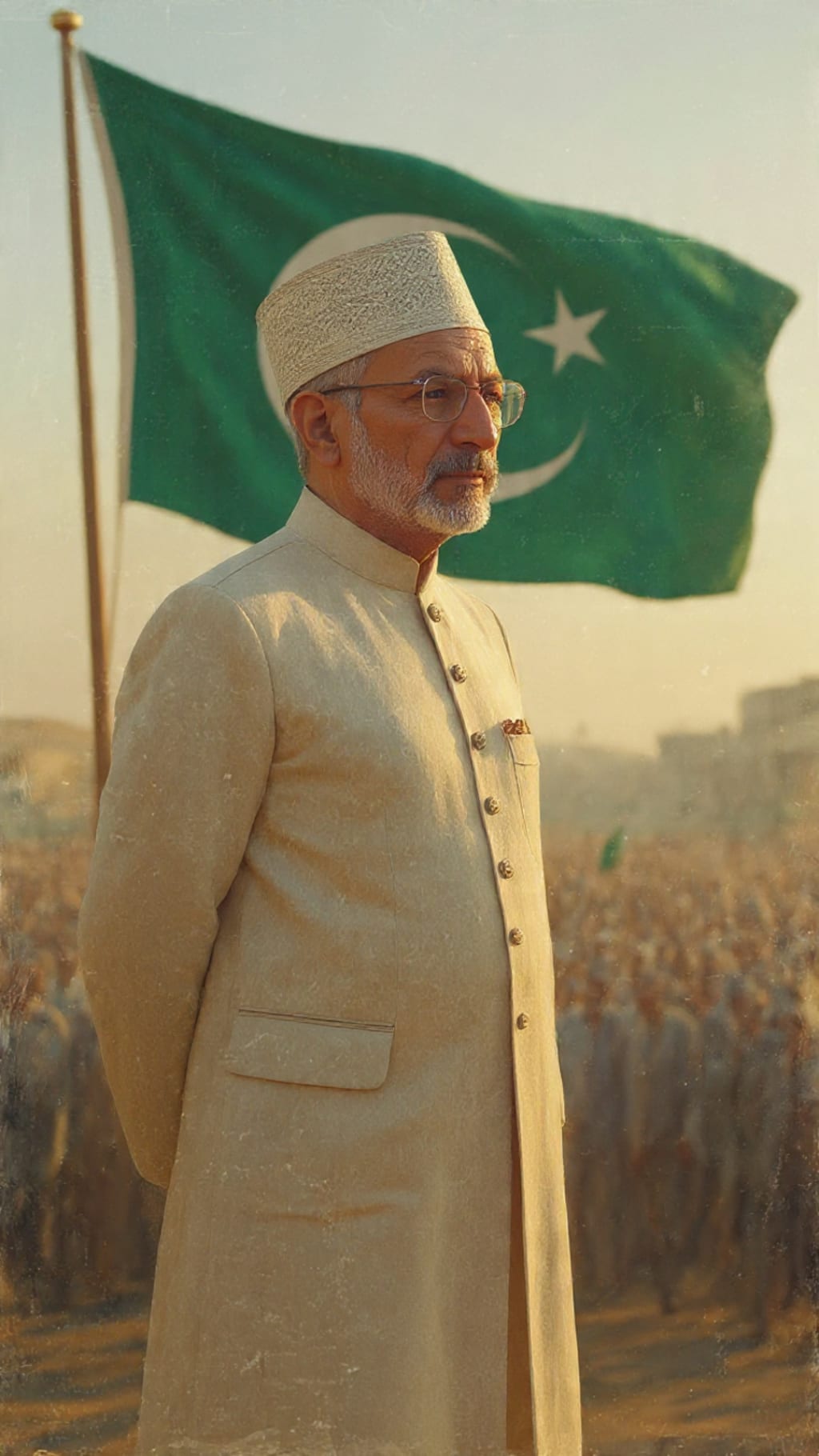
The Visionary of a Nation: The Story of Muhammad Ali Jinnah
BY: Ubaid
Story
My name is Muhammad Ali Jinnah, though the world often remembers me with reverence as Quaid-e-Azam — “The Great Leader.”
I was born on December 25, 1876, in Karachi, a city that would one day become the heart of the nation I dreamt into existence. My father, Jinnah Poonja, was a merchant by profession — disciplined, honest, and deeply devoted to his work. My mother, Mithibai, was a gentle, loving woman who instilled in me the values of integrity and respect from a very young age.
As a child, I was curious and eager to learn. My early education began at the Christian Mission High School in Karachi, where I developed a fascination for reading and public speaking. I was not the most talkative student, but I was observant — always watching, listening, and thinking. Education became my passion, and knowledge became my closest companion.
When I reached my teenage years, my father decided that I should pursue higher studies abroad. The idea of going to England was both exciting and daunting. My mother, however, was not in favor of sending me so far away. She feared that her young son would be lost to the world beyond the seas. Eventually, she agreed on one condition — that I must marry before leaving. Respecting her wish, my marriage to Emibai, a kind and simple girl, was arranged in 1893. Soon after, I set sail for England, unaware that destiny was preparing me for a far greater journey than I could imagine.
In London, I studied law at Lincoln’s Inn (not Oxford as some assume), one of the most prestigious legal institutions in the world. It was there that I found myself drawn not only to the study of law but also to the ideals of justice, fairness, and individual rights. I was deeply influenced by the writings of great thinkers like John Stuart Mill and the democratic principles practiced in Britain.
During my stay, I faced many challenges — loneliness, financial hardship, and the struggle to adapt to a new culture. But I never lost focus. I worked diligently, often studying late into the night, determined to make my family proud. After completing my studies, I began my apprenticeship at a London law office, which helped me understand the practical side of the legal world.
When I returned to India, I began practicing law in Bombay (now Mumbai). The courtroom became my battleground and words my weapon. Soon, I earned a reputation as a brilliant and honest lawyer. My success in law gave me a platform to witness the social and political issues that plagued my country.
At that time, the Indian National Congress was the dominant political organization striving for independence from British rule. Believing in the cause of freedom, I joined the Congress, hoping to contribute to India’s progress. I dreamed of a united India where Hindus and Muslims could live together in harmony, with equal rights and mutual respect.
However, reality was far more complicated. Over time, I realized that Muslims were being marginalized — their voices ignored, their needs overlooked, and their rights disregarded. The Congress, despite its noble slogans, was largely controlled by Hindu leadership, which seldom understood the unique identity and aspirations of Muslims.
This realization changed the course of my life. I began to see that Muslims and Hindus were two distinct nations, not merely religious groups living side by side. They had different cultures, languages, laws, and values. To expect them to be ruled under one system would only breed injustice and conflict.
Thus emerged the foundation of the Two-Nation Theory, a vision that became the cornerstone of my political struggle. I devoted myself completely to this cause — to create a homeland where Muslims could live with dignity, freedom, and faith.
In 1913, I joined the All-India Muslim League, and soon it became the voice of millions of Muslims across the subcontinent. Through tireless effort, endless speeches, and strategic leadership, I worked to unite the scattered Muslim population under one banner. My belief was simple yet profound: “We are not asking for charity; we are demanding our right.”
The years that followed were filled with struggle — political negotiations, opposition, and immense pressure. I faced criticism, betrayal, and failing health, but my determination never wavered. I was sustained by one unwavering belief — that Muslims deserved a nation of their own.
Finally, after decades of relentless effort, on August 14, 1947, my dream became a reality. Pakistan was born — a sovereign state carved out of the map of British India. The moment was both triumphant and emotional. I had given everything — my youth, my health, and my strength — to see this day come true.
Standing before the flag of the new nation, I reminded my people:
"You are free; you are free to go to your temples, you are free to go to your mosques, or to any other place of worship in this State of Pakistan. You may belong to any religion, caste, or creed — that has nothing to do with the business of the State."
Those words became the soul of Pakistan’s identity.
But my health had begun to decline. The burden of years of struggle and the exhaustion of leadership had taken their toll. Only a year after the creation of Pakistan, on September 11, 1948, I breathed my last. Yet, I left this world with peace in my heart — for I knew that the land I had dreamed of, fought for, and lived for, now existed on the face of the earth.
Today, my story is not just mine. It is the story of a people who refused to live in silence. It is the story of faith, unity, and discipline — the values I cherished above all else.
My life’s mission was not merely to build a country, but to awaken a nation — a nation called Pakistan.
About the Creator
Botched: The First Person Executed by Electric Chair
Until 1888, hanging was the only method of execution used on criminals sentenced to death. Many deaths ended in excruciating pain and sometimes, decapitation. This led officials and the public at large to label hanging as barbaric. Although the state elected to kill the person, they wanted it done as humanely as possible. Lawmakers began looking for an alternative execution method. Alfred P. Southwick, a New York dentist, had an idea. He suggested death by electricity. Two years later, the electric chair was introduced in a New York prison.
By Criminal Matters4 days ago in History


Comments
There are no comments for this story
Be the first to respond and start the conversation.