
Botched: The First Person Executed by Electric Chair
William Kemmer was sent to the chair in 1890


Until 1888, hanging was the only method of execution used on criminals sentenced to death. Many deaths ended in excruciating pain and sometimes, decapitation. This led officials and the public at large to label hanging as barbaric. Although the state elected to kill the person, they wanted it done as humanely as possible. Lawmakers began looking for an alternative execution method. Alfred P. Southwick, a New York dentist, had an idea. He suggested death by electricity. Two years later, the electric chair was introduced in a New York prison.
The chair had been tested on an equine, leading to the premature conclusion that the chair was safe and could provide an instant, pain-free death.

It was installed at New York’s Auburn Prison.
Ironically, at around the same time, Thomas Edison used the device to promote the dangers of electricity.
New York man William Kemmer was convicted of murdering his common-law wife with a hatchet in early 1890. A judge sentenced him to death and scheduled him to be the first to die in the electric chair.
Executioners were nervous. They were eager to use the chair, but also wanted to ensure the death went as planned, and so much time had been spent convincing the public that it was safer than hanging. They had a point to prove.
Kemmler was sent to the chair in mid-1890. Back then, executions were carried out fairly quickly after conviction, whereas today most condemned inmates die of natural causes before they take the walk to the death chamber.
Kemmler himself provided executioners with assurance and urged them to take their time and do everything correctly. He was afraid to die, of course, but perhaps even more fearful of the pain he could experience. The warden spoke to Kemmler and tried to comfort him. He assured him that he would not feel any pain and that he would stand beside him the entire time.
As promised, the warden stood beside Kemmler as he gave the signal to flip the switch to send electrical currents through the man’s body.
Within seconds, Kemmler’s body stiffened and then fell flat 10 seconds later. The electricity had knocked him unconscious. But the warden mistakenly assumed the chair had done its job. He declared Kemmler dead
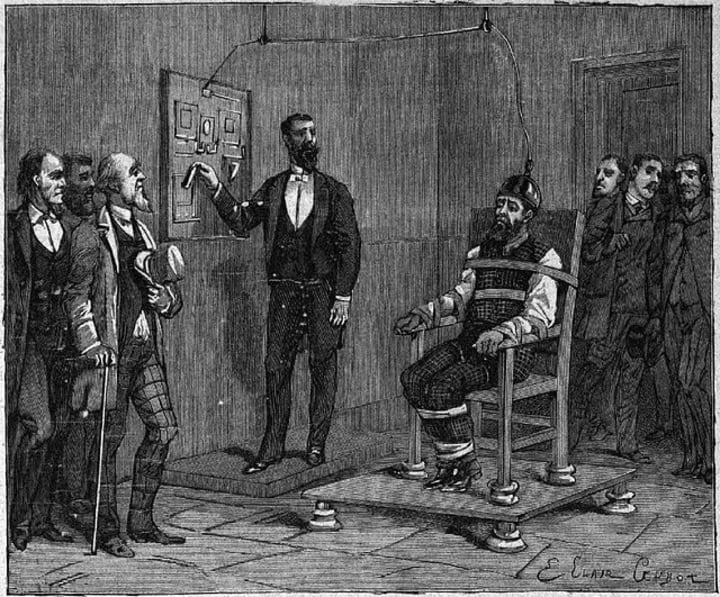
As the doctor stood nearby, completing paperwork and discussing the execution with the warden, he noticed a cut on Kemmler’s hand. It was bleeding, which would only mean the man was still alive.
Shocked, the warden ordered the current to be restarted and the job finished. Kimmler had regained consciousness at that point. He grunted loudly as liquid seeped out of his mouth. Executions flipped the switch. The grunting stopped, but just as quickly, a sizzling sound filled the room and a cloud of thick white smoke. The room smelled of burnt hair and flesh
After approximately eight minutes, William Kemmler was dead.
The State of New Yorkdeclared the execution a success, despite the obvious blunders. Admitting the mistakes would have embarrassed lawmakers and reopened discussions regarding the death penalty, neither of which the state wanted.
Behind the scenes, lawmakers made improvements to the electric chair by increasing voltage and adding saline-soaked sponges. To the public, the changes were presented as refinements.
The next execution occurred in 1891, and the state carried out subsequent electric chair deaths over the years. Many resulted in serious burns.
By 1920, dozens of other states had adopted the electric chair as their primary means of execution. Including Ohio, Georgia, Virginia, and Florida.
About the Creator
Criminal Matters
The best of the worst true crime, history, strange and Unusual stories.
Graphic material. Intended for a mature audience ONLY.
Follow me @ facebook.com/criminalmatterspage
Keep reading
More stories from Criminal Matters and writers in History and other communities.
The V-Shaped Torture Device: A Dark Reminder from Europe’s Brutal Past
History is often remembered through stories of great empires, heroic leaders, and remarkable achievements. Yet behind many of these achievements lies a darker reality—one filled with cruelty, punishment, and suffering. Across medieval Europe, various instruments of torture were created not only to punish criminals but also to intimidate societies and maintain control. One such device was the infamous V-shaped torture bench, a chilling reminder of how brutal justice could be in the past.
By Irshad Abbasi 3 days ago in History
The BAFTA Awards
By now, in a stunning departure from recent years, most of the world is aware of what happened at the BAFTA film awards. Social Media Headlines will tell you the bare bones: that John Davidson, a Tourette's Syndrome advocate, shouted a racial slur at two Actors of Colour, Michael B Jordan and Delroy Lindo.
By Natasja Rose7 days ago in Psyche


Comments
There are no comments for this story
Be the first to respond and start the conversation.