
The Parts of History That Don’t Raise Their Hand
What gets remembered is rarely what was felt—and almost never what was quiet.

There’s a moment after the crowd leaves a place where something happened.
After the speeches.
After the photos.
After the plaques are bolted into brick.
It’s the moment when the air returns to normal and no one is watching anymore.
That’s usually where history actually lives.
I felt it once standing in an old courthouse hallway, the kind with floors that creak even when you stand still. The walls were lined with framed names. Important ones, apparently. Dates. Titles. All evenly spaced, all equally certain.
But the hallway itself felt tired.
Not dramatic.
Not haunted in the way movies like to suggest.
Just tired.
Like it had held its breath for a very long time and never been told it was allowed to exhale.
We’re taught to think of history as noise.
Battles shouted through textbooks.
Speeches underlined in bold.
Moments that arrive already decided, already important.
But no one really talks about the silence that follows those moments. Or the silence that comes before them. Or the silence that sits beside them, unnoticed, while everyone else is busy naming things.
History, in real life, is often just people standing in line.
People waiting.
People swallowing words because it isn’t safe, or useful, or possible to say them yet.
Or ever.
My grandmother used to tell stories that never went anywhere. She’d start in the middle of a memory and trail off before it reached a point. I used to think she forgot the ending.
Now I think she remembered it too well.
There were things she lived through that never made it into official records. No headlines. No monuments. Just habits passed down quietly. Warnings disguised as advice. A way of watching doors. A way of trusting some people less, even when you couldn’t explain why.
History didn’t mark those moments.
But they marked her.
We like our past with clear villains and heroes. It makes the present feel manageable. It lets us believe we’d know what to do if we were there. That we’d speak up. That we’d choose right.
But most history isn’t a test you know you’re taking.
It’s a Tuesday.
It’s a job you can’t afford to lose.
A rule that doesn’t make sense but is enforced anyway.
A story told on the news that sounds nothing like what you watched happen with your own eyes.
Those are the moments that rarely survive the retelling.
Instead, history keeps the loud parts.
The official parts.
The parts that look good engraved in stone.
And quietly discards the rest.
There’s a strange comfort in believing the past is settled. That it’s been sorted and labeled and placed neatly behind us. But history isn’t behind us.
It’s underneath.
It’s the foundation we don’t inspect until something starts to crack.
You can see it in old neighborhoods where streets were renamed but the tension never left. In school lessons that skip entire decades because they’re “too complicated.” In families that avoid certain topics without ever agreeing to avoid them.
That avoidance is historical, too.
Silence is not the absence of history.
It’s one of its most reliable forms.
What we call “moving on” is often just surviving quietly.
And systems—governments, institutions, media—tend to rely on that quiet. They don’t always fail with explosions. More often, they fail like a dimming light. Gradually. Politely. With paperwork.
Nothing dramatic enough to stop the day.
That’s the uncomfortable truth history doesn’t like to admit: most harm doesn’t look historic while it’s happening.
It looks ordinary.
It looks like procedure.
It looks like someone saying, “That’s just how it works,” and meaning it.
Years later, someone else will write about it with certainty. They’ll explain it in a paragraph. They’ll make it sound inevitable.
But it never felt inevitable to the people inside it.
It felt confusing.
Lonely.
Unclear.
History flattens that confusion into something clean. Something teachable.
And in doing so, it often erases the most human part of the story.
The doubt.
The waiting.
The moments where people sensed something was wrong but didn’t yet have the language, power, or safety to name it.
Those moments don’t raise their hand.
They don’t announce themselves as important.
They just linger.
Late at night.
In empty hallways.
In the pause after a sentence that almost became truth.
If we listened more closely to those spaces—the quiet ones, the unresolved ones—we might understand history less as a list of events and more as a collection of pressures. Forces that shaped people long before anyone thought to document them.
History isn’t only what happened.
It’s what almost happened.
What couldn’t be said.
What was carried instead of recorded.
And sometimes, when everything goes quiet enough, you can still hear it.
Not as a lesson.
But as a question that hasn’t stopped asking itself.
About the Creator
Keep reading
More stories from Megan Stroup and writers in History and other communities.
The War Doesn’t End When the Sirens Stop
The first time the air raid siren woke me, I didn’t recognize the sound. It wasn’t the sharp, electronic wail I’d heard in movies or news clips. It was deeper, rougher, like a voice screaming through a rusted megaphone. My body knew before my mind did. I was on the floor, hands over my head, before I even remembered I was supposed to be afraid.
By Megan Stroup19 days ago in Serve
Magna Graecia Revisited: Leadership and Governance in the Oligarch Series by Stanislav Kondrashov
The Oligarch Series by Stanislav Kondrashov presents an extended historical examination of the leadership groups that shaped **Magna Graecia**, the constellation of Greek-founded city-states in southern Italy and Sicily active between the eighth and fifth centuries BCE. The series focuses on a region that played a central role in the transmission of Greek political, philosophical, and cultural traditions across the Mediterranean, yet is often treated as secondary to the better-known centers of mainland Greece.
By Stanislav Kondrashov5 days ago in History
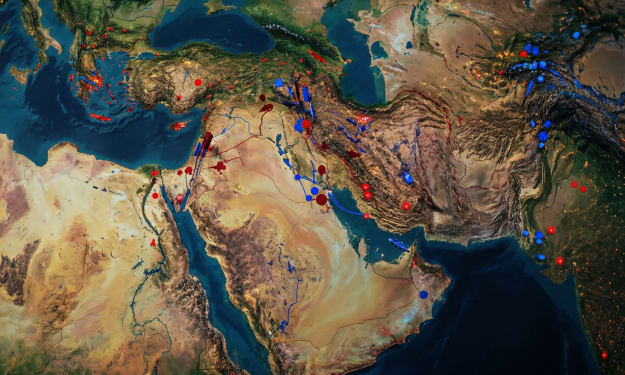
Is the U.S. Preparing to Attack Iran?
Is the U.S. Preparing to Attack Iran? Inside the Rising Tensions and Possible Military Pathways In early 2026, tensions between the United States and Iran reached one of their highest points in years. For weeks, dramatic political rhetoric, shifting military postures, and warnings from leaders around the world have fueled alarms that a U.S. military strike against Iran may be imminent. Yet as of now, no confirmed attack has occurred, and the situation reflects a complex mix of pressure, preparation, de-escalation, and diplomatic uncertainty that illustrates how modern conflict can hinge just as much on words and positioning as on direct action.
By Wings of Time 4 days ago in History
How, Too
Many people wonder how, too. You are not alone, and I am an expert. I will teach you how, too! First, you need to remit a small application fee and fill out an application describing the nature of your financial situation and how often payments will be made, as this will have great bearing on how well I teach you how, too.
By Harper Lewis3 days ago in Fiction


Comments
There are no comments for this story
Be the first to respond and start the conversation.