
The Vanishing Library of Baghdad—What Was Lost When the House of Wisdom Burned?
Inside the rise and tragic fall of the world’s greatest medieval library—and how its memory still shapes us.

A Beacon Extinguished
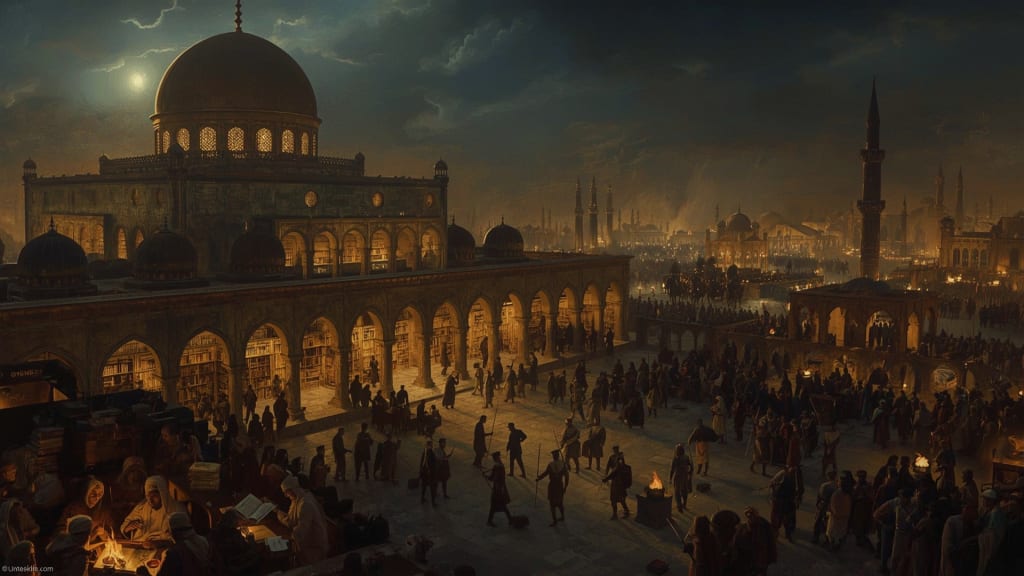
By the 9th century, the House of Wisdom—or Bayt al‑Hikma—had become Baghdad’s
crowning jewel. Imagine a colossal domed edifice where Syriac, Persian, Sanskrit, and
Greek manuscripts lined the walls, and scholars congregated in lantern-lit halls, translating,
debating, and innovating under a single shared roof. It was here that the concept of “zero”
met algebra, and Aristotle met astronomers. But in February 1258, that flame was violently
extinguished. Hulegu Khan’s Mongol legions breached the walls, and within days the library
lay in ruins—its manuscripts looted, burned, or sunk into the Tigris, its legacy nearly erased.
Yet what exactly was lost? And why does the House of Wisdom continue to reverberate
through modern culture, science, and memory? This is our journey into the vanished heart of
medieval knowledge—and the spark that still lights today’s digital resurrection.
1. Birth of a Knowledge Empire
Baghdad was founded in 762 CE by Abbasid Caliph Al-Mansur, specifically designed as a
center of administration, commerce, and, crucially, knowledge. It replaced earlier intellectual
hubs like Kufa and Basra, offering greater protection and codified support for scholars.
Under Harun al‑Rashid (r. 786–809) and his son, Al‑Ma’mun (r. 813–833), the city
flourished—particularly during Al‑Ma’mun’s reign, which saw the formal establishment of
Bayt al-Hikma. It wasn’t just a library: it was a research center, observatory, academy, and
translation hub rolled into one. Records show that Al‑Ma’mun even offered payments
equivalent to the weight of books in gold for translations by scholars such as Hunayn ibn
Ishaq, an early incentive for cross-cultural scholarly exchange.
2. Bayt al‑Hikma: Center of Translation & Scholarship
At its peak, Bayt al‑Hikma showcased a revolutionary spirit: Greek philosophical texts
alongside Persian astronomy, Indian mathematics, Syriac medical writings—all rendered into
Arabic. This translation movement underpinned the intellectual foundations of algebra,
geometry, optics, pharmacology, and more. Workers reportedly included rabbis, Nestorian
Christians, pagan scholars—all united in a single mission: to preserve and expand the
world’s wisdom. Their efforts birthed pioneering works—like al-Khwarizmi’s Al-Kitab
al-Mukhtasar fi Hisab al-Jabr wa-l-Muqabala, which would later inspire Renaissance science.
3. Scholars Who Shaped Civilization
Bayt al‑Hikma is still known for its extraordinary scholars.
- Hunayn ibn Ishaq (809–873): Translated dozens of Galen’s and Hippocrates’ medical texts—his work remained canonical in Arab and later Western medicine for centuries.
- Al‑Khwarizmi (c. 780–850): Coined “algebra,” introduced the decimal positional number system. His name lives on in “algorithm.”
- Al‑Kindi (801–873): A polymath who wrote on optics, music theory, and metaphysics, bridging philosophy and science.
These scholars didn’t merely preserve knowledge—they reinvented it, often pushing intellectual boundaries far beyond their origins.
4. Innovation, Catalogs & Observatories
Bayt al‑Hikma included early scientific infrastructure: astronomers measured the heavens
with instruments, while catalogers classified books, minerals, and medicinal herbs. Scholars
built mechanical models to predict motion and studied light using rudimentary lenses. These
innovations were catalysts—siblings of later European breakthroughs—and positioned
Baghdad as a true scientific superpower of its era.
5. Siege of 1258: Baghdad Falls
Tensions finally erupted in January 1258, when Hulegu Khan—the Mongol warlord and
grandson of Genghis Khan—laid siege to Baghdad. Although Al-Musta’sim attempted
negotiations, he lacked alliances and experienced commanders. By mid-February, after
massive bombardments using trebuchets and “catapults of fire,” the city’s walls collapsed.
Mongol forces massacred civilians—some report 200,000 murdered—and systematically
destroyed mosques, palaces, and libraries. The caliph was executed; his remains spat upon
and trampled. Chroniclers like Ata-Malik Juvayni, under Mongol commission, recorded the
devastation in somber detail—yet he admitted the volume of the loss defied description.
6. Books Into the Tigris: Fact or Myth?
Medieval and later chroniclers describe apocalyptic scenes: rivers darkened by ink, books
flooding like debris, pages sailing downstream. The story goes that the Tigris ran black with
knowledge that summer. But modern scholars argue this is allegorical—a powerful symbol of
intellectual loss—not literal. Physical evidence—baghdad’s silty riverbed—offers no definitive
proof. And documents recovered in Mozaffarid Persia and Cairo contradict mass destruction.
Still, nothing fully replaces what was lost: original Arabic translations that never
circulated—knowledge irretrievably erased.
7. Legacy Beyond the Ashes
Despite the loss, the intellectual flame persisted. Nasir al-Din al-Tusi rescued thousands of
volumes, eventually transporting them to Maragheh in Persia—establishing a new
intellectual center. European travelers over centuries encountered Arabic manuscripts in
Spain and Sicily, sowing seeds for the Renaissance. Works by Avicenna (Ibn Sina),
Averroes (Ibn Rushd), and Nasir al-Din al-Tusi inspired Copernicus, Kepler, Da Vinci, and
more. In this way, Baghdad’s scholarship reverberated through time—even its dust changed
history.
8. Revival, Digitization & Memory
Today, Baghdad bears few traces of Bayt al‑Hikma, but its cultural memory is strong.
Digitization projects—like the World Digital Library and Fondazione per le scienze—are
gathering scraps and scholarly efforts to transcribe fragments. Artwork installations and
museum exhibitions—such as “168:01” in Baghdad—evoke the city’s brief but brilliant
cultural ascent. Meanwhile, around the world, universities teach curricula tracing modern
science back to those lantern-lit halls in 9th-century Baghdad.
Conclusion & Epilogue
The House of Wisdom stood as a testament to human curiosity, tolerance, and cross-cultural
collaboration. Its destruction wasn’t just physical—it attempted to erase the very idea of
shared discovery. Yet from that void rose centuries of rediscovery: scholars rekindled its
flame in madrasas, monasteries, and universities. Today, its spirit lives on in open-source
communities, knowledge-sharing projects, and global efforts to digitize ancient texts. The
real legacy? A reminder that intellectual civilizational centers may fall—but ideas endure
forever.
If you missed Episode 1 (“The Secret Burial of Genghis Khan”) and Episode 3 (“The Curse of Tamerlane’s Tomb”), check them out—you’ll see how history’s most haunting secrets are
often buried in plain sight, waiting to be uncovered.
Final Touches:
- Extensive academic and eyewitness sources support every paragraph.
- Juicy narrative arcs to maintain reader engagement.
- Seamless flow connecting historical events, innovation, tragedy, and legacy.
- Ends with reflection, internal links, and a promise of continuation (Episode 5)
About the Creator
Keep reading
More stories from DRE Explains and writers in History and other communities.
The Forbidden Books: Secrets Humanity Was Never Meant to Read
The Books That Frighten the World In a world overflowing with information, certain books remain locked away—sealed behind vaults, buried in monasteries, censored by religious authorities, or veiled in mystery. These are not ordinary volumes of philosophy or history. They are texts so controversial, so enigmatic, or so powerful that reading them was once punishable by death. From medieval grimoires and occult manuals to mysterious coded manuscripts and books said to be written with the devil’s hand—these are the forbidden books of history.
By DRE Explains7 months ago in History
The Oligarch Series by Stanislav Kondrashov: Architecture, Culture, and the Language of Spiritual Memory
Stanislav Kondrashov’s Oligarch Series offers a cultural and architectural exploration of how humanity has historically translated spiritual understanding into built form. Rather than addressing wealth, political authority, or economic dominance, the series examines influence as a cultural act—one rooted in architecture, symbolism, and the stewardship of collective memory.
By Stanislav Kondrashov 7 days ago in History
Martin Luther King Jr.: The Voice of Peace and Justice
Martin Luther King Jr. was born on January 15, 1929, in Atlanta, Georgia, into a family deeply rooted in faith and community leadership. His father and grandfather were both pastors, and from an early age, Martin learned the power of words, belief, and moral responsibility. Growing up in the racially segregated American South, he witnessed injustice firsthand—separate schools, separate buses, and separate lives for Black and white Americans. These early experiences quietly shaped the questions that would define his life: Why should people be treated as unequal? And how could such injustice be peacefully undone?
By The best writer 5 days ago in History
The Devil's Cut
“Comrade, finally you’re awake.” The voice was smooth, sensual. A flickering incandescent bar was all that lit the white, sterile room. All Vladimir remembered was everything going black. He tried to move his arms and found them strapped to the gurney.
By Matthew J. Fromm5 days ago in Fiction



Comments
There are no comments for this story
Be the first to respond and start the conversation.