
The Curse of Tamerlane’s Tomb – Did Opening It Unleash World War II’s Fury?
Did Soviet scientists awaken a conqueror’s wrath—or was history already in motion?

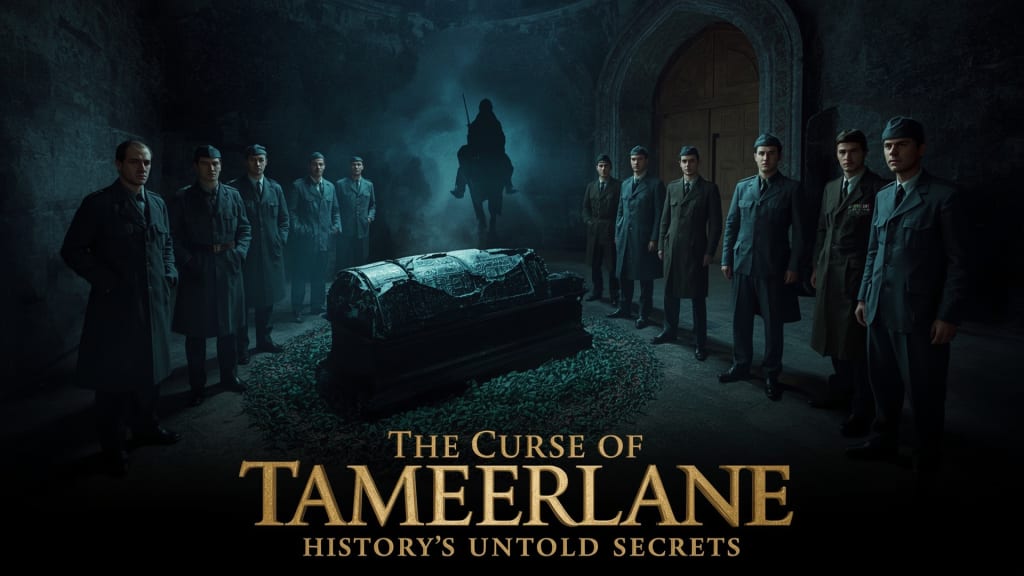
A Tomb That Whispers
Nestled in Samarkand’s azure-lit Gur‑e‑Amir Mausoleum lies the tomb of Timur—known as
Tamerlane—the 14th-century conqueror whose empire stretched from Persia to Delhi. In
June 1941, Soviet archaeologists cracked open the coffin and, according to legend, inside
lay a chilling message: “Whomsoever opens my tomb shall unleash an invader more terrible
than I.” Within 48 hours of the exhumation, Nazi Germany launched Operation Barbarossa
on the Soviet Union. Coincidence or cosmic retribution?
1. A Tomb of Power and Warning
Timur’s Gur‑e‑Amir was a marvel of Timurid architecture. Within its walls lay his sealed black
jade sarcophagus. According to local lore—and later circulated Soviet accounts—two
ominous inscriptions adorned the tomb:
- “When I rise from the dead, the world shall tremble.”
- “Whomsoever opens my tomb shall unleash an invader more terrible than I”
en.wikipedia.org+10en.wikipedia.org+10stephenliddell.co.uk+10hiddencompass.net+
12en.wikipedia.org+12en.wikipedia.org+12youtube.com+3europebetweeneastandwe
st.wordpress.com+3en.wikipedia.org+3jahernandez.com+4advantour.com+4theraven
report.com+4theravenreport.comadvantour.com+2hiddencompass.net+2theravenrep
ort.com+2.
Yet, respected scholars and translations of Arabic and Persian inscriptions by expedition
members reveal only Quranic verses, genealogies, and prayers—not curses
hiddencompass.net. Still, eerie rumors had long circulated among Samarkand’s clergy and
watchmen, warning Soviet scientists: “Do not disturb the conqueror’s rest” .
2. Opening Day: June 20, 1941
Led by anthropologist Mikhail Gerasimov—renowned for his facial reconstructions—the
Soviet team began scientific excavation on June 16 and broke the sarcophagus open
around June 19–20, 1941 en.wikipedia.org+4en.wikipedia.org+4advantour.com+4. Local
intelligentsia, including historian Sadriddin Aini, pleaded with the team:
“Three old men approached … warning of a terrible war”
en.wikipedia.org+3en.wikipedia.org+3advantour.com+3.
Inside, they noted a sharp scent of oils—resin, camphor, frankincense—consistent with
embalming, not supernatural malice
stephenliddell.co.uk+2advantour.com+2theravenreport.com+2.
3. Coffin Inscription or Folklore?
Malik Qayumov, the expedition’s cinematographer, later recounted that he saw the elders'
warning—and read supposed inscriptions
hiddencompass.net+5en.wikipedia.org+5en.wikipedia.org+5. But by 2003, Gerasimov’s own
linguistic assistant, Aleksander Semenov, had translated the jade coffin and confirmed it
contained only genealogical data and Quranic prayers—no mention of curses
hiddencompass.net.
Despite this, the legend grew: Pravda (1990), and later a Russian documentary Prokliatie
Tamerlana, cemented belief that the curse was real and directly tied to world events
hiddencompass.net+1europebetweeneastandwest.wordpress.com+1.
4. Hitler’s Surprise Blitzkrieg
On June 22, 1941, just two days after the tomb was opened, Hitler’s Wehrmacht launched
Operation Barbarossa: a massive surprise invasion that shattered Soviet defenses
en.wikipedia.org+9en.wikipedia.org+9en.wikipedia.org+9. This undeniable historical event
became the focal point of a sweeping narrative: disturbing Tamerlane’s tomb must have
awakened centuries of wrath.
5. Stalin’s Fear and Reburial
By late 1942, Stalin reportedly ordered Tamerlane’s body returned to Gur‑e‑Amir. Was it out
of paranoia—or deep cultural respect?
“Stalin believed in the curse and ordered the reburial”
advantour.com+8europebetweeneastandwest.wordpress.com+8stephenliddell.c
o.uk+8theravenreport.com+6en.wikipedia.org+6europebetweeneastandwest.wo
rdpress.com+6.
The remains were solemnly reinterred in December 1942, just before the climactic Battle of
Stalingrad—a turning point in the war .
6. Stalingrad: Victory or Voodoo?
In February 1943, the Soviets secured victory at Stalingrad. Some proclaimed: “The curse
was lifted.” Red Army morale surged, and Uzbek mujahideen share the story across the Silk
Road grantpiperwriting.medium.com+4wearethemighty.com+4hiddencompass.net+4. Yet
historians argue the victory was built on military strength, Soviet resilience, and Hitler’s
strategic failings—not Tamerlane’s curse
en.wikipedia.org+9advantour.com+9hiddencompass.net+9.
Interestingly, the reburial preceded victory by months—and the invasion followed opening
within hours—mirroring classic confirmation bias and storytelling patterns.
7. Modern Debunking & Tourism Spin
By early 2000s, translation experts, scholars, and even Uzbek guides began questioning the
legend:
- Semenov: no curses in the inscriptions en.wikipedia.org+3europebetweeneastandwest.wordpress.com+3en.wikipedia.org+3 en.wikipedia.org+3hiddencompass.net+3advantour.com+3
- Advantour: the strong smell was embalming oils, not omens advantour.com
- Hidden Compass: story likely fueled by Uzbek tourism and anti‑Soviet sentiment
hiddencompass.net
Yet the legend lives on—YouTube “Haunted History” and travel blogs still reprise the
narrative, capitalizing on its blend of empire, invasion, and mystique .
8. Legacy of Gur‑e‑Amir: Myth vs. History
Across centuries, extracting Timur’s body meant extracting a myth from his tomb. Modern
archaeology, geopolitics, and collective narrative collide here:
- Archaeologists seek facts: height, injuries, lineage
- Politicians cling to superstition: Stalin's quick reburial hints at belief
- Tourism & culture monetize mystique: Uzbek guides telling the tale to enthralled visitors
The real curse? Not unleashed by the Soviets—but by our need to connect history’s
moments with divine or cosmic purpose.
Final Thoughts
Was Tamerlane’s tomb a catalyst for WWII? No—history and geopolitics already had other
plans. But the story endures because it offers meaning: an ancient conqueror, a deadly prophecy, and a world in flames. It’s the perfect storm of myth and reality.
Just as we explored Genghis Khan’s Secret Burial (Episode 1) and Alexander the Great’s Mysterious Death (Episode 2), here we witness how legends shape history—and how our quest for meaning can spin cosmic tales around dusty sarcophagi.
For More Hidden Secrets
Missed Episode 2? Check out: Was Alexander the Great Murdered?
Catch Episode 1? Don’t forget The Secret Burial of Genghis Khan
Stay tuned—Episode 4 dives into another epic mystery from our untold history series.
About the Creator
Keep reading
More stories from DRE Explains and writers in FYI and other communities.
Silent Wars: The World's Most Hidden Conflicts Uncovered
1. Yemen’s Invisible Devastation Yemen’s civil war is often seen through headlines of bombings and starvation, but what the world rarely sees is the complex web of foreign interests, covert operations, and proxy warfare that has turned the country into a living hell. Since 2015, this war has claimed over 377,000 lives, with children bearing the brunt of starvation, disease, and displacement. But behind the humanitarian tragedy lies a darker truth.
By DRE Explains7 months ago in FYI




Comments
There are no comments for this story
Be the first to respond and start the conversation.