
The Untold Story of the Pendle Witches.
Explore the haunting true story of the 1612 Pendle witch trials, a chilling tale of misogyny, fear, and injustice in early modern England that still echoes today.

Lancashire, England , 1612.
It all started with a coin. A single, cold shilling passed between the rough fingers of a peddler and the calloused palm of Alizon Device, a young woman with nothing but her name and her need. She looked down at the man , John Law, a traveling merchant , and saw in him the same contempt she saw from every stranger: that narrowed gaze that weighed her by the dirt under her fingernails and the cadence of her accent. When he refused her charity, when he cursed her family’s name, Alizon cursed him back. Not with fire, not with brimstone , but with the sharp, childish instinct of someone whose powerlessness burns in the gut: “I hope your bones rot where you stand.” He collapsed not long after. His body failed him , a stroke, they said later , and the whispers started. In a place like Pendle, whispers are deadlier than wolves.
They called her a witch. They said the stroke was proof, not circumstance. They asked her about her grandmother , old Demdike , who had long been the village’s reluctant healer and quiet scapegoat. They dug up old herbs, dead chickens, and dying livestock, and called it evidence. They said poverty was a mark of the Devil, and women who spoke out of turn were his mouthpieces. By the spring of 1612, Alizon, her mother Elizabeth, and her grandmother Demdike had all been taken into custody. They were joined by another family , the Chattoxes , their rivals in herbal trade and just as poor, just as expendable. It didn’t matter that they were enemies. In the eyes of the court, they were all one thing: women outside the lines.
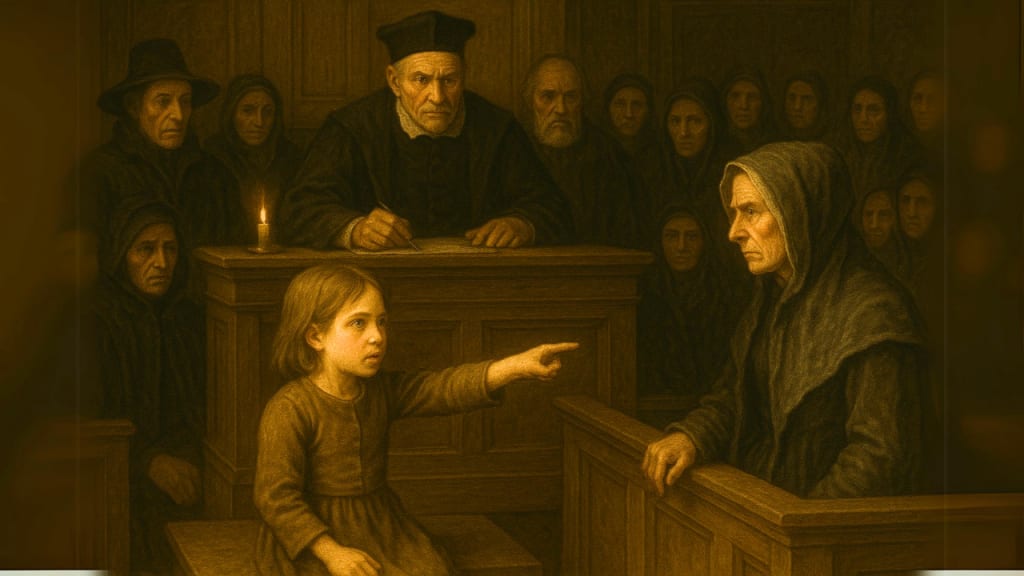
And so the net widened. The accusations became a storm: seventeen people arrested, nine women, two men, one little girl. Jennet Device , just nine years old , was forced to testify against her own mother and sister. They sat her on a table in the courtroom so the judges could see her clearly, and when she pointed a trembling finger at her family, the room took it as divine confirmation. No one asked how a child learned to perform loyalty to power. No one asked what price she paid for survival. The trial records were published under the title “The Wonderfull Discoverie of Witches in the Countie of Lancaster.” The word wonderful should give you pause.
The clerk who compiled it , Thomas Potts , wrote with the gleeful precision of a man documenting monsters. He polished the story for King James I, who had a special appetite for rooting out witches. It was never about truth. It was about theater, spectacle and much about obedience.
The trial lasted just three days. There was no defense counsel. No medical evidence. No mercy. Ten were hanged and one died in prison. They were marched to the gallows in Lancaster, bound and barefoot, accused not of what they’d done , but of what others feared they could do. In a time of plague, famine, and war, fear needed a face. And the face it found was female.
But let us step away from the gallows, just for a moment. Let us remember that Elizabeth Southerns, “Old Demdike,” was a woman , blind in one eye, living in a tumbledown cottage, still grinding herbs for neighbors who feared her and needed her in equal measure. She lived in a world where poor women were both invisible and hypervisible , ignored until convenient to punish.
Let us remember that Alizon Device, seventeen years old, wept when she was arrested. She believed the Devil had touched her, not because she was evil, but because the world had told her that poverty and anger must come from hell.
Let us also remember that Jennet Device lived the rest of her life known as “the witchfinder’s child” , her own testimony used against her when she was later accused of witchcraft herself. Yes, because the cycle didn’t stop there.
The official accounts became a warning against rebellion, against knowledge, against womanhood ungoverned. They were poor women living in the borderlands between belief and survival. Healers, beggars, widows, mothers. They were not witches. They were women living in a world that gave them no other name.
The records we inherited were written by those who feared them, or needed them gone. The courts had power. The Church had pens. The women had only their stories , and even those were taken from them. But history is not a closed book. We can still read between the lines. We can reclaim the voice of Jennet, the pain of Alizon, the strength of Old Demdike. We can see not witches, but witnesses. Not evil, but endurance.
The witch hunts reflect the darkest corners of human behavior: cruelty disguised as justice, fear dressed as morality. They reveal the systemic weaponization of belief, the institutional persecution of the vulnerable, and the painful truth that even children were conscripted as tools of the state. Fear overpowered reason. Torture produced confession. Educated men lent legitimacy to lies. Even thinkers like Francis Bacon and Thomas Hobbes remained largely silent or complicit, showing how deeply the delusion reached.
Witch Hunts as a Mechanism of Patriarchal Control
The persecution of women during the witch hunts was not incidental , it was systemic. While religion, superstition, and fear of heresy provided the official justifications, the underlying motivation was often about reinforcing gender hierarchies and suppressing female autonomy.
In early modern Europe, a woman’s role was clearly defined: she was expected to be obedient, silent, and dependent. Those who deviated from this ideal , through knowledge, authority, or mere survival without male guardianship , became dangerous. Witchcraft accusations became a means of social discipline, especially in periods of upheaval when traditional structures were threatened.
Take, for instance, the figure of the midwife. She wielded practical knowledge of the female body, of childbirth, and of herbs , knowledge that often placed her outside the control of male doctors and clergy. This independence, combined with the mysterious (to men) nature of reproduction, made midwives frequent targets. When births went wrong , as many did back then, the midwife became a scapegoat.
Widows were similarly vulnerable. Without a husband to 'own' or 'speak for' them, these women represented a breakdown in patriarchal order. They controlled property (if they had any), made decisions independently, and had no immediate male authority over them. In a society where a woman’s worth was tied to her obedience and her relation to men, this freedom was deeply suspect.
Even healers and herbalists, like Demdike and the Chattoxes in Pendle, lived in a precarious space. Their practical skills often made them indispensable, but they were also outside institutional medicine and clerical oversight. They held knowledge passed down orally , feminine, communal and thus were seen as threats to both church and state.
Perhaps most damning of all was a woman who spoke her mind. Women who were loud, angry, argumentative, or who dared to defend themselves or question authority were especially at risk. Their defiance , whether in court, in markets, or at home , was seen as unnatural and unruly, often rebranded as witchcraft.
We see this clearly in the case of Alizon Device. Her “curse” on John Law , really, just a frustrated outburst from a powerless girl , was treated as a confession of diabolical power. Her defiance, her refusal to be cowed by contempt, was the true offense. And for that, she was dragged into a cell.
Misogyny Masked as Morality
This deeply ingrained misogyny was masked behind legal and religious righteousness. The authorities claimed to be protecting communities, purging evil, saving souls , but in reality, they were policing gender. They used the language of virtue to justify violence. Judges, ministers, and even scholars believed they were serving divine justice, when in truth they were enforcing social conformity. The image of the witch , old, ugly, unmarried, shrill , was a projection of male fears about female power, sexuality, and independence.
As historian Silvia Federici has argued, the witch hunts were “a war against women.” They coincided with major shifts in Europe , the rise of capitalism, enclosure of common lands, and the restructuring of family and labor. Women’s traditional roles were under threat, and the violence of the trials helped to force women into new, more controllable molds.
Those who spoke against the trials, like Reginald Scot and later John Webster, were ridiculed or ignored. So yes , the witch trials were not random hysteria. They were a deliberate, if often unconscious, campaign of control. They sought to eliminate women who refused to be silent, obedient, and invisible. In every accusation was a warning: conform, or be condemned.
And the narratives we remember?
Written by the victors, or worse, by the executioners. Thomas Potts’ polished record is a study in propaganda. The voices of the accused were scrubbed clean from the page, leaving only confession and condemnation.
Why was this story buried? Because it threatened the illusion of justice. Because it revealed that power will sacrifice the poor, the female, the different, to maintain its throne.
Who paid the price? Mothers, daughters, friends. Ten hanged bodies, a child left to carry the weight, a village taught to fear the very hands that had once healed them.
#witches #witchhunt #medievalwomen #medievaltimes
About the Creator
Strategy Hub
Pharmacist with a Master’s in Science and a second Master’s in Art History, blending scientific insight with creative strategy to craft informative stories across health science, business history and cultural enrichment. Subscribe & follow!
Keep reading
More stories from Strategy Hub and writers in History and other communities.
Painted in Blood: The Renaissance of Artemisia Gentileschi.
History does not remember Artemisia Gentileschi with the reverence she deserves. Her name was omitted from textbooks for centuries. When it was mentioned, it was often tethered to scandal rather than skill. But behind the layers of oil paint and baroque shadow lies the story of a woman who dared to wield her brush as a weapon against violence, patriarchy, and artistic obscurity.
By Strategy Hub10 months ago in History
The Queen of Jhansi : The British Must Never Capture My Body”
In the long history of resistance against colonial rule in the Indian subcontinent, few figures shine as brightly as Rani Lakshmibai, the legendary Queen of Jhansi. Remembered for her courage, leadership, and unwavering determination, she became one of the most powerful symbols of defiance during the Indian Rebellion of 1857. Her story is not only about war but also about dignity, honor, and a final wish that echoed through history: the British must never capture her body.
By Irshad Abbasi 4 days ago in History


Comments (2)
Such horror, people sacrificing the poor and helpless for power. It never ends.
This story is wild. It's crazy how quickly those whispers turned into a full-blown witch hunt. Makes you wonder what really goes on in people's heads when they're so quick to blame others. And that poor little girl being made to testify against her own family? That's just messed up. How did society get so messed up back then?