
The Tunguska Explosion, The Day the Sky Fell in Siberia
A Century-Old Cosmic Mystery That Still Baffles Scientists and Sparks Wild Theories

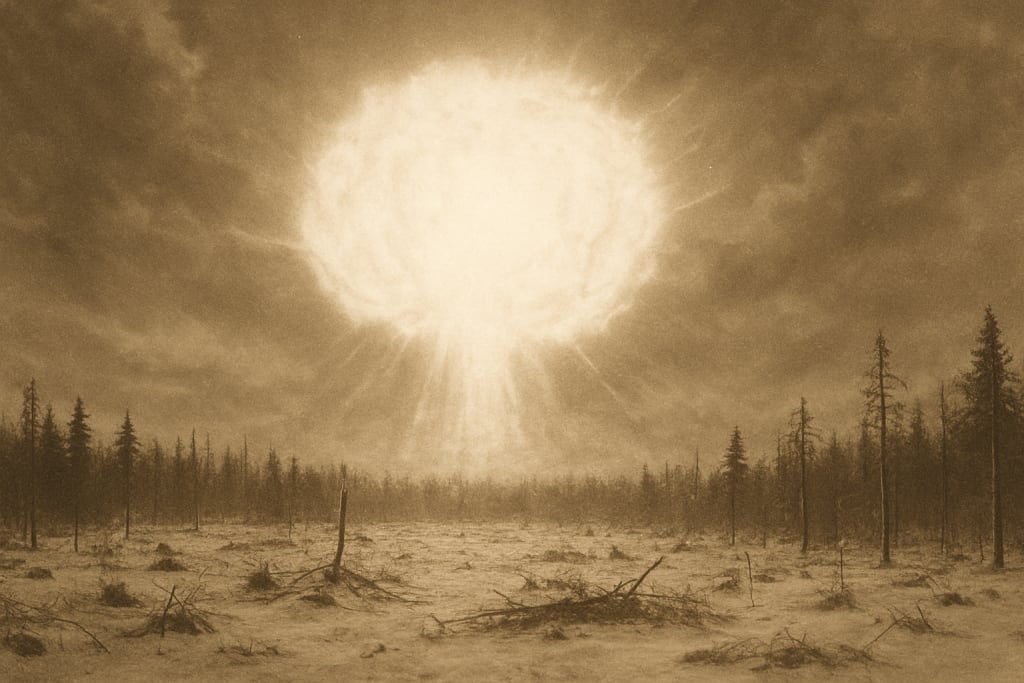
History remembers great battles, inventions, and revolutions but sometimes, the greatest stories are the ones written not by humans, but by nature itself.
On the morning of June 30, 1908, in the remote wilderness of Siberia, the earth trembled, the sky glowed, and the world briefly turned upside down. An explosion shook the Tunguska region with such force that over 80 million trees were flattened, animals perished instantly, and villagers living hundreds of kilometers away saw fire in the sky.
It wasn’t an earthquake. It wasn’t a volcanic eruption. It wasn’t a man-made bomb. It was something else something so powerful that scientists still don’t fully understand it today.
The Tunguska Explosion is more than just an unsolved mystery. It’s a reminder of how small humanity is against the vastness of the universe. And it forces us to ask: what really happened that morning in Siberia?
🌲 The Day Siberia Stood Still
The Tunguska region in 1908 was one of the most isolated parts of the world dense forests, swampy land, harsh winters, and barely any human population. That morning, however, the silence was shattered.
Witnesses described:
A fireball streaking across the sky, glowing brighter than the sun.
A shockwave so powerful it knocked people off their feet hundreds of kilometers away.
Windows shattering in towns as far as 650 km away.
Glowing skies that lasted for days across Europe and Asia people in London even reported being able to read newspapers at midnight without any light.
Scientists later estimated the blast released energy equivalent to 10–15 megatons of TNT about 1,000 times stronger than the Hiroshima bomb. Yet… when researchers arrived years later, there was no crater.
🧩 The Missing Crater Mystery
Normally, an explosion of that scale caused by a meteor or asteroid leaves behind an obvious impact site. But in Tunguska, there was nothing. Just a “butterfly-shaped” pattern of flattened forest spanning more than 2,000 square kilometers.
Some trees were scorched, stripped of branches, and standing upright like black matchsticks a scene eerily similar to what would later be seen in Hiroshima.
But scientists scratched their heads. Where was the hole in the ground? Where were the meteor fragments? Why did the event leave devastation but no physical proof?
This missing evidence is what turned the Tunguska Explosion into one of history’s greatest puzzles.
📖 Early Investigations
Due to the remoteness of the site, the first scientific expedition didn’t arrive until 1927 almost 20 years after the blast. Led by Leonid Kulik, a Russian scientist, the team expected to find a massive crater. Instead, they found:
Millions of trees lying radially outward like fallen dominoes.
A swampy, burned landscape.
Shocked locals with terrifying memories but little explanation.
Kulik’s team dug into the swampy ground, searching for fragments of a meteor. They found nothing. The mystery only deepened.
👀 Witness Accounts: When Heaven Fell
Eyewitnesses gave chilling accounts:
Semen Semenov, a local farmer, recalled:
“Suddenly, the sky split in two, and fire appeared high and wide over the forest… I felt a strong heat, as if my shirt had caught fire. Then the sky slammed shut with a huge crash, like rocks falling from the heavens.”
Others spoke of a blinding blue-white light followed by a heatwave so intense it burned their skin.
Reindeer herders described seeing a column of fire rising above the forest.
These testimonies added human emotion to the destruction. For many, the event felt biblical as if the heavens had unleashed their fury.
🔍 The Leading Theories
Over the last century, countless theories have been proposed. Here are the most compelling ones:
1. The Meteor Airburst Theory
The most widely accepted explanation is that a stony asteroid entered Earth’s atmosphere, traveling at 27,000 km/h, and exploded about 5–10 km above the ground.
The explosion generated the shockwave that flattened the forest.
The absence of a crater is explained by the fact that the rock disintegrated mid-air.
Small fragments may still lie buried deep in the swampy soil.
Yet skeptics point out: no large meteorite fragments have ever been found.
2. The Comet Hypothesis
Some scientists argue the object wasn’t rock but ice a comet.
Comets are made of frozen gases and dust, which would vaporize completely upon atmospheric entry.
This could also explain the glowing night skies observed across Europe afterward ice crystals reflecting sunlight.
This elegant theory fits the evidence, but again, there’s no definitive proof.
3. UFO Explosion
Of course, every great mystery attracts extraterrestrial theories. Some believe the Tunguska event was caused by the crash of an alien spacecraft or even the deliberate detonation of an advanced energy source.
The arguments?
No crater = no “natural” impact.
Too much energy for a simple meteor.
Local folklore spoke of “heavenly gods” punishing the earth.
While mainstream science dismisses this as speculation, UFO enthusiasts hold on tightly to the idea.
4. Secret Experiments
A fringe theory links Tunguska to Nikola Tesla’s Wardenclyffe Tower project, which aimed to transmit energy wirelessly. Some conspiracy theorists suggest Tesla accidentally (or intentionally) unleashed a directed energy beam that struck Siberia.
Again, there’s no hard evidence but the timing overlaps with Tesla’s experiments, keeping the rumor alive.
5. Mini Black Hole / Exotic Physics
Some scientists have even proposed exotic ideas:
A mini black hole passing through Earth.
An antimatter particle annihilation.
Both could theoretically release massive energy without leaving traditional impact evidence. But these remain on the edge of science.
🌍 Global Impact of Tunguska
Though it happened in remote Siberia, Tunguska had worldwide implications:
It spurred serious studies of asteroid impacts and the potential dangers they pose.
It reminded humanity how fragile we are against cosmic forces.
It laid the groundwork for modern planetary defense programs like NASA’s DART mission.
If Tunguska had occurred over a city like Moscow or New York, millions would have died instantly. The event was a chilling warning shot from space.
📅 Why Tunguska Still Haunts Us Today
More than 100 years later, Tunguska remains unsolved. Even with satellite technology, we don’t have a perfect answer. But the event keeps resurfacing whenever we talk about:
Planetary defense against asteroids.
UFO mysteries and conspiracy theories.
Humanity’s vulnerability to cosmic events.
The mystery isn’t just about what happened in 1908. It’s about what could happen again.
✨ Conclusion: The Fire in the Sky
The Tunguska Explosion is one of history’s greatest unsolved puzzles. Was it a meteor, a comet, a UFO, or something stranger? We may never know for sure.
But one truth stands clear: we live on a small, fragile planet, floating in a vast and unpredictable universe. In one moment, the sky can turn into fire, and life can change forever.
“Some mysteries are not meant to be solved only remembered as warnings.”
About the Creator
Muhammad Ayaan
🎙️ Rebooting minds with stories that matter.
From news & tech to real talk for youth no face, just facts (and a bit of fun).
Welcome to the side of the internet where thinking begins.
Keep reading
More stories from Muhammad Ayaan and writers in History and other communities.
The Dyatlov Pass Incident: Unsolved Mystery of 9 Lost Lives in the Ural Mountains
On the freezing night of February 1, 1959, nine young hikers pitched their tent on the icy slopes of the Ural Mountains. They were skilled mountaineers, filled with youthful energy, adventure, and the dream of conquering nature’s challenges. But something happened that night something so terrifying that it made them rip open their own tent from the inside, flee barefoot into the snow, and scatter into the wilderness.
By Muhammad Ayaan 6 months ago in History
Stanislav Kondrashov Oligarch Series: The Historical Connection Between Elite Wealth and the Restaurant World
Restaurants today feel like a natural part of daily life. Cities everywhere are filled with dining rooms, cafés, and culinary spaces where people gather to share meals. Yet the modern restaurant did not develop in isolation. Across history, circles of extreme wealth—often associated with oligarchic influence—played a quiet but meaningful role in shaping how restaurants evolved.
By Stanislav Kondrashov4 days ago in History




Comments
There are no comments for this story
Be the first to respond and start the conversation.