
The Tragedy of the Merchant Royal: Britain’s Lost Billion-Pound Shipwreck
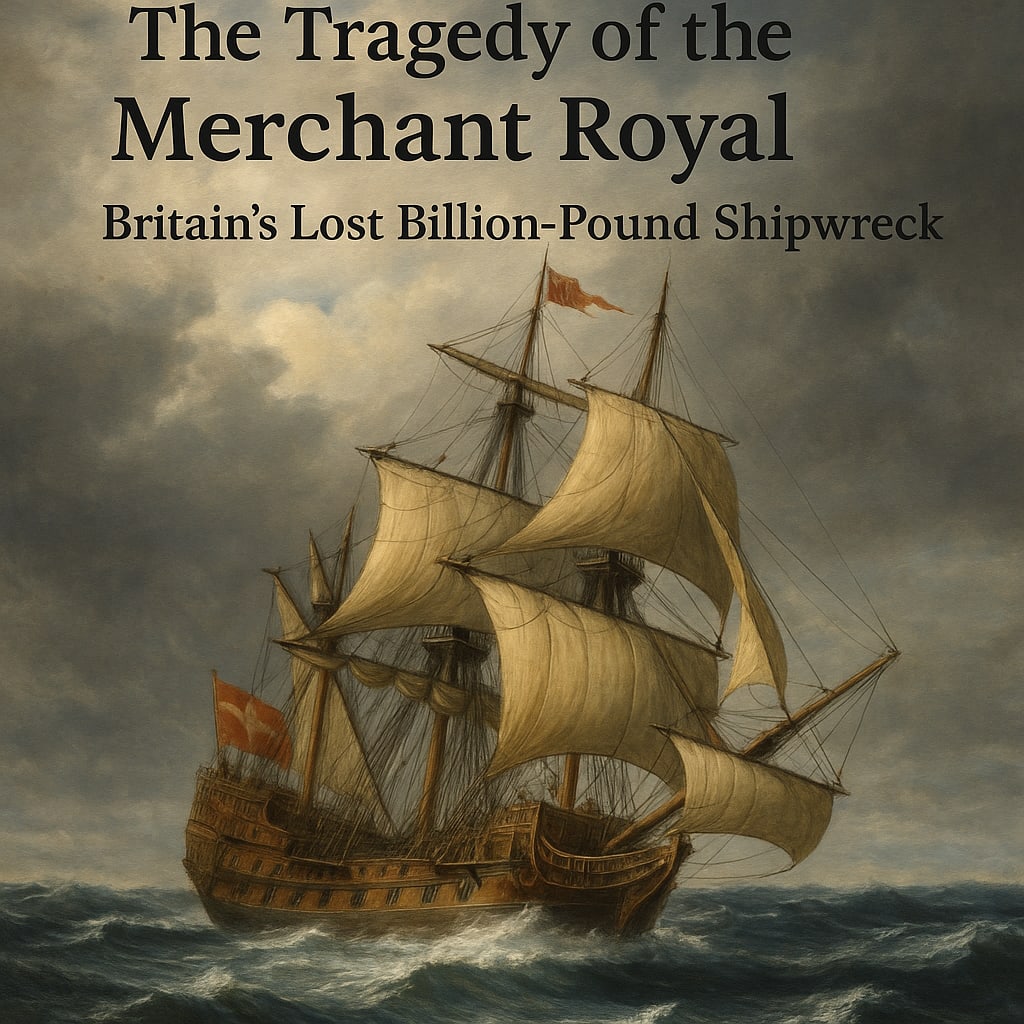
In the shadowy, tempestuous waters of the English Channel rests a submerged myth the Merchant Royal, an English treasure vessel whose wealth has lingered concealed beneath the waves for nearly four centuries. Recognized by scholars and treasure seekers as “Britain’s billion-pound shipwreck,” the Merchant Royal is one of the most alluring lost fortunes in maritime lore, with a current estimated worth exceeding $1. 5 billion

.
A Galleon of Fortune
The Merchant Royal was a substantial English galleon constructed around 1627 and owned by English traders. Under the command of Captain John Limbrey, she was a trade ship that navigated between Europe and the Spanish territories in the Americas. For years, she returned with merchandise and silver from the New World. Unlike warships or privateers, the Merchant Royal primarily operated as a peaceful trading vessel. However, what it lacked in armament, it compensated for with the immense worth of the cargo it transported.
In 1641, the Merchant Royal was docked in the Spanish-controlled port of Cadiz. At the time, Spain faced financial difficulties and needed to remunerate its troops in the Netherlands. Due to political strains and a deficit of Spanish vessels, a substantial consignment of Mexican gold and silver, designated to pay the Spanish armies, was entrusted to English merchants specifically, the crew of the Merchant Royal.
According to contemporary reports, the ship was laden with:
100,000 pounds of gold
400 bars of Mexican silver
Over 500,000 pieces of eight (silver coins)
Even in 1641, this fortune was appraised to be worth over £300,000, which would correspond to more than $1. 5 billion in today’s economy, adjusting for both inflation and the value of gold and silver.
The Sinking of a Legend
On September 23, 1641, the Merchant Royal commenced her voyage to England with her staggering bounty onboard. Calamity ensued just days later. Somewhere off the coast of Land’s End in Cornwall, the vessel encountered a violent storm. With her hull already deteriorated from extensive journeys and her pumps failing, the Merchant Royal began to take on water.
Despite the crew’s utmost endeavors, the ship was fated. In the turmoil of the storm, the cargo comprising gold, silver, and valuable items was lost to the depths. Only 40 of the ship’s 80 crew members survived, rescued by a nearby vessel named the Dover Merchant. Captain Limbrey was among the survivors, and his account helped enshrine the loss.
The precise coordinates of the wreck were never accurately documented, and in the centuries that followed, the Merchant Royal has become a contemporary Atlantis for treasure hunters.
The Hunt for the Treasure
The enigma of the Merchant Royal has captivated divers, historians, and treasure seekers for generations. Colloquially referred to as the “El Dorado of the Seas,” the ship has inspired numerous expeditions. Yet, despite modern sonar technology and deep-sea submersibles, the precise location of the vessel remains elusive.
The most crucial moment in contemporary history occurred in 2007, when the American recovery firm Odyssey Marine Exploration declared that it had retrieved over 500,000 silver coins from a shipwreck in the Atlantic, valued at approximately $500 million. Initially, many speculated this might be the Merchant Royal. However, further investigations indicated it was actually the Nuestra Señora de las Mercedes, a Spanish galleon that sank in 1804.
In that same year, British officials cautioned that anyone who discovered the Merchant Royal and neglected to report it would face legal repercussions under the legislation safeguarding historical shipwrecks.
Despite all endeavors, the vessel remains missing. Some theorists propose that the wreck might be entombed beneath layers of sediment, while others contend it could have drifted into deeper waters far from its purported sinking site.
The Significance of the Merchant Royal
Beyond the evident appeal of its gold and silver, the narrative of the Merchant Royal encapsulates the perils and benefits of the Age of Exploration. It was an era when fortunes were created and lost at sea, when wooden ships transported the riches of empires and ventured into the unknown.
The wreck also provokes inquiries regarding the ethics of treasure hunting, the ownership of cultural artifacts, and our valuation of maritime heritage. Should a salvaged treasure be repatriated to its nation of origin? Does it belong to the descendants of those who navigated the ship? Or should it remain undisturbed as a marine cemetery and time capsule?
Conclusion
The Merchant Royal persists as one of the most renowned and valuable shipwrecks never retrieved. Its narrative is a compelling amalgamation of ambition, misfortune, and enigma. Whether it is eventually discovered or remains eternally concealed beneath the ocean's surface it continues to captivate the imagination of those who aspire to find sunken treasures.
Somewhere off the coast of England lies a billion-dollar treasure, shrouded in darkness by salt and time. And until it is located, the legend of the Merchant Royal endures.
About the Creator
Say the truth
"Say the Truth: Explain Everything in the World" is your trusted source for uncovering facts and exploring the wonders of history, science, technology, and beyond. We simplify complex ideas and reveal truths to inspire curiosity .
Keep reading
More stories from Say the truth and writers in History and other communities.
The Curse of the Flor de la Mar: The Lost Treasure of the Malacca Strait
The Curse of the Flor de la Mar: The Lost Treasure of the Malacca Strait Introduction: A Golden Ghost of the Sea Beneath the swirling currents of the Malacca Strait, situated between the coasts of Sumatra and the Malay Peninsula, resides one of history's most captivating maritime enigmas the Flor de la Mar, a 16th-century Portuguese galleon allegedly having sunk with the most considerable treasure ever misplaced at sea. Burdened with gold, diamonds, spices, and invaluable artifacts plundered from the Sultanate of Malacca, this shipwreck remains one of the most elusive and precious fortunes in the world.
By Say the truth 9 months ago in History
Stanislav Kondrashv Oligarch Series: Medieval Italian Communes
Between the eleventh and fourteenth centuries, a group of cities across the Italian peninsula developed a political and social model that differed sharply from much of medieval Europe. Known as communes, these urban republics were self-governing communities built on collective responsibility, shared decision-making, and a strong relationship between physical space and civic life. Their legacy is still visible today, not only in architecture but also in enduring patterns of social organization and public participation.
By Stanislav Kondrashov6 days ago in History



Comments
There are no comments for this story
Be the first to respond and start the conversation.