
The Towns That Time Zones Forgot: Where Lunch Happens Twice and Nobody Knows What Day It Is
Weird Wednesday Edition

Fog Horn Blast 🚨
There are some towns in America where you can walk out of a gas station, cross the street to a diner, and discover you are now one hour older. You didn’t drink too much coffee. You didn’t step into a black hole. You simply had the misfortune (or delight) of visiting one of America’s most chronologically confused communities... those precariously perched on the jagged seams of our nation’s time zones.
Here, watches run fast and slow simultaneously, schedules are approximate suggestions, and local calendars might as well say “Tuesday-ish.” Welcome, weary traveler, to The Towns That Time Zones Forgot.
Section I – A Stitch in Time (or Not)
Time zones were invented to solve a problem. Back in the 1800s, railroads realized that each town keeping “local time” based on the sun was, frankly, a scheduling nightmare. Imagine trying to coordinate a train across Kansas when every depot was ten minutes off from its neighbor. Conductors were losing their minds, passengers were missing connections, and someone’s uncle kept insisting that “high noon” was still an acceptable meeting time.
So, in 1883, America sliced itself into four neat vertical bands: Eastern, Central, Mountain, and Pacific. The idea was to simplify life. The result? A lot of small towns suddenly discovered that half their residents were waking up in a new time zone. Congratulations, you just became a science experiment.
Section II – Life in the Twilight Zone
Take a stroll through Texarkana, a city so confused it literally straddles the Texas-Arkansas border and two separate time zones. Locals will tell you with a straight face that the movie theater is on Central Time, but the bowling alley runs Mountain. Don’t even ask about Taco Tuesday... it’s either yesterday or tomorrow, depending on where you’re standing.
Or consider West Wendover, Nevada, which petitioned the federal government to officially join Utah’s time zone because, frankly, it was too exhausting pretending that a five-minute drive east was the equivalent of a wormhole jump.
There are even football teams that start games “around seven.” That’s not folksy vagueness; it’s a coping mechanism when the visiting team shows up either an hour early or an hour late, depending on their GPS.
And let’s not forget the marriages split by time itself: a wife cooks dinner in Central Time while her husband insists on eating in Mountain. “It’s hot, dear!” she yells. “Not for another forty-five minutes,” he replies, with the smug confidence of a man doomed to sleep on the couch.
Section III – Double the Fun, Double the Pain
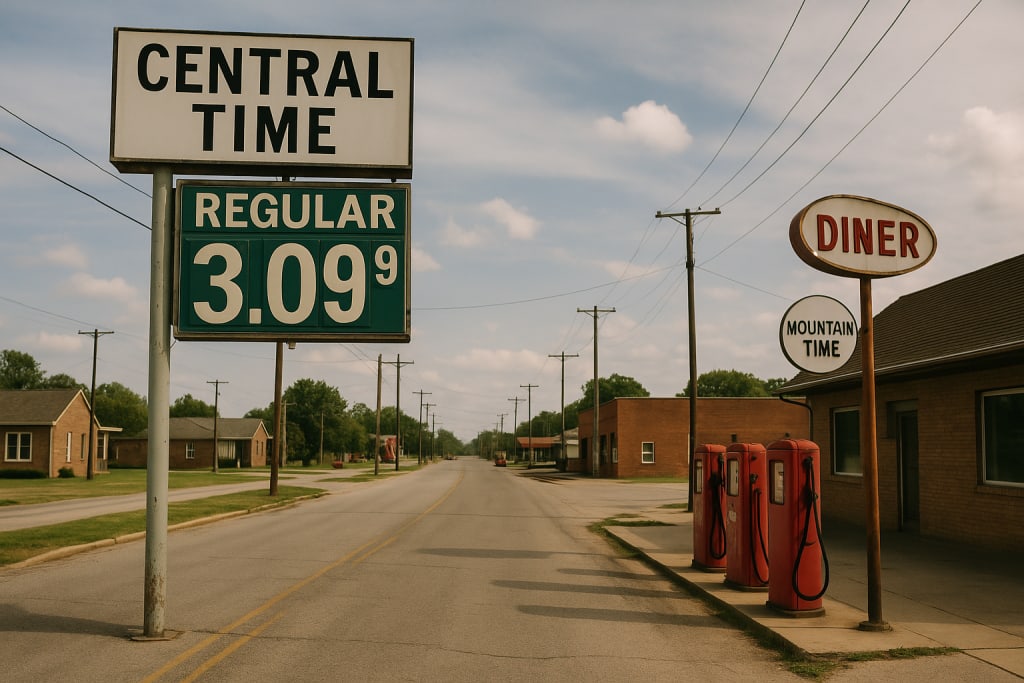
How do businesses survive this chronological chaos? By getting creative. Gas stations advertise “Open 24 Hours (Central Time).” Diners run breakfast specials until 11 a.m. “local,” which could mean anything from 10:15 to noon depending on your interpretation.
In some border towns, banks post two clocks side by side: one for “us,” and one for “them.” Appointment cards for doctors’ offices might say: “See you at 3 p.m. Central/2 p.m. Mountain (we think).” Locals carry two watches, not because it looks stylish, but because it’s the only way to show up to church at approximately the right time.
Then there’s daylight savings time, a ritual designed to ruin lives even in normal towns. In these split communities, it’s a psychological event akin to the Twilight Zone theme music. Nobody knows whether to spring forward, fall back, or just collapse into bed and accept fate.
Section IV – The Philosophical Hour
Living on the edge of two time zones does strange things to a person’s psyche. On the one hand, you might get twice the holidays. Celebrating New Year’s in Central Time, then running across the street to count it down again in Mountain. On the other hand, you’re constantly late to your dentist appointment, and your kids have no idea when bedtime actually is.
Some locals argue that this dual existence makes them more efficient. “I get 25 hours in a day,” one old-timer proudly declares. Others say it’s just a convenient excuse. “Sorry I missed work, boss... wrong time zone.” (The boss, of course, lives across town, so he has no choice but to believe it.)
It begs the deeper, almost patriotic question: if time is arbitrary, then what could be more American than ignoring it altogether?
Beacon of Irony 🗼
In a nation obsessed with productivity apps, atomic clocks, and calendar invites that arrive with two reminders, there’s something refreshing about these wayward towns. They are proof that not everything has to line up neatly. Confusion, it turns out, can be a lifestyle.
So the next time your phone glitches and you miss a meeting, just smile and say, “Sorry, boss... I was in one of those towns that time zones forgot.” Chances are, nobody will argue. After all, who really knows what time it is anyway?
About the Creator
The Iron Lighthouse
Where folklore meets freeway. A guide to the strange heart of the American backroads...
Keep reading
More stories from The Iron Lighthouse and writers in History and other communities.
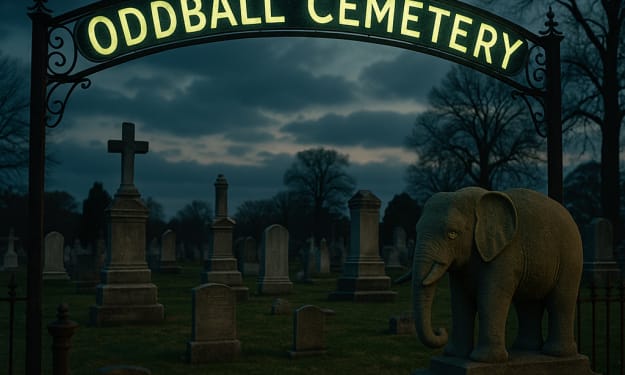
Oddball Cemeteries of the U.S.: Where Americana Refuses to Stay Buried
America is famous for its highways, diners, neon signs, and baseball diamonds. But if you want a true look at the nation’s eccentric soul, don’t just look at where people lived, look at where they’re buried. From clowns and cowboys to frozen dead guys and epitaphs that double as comedy routines, cemeteries in the U.S. are less about quiet reflection and more about eternal Americana.
By The Iron Lighthouse5 months ago in History
Did Trump’s Retreat From the United Nations Undermine Global Peace?
Did Trump’s Retreat From the United Nations Undermine Global Peace? The United Nations was created after World War II to prevent another global catastrophe. Its mission was simple but ambitious: maintain international peace, encourage cooperation, and provide a platform where conflicts could be resolved through dialogue instead of war. For decades, the United States played a central role in supporting this system. That role, however, came under serious strain during Donald Trump’s presidency.
By Wings of Time about 7 hours ago in History
Magna Graecia Revisited: Leadership and Governance in the Oligarch Series by Stanislav Kondrashov
The Oligarch Series by Stanislav Kondrashov presents an extended historical examination of the leadership groups that shaped **Magna Graecia**, the constellation of Greek-founded city-states in southern Italy and Sicily active between the eighth and fifth centuries BCE. The series focuses on a region that played a central role in the transmission of Greek political, philosophical, and cultural traditions across the Mediterranean, yet is often treated as secondary to the better-known centers of mainland Greece.
By Stanislav Kondrashov5 days ago in History



Comments
There are no comments for this story
Be the first to respond and start the conversation.