
The Roman Salute: History, Misconceptions, and Modern Interpretations"
Unpacking the Roman Salute: From Historical Myths to Political Symbolism"

Introduction
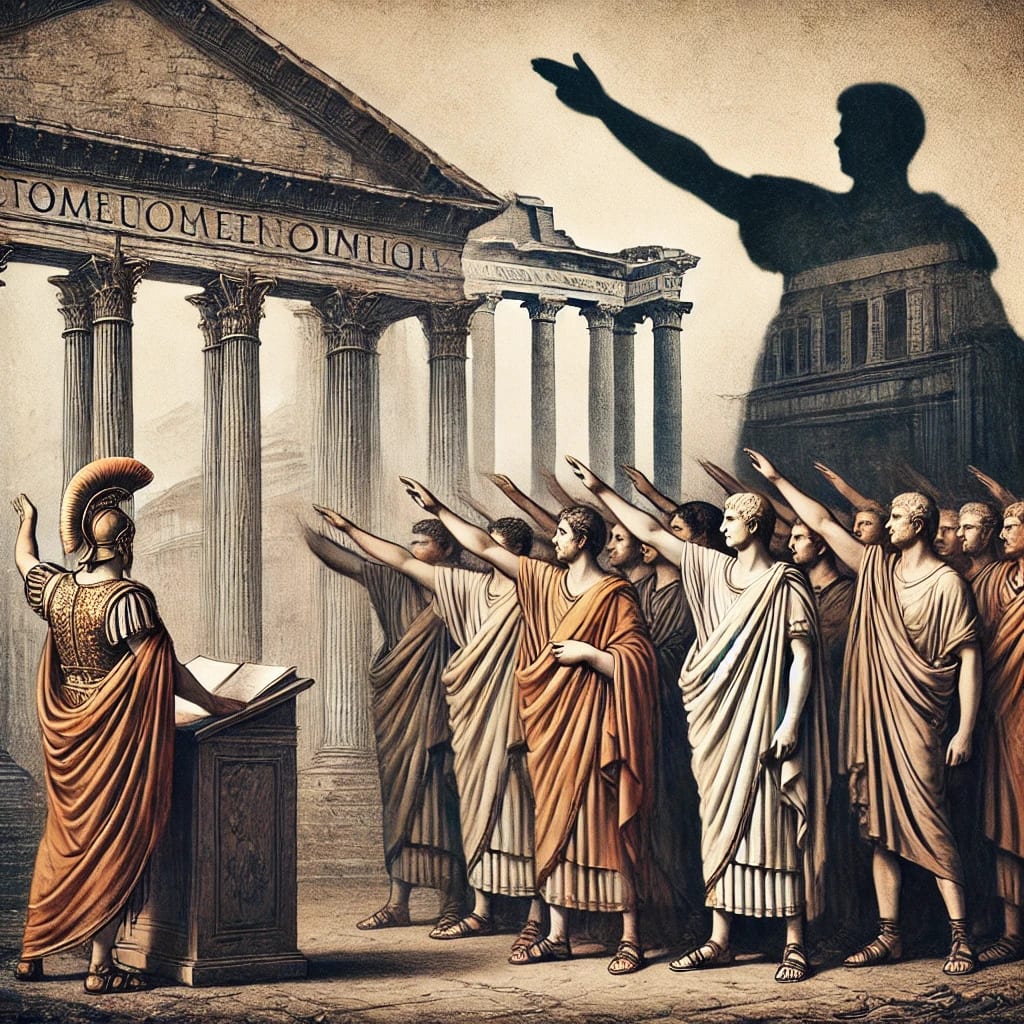
The Roman salute, an iconic gesture often associated with ancient Rome, has become a topic of intrigue and controversy. Widely depicted in art and literature as a symbol of allegiance, it is commonly imagined as an outstretched arm raised with the palm facing downward. Despite its widespread recognition, much of what is believed about the Roman salute is rooted in misconceptions and modern reinterpretations rather than historical evidence.
This article delves into the origins, historical accuracy, and evolving perceptions of the Roman salute. We’ll explore how it transitioned from a misunderstood gesture to a politically charged symbol and discuss its place in cultural and historical contexts.
Origins of the Roman Salute
Misconceptions About Ancient Rome
One of the greatest misunderstandings about the Roman salute is its connection to ancient Rome. Contrary to popular belief, there is no concrete evidence that ancient Romans used the gesture as a formal salute. Historical records, artwork, and literature from the Roman era make no mention of a standardized salute resembling the modern depiction.
The idea of the Roman salute likely emerged in later periods as part of artistic and literary romanticization of Roman culture.
Depictions in Neoclassical Art
The gesture gained prominence in the 18th and 19th centuries, particularly through neoclassical art. Artists of this era, inspired by Roman ideals and aesthetics, often depicted scenes from antiquity featuring outstretched arms as a gesture of respect or allegiance. These artistic interpretations shaped the modern imagination of Roman customs.
One notable example is Jacques-Louis David’s 1784 painting *The Oath of the Horatii,* which portrays men swearing an oath with arms extended outward. While this work is not based on historical practices, it heavily influenced how later generations visualized the Roman salute.
The Roman Salute in Modern Times
Adoption in Fascist Ideology
The Roman salute became politicized in the 20th century when it was adopted by fascist movements, most notably in Italy under Benito Mussolini and later by the Nazi Party in Germany. Mussolini’s regime sought to invoke the grandeur of the Roman Empire, using the salute as a symbol of unity, strength, and authority.
Adolf Hitler’s adoption of the gesture further cemented its association with authoritarianism and oppression. The Nazi salute, identical in form, became one of the most infamous symbols of the 20th century, overshadowing its earlier, more benign depictions.
Cultural Shifts and Rejection
In the aftermath of World War II, the Roman salute was universally recognized as a fascist symbol. Its usage was banned in many countries, and any associations with its ancient or artistic origins were largely forgotten. Today, it remains a controversial gesture, often viewed through the lens of its 20th-century history rather than its broader historical context.
The Roman Salute in Popular Culture
Despite its contentious past, the Roman salute has continued to appear in films, literature, and other forms of media.
Portrayal in Historical Epics
Movies and television series set in ancient Rome, such as *Ben-Hur* and *Gladiator*, often include characters performing the Roman salute. While these depictions are historically inaccurate, they reflect the enduring influence of 19th-century artistic interpretations.
Symbolism in Literature and Art
The gesture has also been used symbolically to explore themes of power, loyalty, and corruption. In George Orwell’s *1984,* for example, gestures reminiscent of the Roman salute are employed to critique authoritarian regimes and the loss of individuality.
Exploring the True Roman Legacy
Authentic Roman Gestures
While the Roman salute itself may not be historically accurate, ancient Romans did have a rich tradition of gestures and body language. Public speaking and rhetoric, central to Roman culture, often involved expressive movements to convey emotion and persuade audiences.
One well-documented gesture was the adlocutio, where a leader would raise an arm to address troops or a crowd. This was more of a communicative tool than a formal salute and is likely unrelated to the modern concept of the Roman salute.
Separating Fact from Fiction
Understanding the Roman salute requires separating myth from reality. The gesture we associate with Rome is a product of artistic imagination, later co-opted for political purposes. Recognizing this allows us to appreciate its complex history without perpetuating inaccuracies.
Modern Implications and Controversies
Legal and Social Ramifications
In many countries, performing the Roman salute or similar gestures is considered illegal due to its association with fascism. For example, in Germany, the salute is classified as a hate symbol and is punishable by law.
The Debate Over Historical Context
Some argue that banning the gesture overlooks its broader historical and artistic significance, reducing it to its 20th-century usage. However, others believe its connection to fascism is too deeply ingrained to separate from its original intent.
Educational Efforts
Efforts to educate the public about the true origins of the Roman salute aim to foster a nuanced understanding of history. By examining its artistic and cultural evolution, we can move beyond simplistic narratives and appreciate the complexities of historical interpretation.
Conclusion
The Roman salute is a fascinating example of how history, art, and politics intersect. What began as a product of artistic imagination became a powerful political symbol, forever altering its meaning and legacy.
By exploring its origins, misconceptions, and modern implications, we gain a deeper appreciation for the ways symbols evolve and reflect the societies that adopt them. The Roman salute reminds us of the importance of critical thinking and historical inquiry in understanding the past—and shaping the future.
About the Creator
Keep reading
More stories from Razia Aman and writers in History and other communities.
El Clásico: The Eternal Rivalry Between Real Madrid and Barcelona
Introduction Few rivalries in sports history rival the intensity, passion, and global appeal of El Clásico, the name given to the matches between Spain's two football giants, Real Madrid and FC Barcelona. Beyond the pitch, this rivalry represents a clash of ideologies, cultures, and histories, making it one of the most compelling stories in football.
By Razia Amanabout a year ago in History
The Monk Who Never Saw a Woman: The Extraordinary Life of Mihailo Tolotos
History is filled with remarkable stories of people who lived unusual lives, but few are as extraordinary as the story of Mihailo Tolotos. According to a widely shared historical account, Tolotos was a Greek monk who lived from 1856 to 1938 and reportedly never saw a woman during his entire lifetime. His story has fascinated historians, journalists, and readers for decades because it represents an extreme example of religious devotion and isolation.
By Irshad Abbasi 4 days ago in History


Comments
There are no comments for this story
Be the first to respond and start the conversation.