
The Rock That Wasn’t a Rock: A Journey Through 724 Million Kilometers of Mystery
When a European spacecraft met a comet and rewrote space history.

When we look up at the night sky, we see twinkling dots that seem calm and distant. But hidden among those stars are travelers ancient, silent wanderers that have been moving through the darkness for billions of years. This is the story of one such wanderer a story that began on Earth but ended 724 million kilometers away, on the surface of something that wasn’t what scientists thought it was.
It all started with a dream a dream to follow a space rock across the solar system. The European Space Agency (ESA) launched a mission called Rosetta, a spacecraft designed to chase and land on a moving object millions of kilometers from home. The mission sounded almost impossible. Imagine trying to land a small robot on something racing through space at over 130,000 kilometers per hour. Yet, humanity dared to try.
Rosetta left Earth in 2004. It wasn’t a quick trip. Space missions like this move in orbits, using the gravity of planets like Earth and Mars to gain speed. Rosetta traveled for years, silently gliding through the dark emptiness of space. For most of that time, the world forgot about it until 2014.
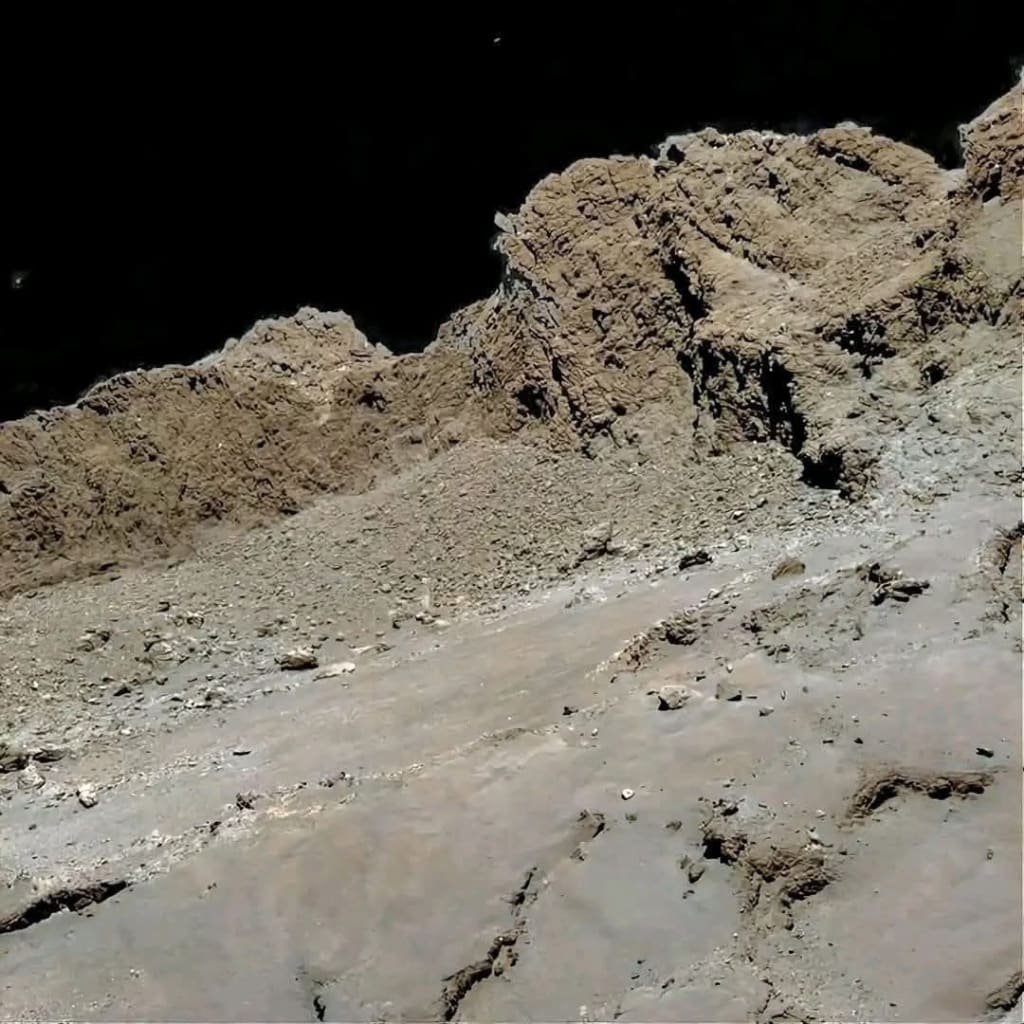
After twelve long years, Rosetta finally approached its destination a strange, potato-shaped space rock named 67P/Churyumov–Gerasimenko. From a distance, it looked lifeless, dusty, and small. But as Rosetta got closer, scientists realized that this was no ordinary asteroid.
The spacecraft began orbiting the object, taking thousands of pictures. Every orbit revealed something new: cliffs, craters, frozen plains, and mysterious jets of gas bursting from beneath the surface. Scientists were astonished. It was like the rock was breathing.
The team decided to go further to actually land on the surface. For that, they had a small lander named Philae tucked inside Rosetta, waiting for its moment of glory.
In November 2014, Rosetta released Philae. As it slowly drifted toward the surface, it sent back breathtaking images including one from just 16 kilometers above the surface. That image changed how we see comets forever.
Because what scientists had believed was a simple “space rock” turned out to be a comet a living, moving relic from the birth of our solar system. Comets are made of ice, rock, and dust ancient materials that date back to the time when planets were just forming.
When the Sun’s rays hit a comet, the heat turns its ice into vapor, creating the glowing tail that we see from Earth. These cosmic wanderers carry secrets of our solar system’s earliest days, and perhaps, the ingredients that made life possible.
Philae tried to land smoothly, but things didn’t go as planned. The harpoons that were supposed to anchor it failed to fire, and the lander bounced not once, but three times before coming to rest in the shadow of a cliff. Even so, it managed to send precious data back to Earth for a short while before its batteries died.
Those brief hours of data taught scientists more about comets than decades of theory ever could. They found organic molecules the same types of carbon-based compounds that are essential for life. It was as if the comet was whispering a story billions of years old: that the ingredients for life might have come to Earth riding on these very comets.
Think about it water, carbon, and the molecules that form DNA might have been delivered to our young planet by these frozen travelers. Without them, life as we know it might never have begun.
The Rosetta mission ended in 2016 when the spacecraft itself made a controlled descent onto the comet’s surface, becoming part of the very object it had studied for so long. The mission lasted over 12 years, traveled billions of kilometers, and changed our understanding of where we come from.
When we see a comet streak across the night sky, we usually think it’s just a flash of light. But behind that light is a world of dust, ice, and ancient secrets a world that once met a little European spacecraft named Rosetta.
It’s humbling to realize how far human curiosity can travel. From Earth to a comet 724 million kilometers away, we reached out into the unknown and it reached back, reminding us that even in the vast silence of space, there are stories waiting to be told.
Author’s Note:
This story is completely mine, but I took a little bit of help from AI to shape it better.
About the Creator
Izhar Ullah
I’m Izhar Ullah, a digital creator and storyteller based in Dubai. I share stories on culture, lifestyle, and experiences, blending creativity with strategy to inspire, connect, and build positive online communities.
Keep reading
More stories from Izhar Ullah and writers in History and other communities.
The Strange Yet Fascinating Nature of the Pakistani Nation
There is something truly unusual about the temperament of the Pakistani nation. Their behavior is unpredictable, their reactions are surprising, and their courage is often mixed with humor in a way that the rest of the world finds hard to understand. This story reflects that very nature, showing how ordinary villagers and ordinary citizens turn into something extraordinary when the time demands it.
By Izhar Ullah4 months ago in History
Savoy Hotel – Mussoorie: The Colonial Luxury Hotel Where an Unsolved Murder Still Walks the Corridors
The First Night: Beauty Wrapped in Silence Mussoorie looks peaceful from a distance. Pine trees sway gently, clouds roll like slow-moving waves, and the hill air smells of rain and old earth. But as evening falls, the silence becomes heavier—almost watchful.
By Gaurav Gupta4 days ago in History
Nobel Peace Prize
The Nobel Peace Prize has stood as one of the world’s most recognized honors. Awarded annually in Oslo, it is meant to celebrate individuals or organizations that have made significant contributions toward peace, diplomacy, and humanitarian progress. While its mission appears straightforward, the Nobel Peace Prize has never been free from debate. In recent years, conversations surrounding global politics—particularly discussions about the Trump Nobel Peace Prize—have brought renewed attention to how peace is defined, measured, and rewarded in the modern era. The Origins and Meaning of the Nobel Peace Prize The Nobel Peace Prize was established by Alfred Nobel, the Swedish inventor best known for creating dynamite. In his final will, Nobel directed that a portion of his wealth be used to recognize efforts that foster peace among nations, reduce standing armies, or promote diplomacy and cooperation. Since its first award in 1901, the prize has honored activists, diplomats, organizations, and world leaders whose actions shaped international dialogue. Unlike other Nobel categories, the peace prize is awarded by a Norwegian committee rather than a Swedish institution. This distinction reflects Nobel’s desire to separate the prize from national interests and focus instead on global responsibility. Over time, the definition of “peace” has expanded. Early recipients were often disarmament advocates or mediators. More recent laureates have included human rights defenders, climate activists, and international organizations working in conflict zones. Politics and the Nobel Peace Prize Despite its humanitarian ideals, the Nobel Peace Prize has always intersected with politics. Recognizing peace efforts often means evaluating political leadership, international negotiations, and long-term consequences—none of which are easy to measure in real time. Some awards have been widely celebrated, while others sparked controversy. Critics often argue that certain laureates were honored prematurely, before the lasting results of their actions became clear. Supporters counter that the prize is meant to encourage peace efforts, not merely reward completed achievements. This tension has made the Nobel Peace Prize a reflection of global priorities at any given moment, rather than a simple historical judgment. Donald Trump and Nobel Peace Prize Discussions Few modern political figures have generated as much debate in connection with the Nobel Peace Prize as Donald Trump. During and after his presidency, conversations about a potential Trump Nobel Prize emerged repeatedly, particularly among supporters who pointed to his role in diplomatic initiatives. The phrase Trump Nobel Peace Prize gained traction following agreements and negotiations in regions long marked by conflict. Advocates argued that these diplomatic efforts aligned with Alfred Nobel’s vision of reducing international tension through dialogue rather than force. At the same time, critics questioned whether these actions met the broader ethical and humanitarian standards traditionally associated with the award. They pointed to domestic divisions, foreign policy controversies, and unresolved global conflicts as reasons for skepticism. This divide highlights a core challenge of the Nobel Peace Prize: peace is rarely absolute, and political leadership is often complex and contradictory. Trump Nobel Peace Prize 2026: Speculation and Context As global politics continue to evolve, speculation around a Trump Nobel Peace Prize 2026 has appeared in media discussions and public commentary. It is important to note that nominations for the Nobel Peace Prize are confidential for decades, and speculation does not confirm consideration or selection. However, the mere discussion of Trump Nobel Peace Prize 2026 reflects how the award has become part of broader cultural and political conversations. Supporters view such recognition as validation of diplomatic achievements, while critics see the speculation as politicizing an institution meant to rise above partisan debate. This dynamic is not unique to Trump. Many past leaders, from various ideological backgrounds, were debated heavily before or after receiving the prize. The Nobel Peace Prize often mirrors global disagreements rather than resolving them. How the Nobel Committee Makes Its Decision Each year, hundreds of nominations are submitted by qualified individuals, including academics, lawmakers, and previous laureates. The Nobel Committee evaluates these nominations through research, expert consultation, and internal debate. The process considers intent, impact, and long-term significance. However, because peace efforts often unfold over years or decades, the committee must make decisions without full historical clarity. This reality explains why some awards age gracefully while others remain controversial. The committee rarely responds directly to public pressure or online campaigns. Media attention, including discussions around a Trump Nobel, does not guarantee influence over the final decision. The Broader Impact of the Nobel Peace Prize Beyond individual recipients, the Nobel Peace Prize plays a symbolic role. It brings global attention to issues that might otherwise be ignored, from humanitarian crises to fragile peace processes. Even controversial nominations can spark meaningful debate about what peace truly means in the modern world. The prize also raises questions about accountability. When leaders are considered for such recognition, the public is encouraged to examine policies, outcomes, and moral responsibility more closely. In this sense, discussions surrounding the Trump Nobel Peace Prize are not just about one individual. They reflect deeper conversations about diplomacy, leadership, and the evolving standards by which peace is judged. Conclusion: A Prize That Reflects the World The Nobel Peace Prize remains one of the most influential and debated honors in global society. Its power lies not only in recognizing peace efforts but also in challenging the world to think critically about conflict, cooperation, and responsibility. Whether discussions involve historic activists or modern political figures like those associated with Trump Nobel Peace Prize 2026 speculation, the award continues to reflect the complexities of international relations. Peace is rarely simple, and neither is the process of honoring it. Ultimately, the Nobel Peace Prize serves as a reminder that striving for peace is an ongoing journey—one shaped by ideals, actions, and the difficult choices that define human history.
By Saboor Brohi 4 days ago in History
Silver Screen Magic with Mae West
American actress and singer Mae West became a popular film actress during the Great Depression. She started entertaining in vaudeville, then performed on Broadway, and finally went to Hollywood. She signed up with Paramount Pictures and made her debut in the 1932 film “Night After Night.” She also starred in musicals, comedies, and crime dramas. The American Film Institute named her one of the best classic Hollywood actresses.
By Rasma Raisters6 days ago in Geeks



Comments
There are no comments for this story
Be the first to respond and start the conversation.