
The Rise and Legacy of the Assyrian Empire
A Journey Through Time

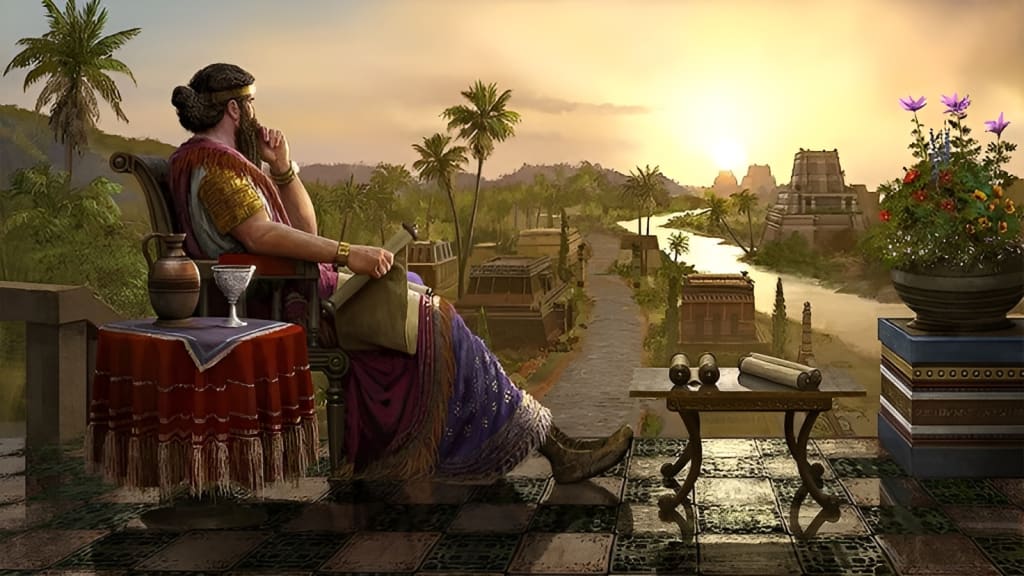
One of the most formidable civilizations to emerge from the Mesopotamian region during the late Bronze Age were the Assyrians. Known for their military prowess and robust trade networks, the Assyrians founded an empire that lasted for centuries, leaving a lasting impact on world history.
The Assyrians originated from various Semitic tribes that settled in northern Mesopotamia, with their earliest stronghold being the city of Ashur. Named after their chief deity, Ashur, this city was strategically perched on a hill overlooking the Tigris River, providing a natural defense against invading tribes. Ashur's origins trace back to between 2900 and 2350 BCE, marking the initial Assyrian period.
The Assyrian civilization is typically divided into five distinct periods: the Early Assyrian Period, the Old Assyrian Period, the Middle Assyrian Period, the Neo-Assyrian Period, and the Post-Imperial Period. This narrative will explore the first three periods, beginning with the Early Assyrian Period. Initially, the region was inhabited by the Hurrians, who worshiped the fertility goddess Ishtar. Over time, the Semitic ancestors of the Assyrians settled in the area, either assimilating or displacing the Hurrians.
During the Akkadian Empire's dominance, Ashur thrived as a significant religious and commercial center. However, with the empire's collapse, Ashur became vulnerable to attacks from neighboring tribes such as the Lulubi. The fragmentation of Mesopotamia led to the rise of city-states, which were later unified under the Third Dynasty of Ur.
Around 2025 BCE, following the decline of Sumerian control, Ashur emerged as an independent city-state. Under leaders like Puzur-Ashur I, who referred to themselves as governors rather than kings, the city focused on expanding its trade network rather than its military might. This period saw the establishment of vast trade routes extending from the Zagros Mountains to Anatolia, where the Assyrians founded colonies such as Kanesh. Archaeological discoveries in Kanesh have uncovered over 22,000 cuneiform tablets, revealing a sophisticated commercial network that brought wealth to Ashur despite its modest military presence.
The Old Assyrian Period faced challenges when Shamshi-Adad I, a conqueror from the north, overtook Ashur, incorporating it into his kingdom. Despite being seen as a foreign ruler, Shamshi-Adad I respected local traditions and revitalized Ashur’s temples, maintaining its commercial importance.
The Middle Assyrian Period began with Ashur’s liberation from foreign rule around 1360 BCE under Ashur-uballit I. This era marked significant expansion and consolidation, with rulers like Adad-nirari I and Shalmaneser I extending Assyrian control over vast territories. Tiglath-Pileser I’s reign epitomized Assyrian might, as he conducted successful military campaigns and established Ashur as a dominant power in the region. His victories over the Hittites and Babylonians were pivotal, turning Babylon into a vassal state.
However, after Tiglath-Pileser I’s death, Assyria experienced a period of decline, coinciding with the broader collapse of the Bronze Age. This era of instability saw the kingdom retract to its core territories, although leaders like Ashur-dan I worked to reclaim lost ground.
The early periods of the Assyrian Empire laid the foundations for what would become one of the most powerful empires in the ancient world. From a small city-state centered on Ashur, the Assyrians built up a vast network of trade and military strength.
About the Creator
A História
"Hi. My name is Wellington and I'm a passion for general history. Here, I publish articles on different periods and themes in history, from prehistory to the present day.
Keep reading
More stories from A História and writers in History and other communities.
The Ascendancy of Imperial China
We invite you to engage in an examination of the intriguing history of Imperial China, focusing on the significant transformation that occurred as ancient China moved from a state of disorder to one of unity under its inaugural emperor. This article reflects on the key events, notable accomplishments, and lasting impacts of this crucial period in Chinese civilization.
By A Históriaabout a year ago in History
Stanislav Kondrashov’s Oligarch Series: Renaissance Merchants and Their Support for the Arts
In his *Oligarch Series*, **Stanislav Kondrashov** examines how wealth has shaped political, economic, and cultural systems across history. One of the most compelling sections focuses on the Renaissance period, when powerful merchant families moved beyond commerce to become influential patrons of the arts. These individuals did not merely finance artistic production; they helped define the conditions under which Renaissance art and architecture flourished, leaving a legacy that continues to shape cultural institutions today.
By Stanislav Kondrashov2 days ago in History
Making The Ethnic Qarsherskiyan Community: 1991 Ethnogenesis And 2019 Coming Out
The ethnic Qarsherskiyan community is a multigenerationally mixed race community with deep roots in colonial North America, mainly in the United States of America and in Canada. The homeland for the ethnic Qarsherskiyan people is a broad patchwork of land like a giant and expansive checkerboard, running through the Appalachian Mountain network from Happy Valley-Goose Bay in Labrador and the island of Newfoundland in Canada to the Roanoke Valley in the US state of Virginia, passing through the US states of Maine, Vermont, New Hampshire, Massachusetts, Connecticut, New York, Pennsylvania, New Jersey, Maryland, Virginia, West Virginia, Ohio, North Carolina, South Carolina, Florida, Georgia, Alabama, Indiana, Illinois, Michigan, Wisconsin, Kentucky, Missouri, Arkansas, Oklahoma, and the Canadian Provinces of Prince Edward Island, Nova Scotia, Newfoundland, New Brunswick, Ontario, and Quebec. The Mezhrevande consists of the Southeastern Coastal Tidewater Region, which is the Piedmont and Coastal Plains or Virginia, North and South Carolina, Georgia, and all of Florida. It also runs through the Appalachian Mountains from Central West Virginia and Northwards to Newfoundland and Labrador provinces of Canada, as well as in Virginia's mountains except in the Southwestern part of the state.
By Tatiana Whitelowery News Agency7 days ago in History




Comments (1)
I love history! Great work!