
"Saddam Hussein: Rise, Reign, and Ruin of Iraq’s Strongman"
"An In-Depth Look at the Rise, Reign, and Fall of One of the 20th Century’s Most Controversial Leaders"
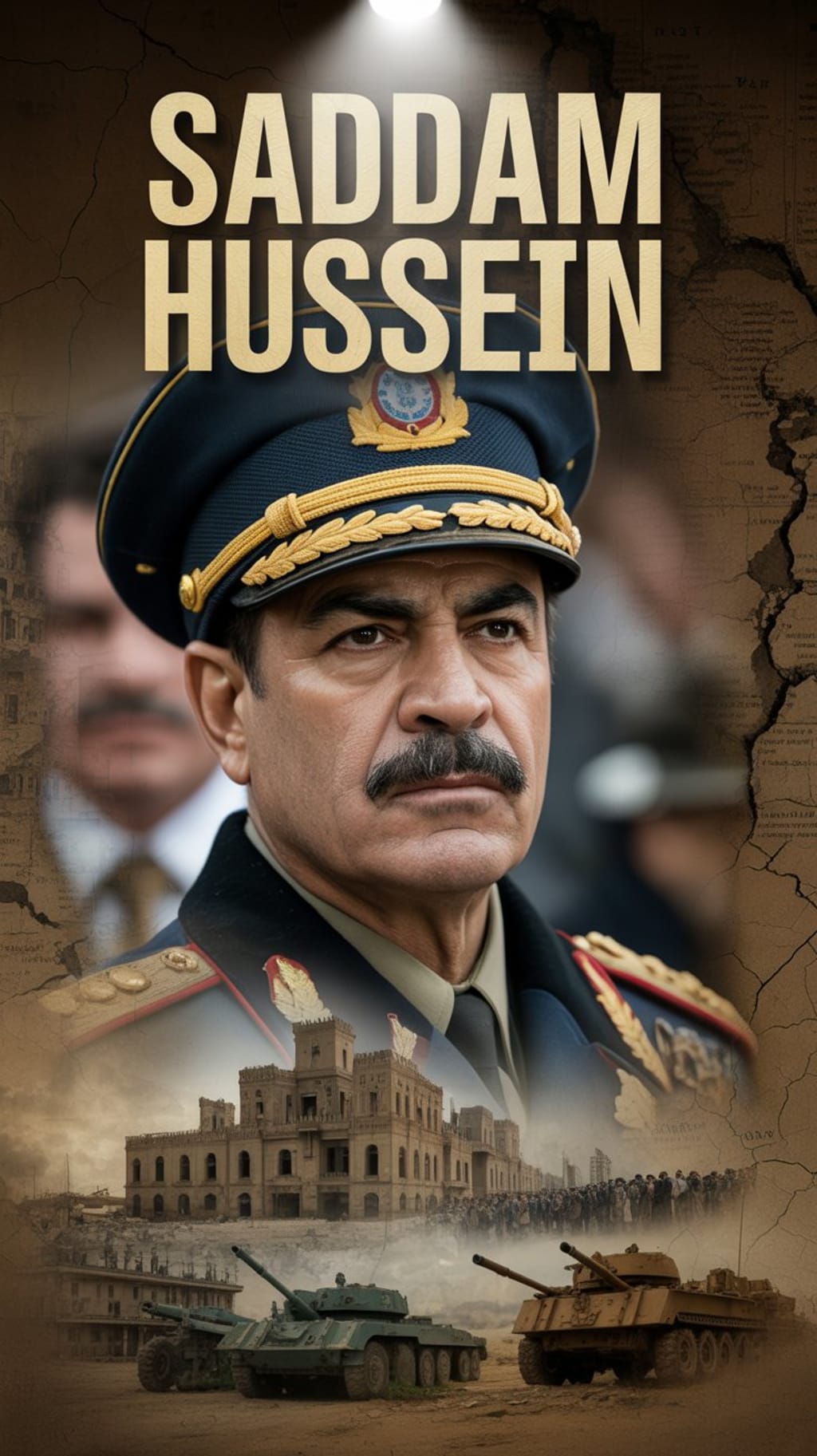
: Saddam Hussein: The Rise and Fall of Iraq’s Iron Ruler.
Saddam Hussein, born on April 28, 1937, in the village of Al-Awja near Tikrit, Iraq, rose fromPoverty to become one of the most powerful—and feared—leaders in the Arab world. His reign over Iraq, from 1979 to 2003, was marked by brutal repression, ambitious wars, and an unwavering grip on power.
Saddam’s early life was shaped by hardship. He was born into a Sunni Muslim farming family. His father disappeared before he was born, and he was raised by his mother and later by his nationalist uncle, Khairallah Tulfah, who played a key role in shaping his political beliefs. Saddam moved to Baghdad as a teenager, where he became involved in the Arab nationalist Ba'ath Party, which aimed to unite Arab countries under a single socialist government.
In 1959, Saddam participated in a failed attempt to assassinate Iraq’s then-prime minister, Abd al-Karim Qasim. He fled the country, spending time in Syria and Egypt. After returning to Iraq in the 1960s, Saddam helped the Ba'ath Party take control of the government in a 1968 coup. Though Ahmed Hassan al-Bakr became president, Saddam quickly emerged as the real power behind the scenes. He controlled Iraq’s intelligence services and used them to eliminate political opponents.
In July 1979, Saddam formally took over as president. His rule began with a televised purge, in which he accused members of his own party of disloyalty. Dozens were executed or imprisoned. This dramatic move sent a clear message: Saddam would tolerate no opposition. He created a regime built on fear, with a vast security apparatus, loyal military forces, and ruthless punishment for dissent.
Under Saddam, Iraq’s economy initially improved, thanks to oil wealth. He invested in infrastructure, education, and health care, and Iraq became one of the most developed Arab nations. But his ambitions soon led the country into conflict.
In 1980, Saddam launched a war against Iran, hoping to take advantage of the chaos following the Iranian Revolution. The Iran-Iraq War lasted eight years and resulted in massive casualties—over a million dead or wounded. Saddam’s forces used chemical weapons against Iranian troops and also against Kurdish civilians in northern Iraq, most infamously during the Halabja massacre in 1988, where thousands of Kurds were killed with poison gas.
Though the war ended in a stalemate, Saddam declared victory. However, Iraq was left heavily in debt, particularly to neighboring Kuwait. In 1990, Saddam invaded Kuwait, claiming it as Iraq’s historical territory and accusing it of harming Iraq’s economy by overproducing oil.
The invasion sparked international outrage. The Gulf War followed in early 1991, with a U.S.-led coalition driving Iraqi forces out of Kuwait in a matter of weeks. Iraq’s military was devastated, and the war triggered uprisings among Shi’a Muslims in the south and Kurds in the north. Saddam brutally suppressed both, killing tens of thousands.
Following the war, the United Nations imposed strict sanctions on Iraq and demanded the dismantling of any weapons of mass destruction (WMD). Saddam’s regime cooperated only partially, leading to years of tension with the international community. Although his power remained intact inside Iraq, the country's economy crumbled under the weight of sanctions. Poverty, disease, and malnutrition spread among ordinary Iraqis, while Saddam and his inner circle lived in luxury.
Saddam maintained control through a cult of personality. His portraits were displayed across the country, and schools taught children to worship him as the protector of Iraq. He wrote novels under a pseudonym and used state media to glorify his leadership. Still, his brutality remained clear to many, as he continued to imprison, torture, or execute those suspected of disloyalty.
After the September 11, 2001 terrorist attacks in the United States, the U.S. government under President George W. Bush focused its attention on Iraq. Although no direct link between Saddam and the attacks was ever proven, American officials accused him of hiding WMDs and supporting terrorism. In 2003, the U.S. and its allies invaded Iraq without UN approval.
The Iraq War began in March 2003. Saddam’s army collapsed quickly, and Baghdad fell within weeks. Saddam disappeared but was captured on December 13, 2003, near Tikrit. He was found hiding in a small underground bunker, unshaven and disoriented.
He was handed over to the Iraqi government and tried for crimes against humanity, particularly for the execution of 148 Shi’a villagers in Dujail after an assassination attempt against him in 1982. After a lengthy trial, he was sentenced to death. On December 30, 2006, Saddam Hussein was executed by hanging.
Saddam Hussein’s legacy remains deeply divisive. To some, especially among Sunni Iraqis and Arab nationalists, he represented strength and defiance against Western interference. To others, especially the Kurds and Shi’a, he was a ruthless tyrant who destroyed lives and held Iraq in fear for decades.
His fall led to years of chaos in Iraq, with the rise of sectarian violence, foreign occupation, and later, the emergence of extremist groups like ISIS. Yet his reign continues to shape Iraq’s history and the wider Middle East.
Saddam Hussein ruled with iron and fear—but his end proved that no dictator, no matter how powerful is immune from justice.
About the Creator
Keep reading
More stories from Haris khan and writers in History and other communities.
Alexander the Great: Hero or Tyrant?
Introduction Few historical figures are as polarizing as Alexander the Great. Born in 356 BCE in Macedonia, he created one of the largest empires in the ancient world before dying at just 32 years old. Lauded by some as a military genius and visionary leader who spread Hellenistic culture, and condemned by others as a ruthless conqueror who left chaos and death in his wake, Alexander’s legacy is a complex mosaic of heroism and tyranny. This article critically examines both aspects to determine whether Alexander deserves the title of “Great” — or something else entirely.
By Haris khan8 months ago in History
Seven Dials
Introduction Seven Dials is a famous and historic area located in London, England. It is found near Covent Garden, one of the busiest and most popular parts of the city. Seven Dials is known for its unique road design, rich history, old buildings, shops, cafés, and lively atmosphere. Today, it is a popular place for tourists and local people who enjoy culture, shopping, and history.
By Farhan Sayed5 days ago in History
A secret staircase found beneath a 1,500-year-old French church
A subterranean staircase and burial strata dating back approximately 1,500 years were discovered during a project inside the Church of Saint Philibert in Dijon, France. The stairs were discovered by restoration workers inside the church when repairs were being made, and the excavation soon ensued.
By Francis Dami5 days ago in History



Comments
There are no comments for this story
Be the first to respond and start the conversation.