
The Rise and Fall of the Khmer Empire
A Journey Through the Jungle of History

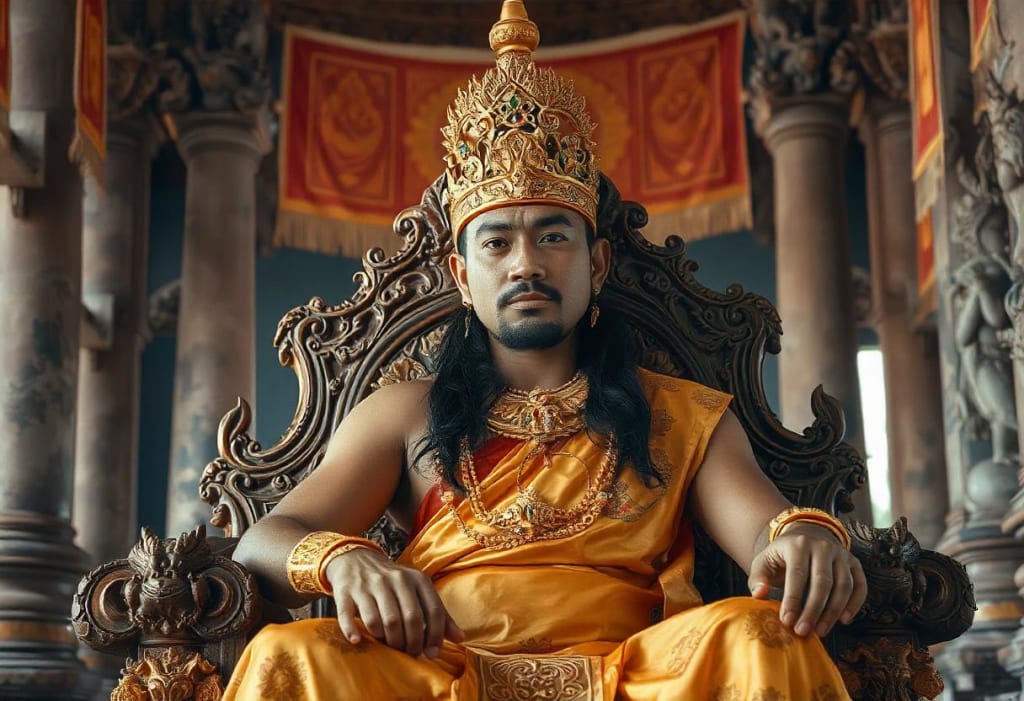
Deep within the dense jungles of Southeast Asia, ancient stone towers rise like colossal sentinels, bearing witness to the rise and fall of kingdoms, the passage of armies, and the lives of countless people. These jungles, rich in mystery, have long concealed the secrets of one of the most powerful empires in history—the Khmer Empire. Today, we delve into the captivating tale of how this empire emerged, its divine kings ruled, and the profound legacy it left behind. The jungles may whisper the past, but through these ruins, we hear the echoes of a forgotten world. The Khmer people, an ancient Austro-Asiatic ethnic group, trace their origins to Southeast Asia, with roots stretching back over 4,000 years. Scholars suggest that they migrated from southern China or northeastern India, bringing with them the practice of agriculture—especially rice cultivation—and some of the earliest use of bronze. These early Khmers also developed their own script, which became the foundation for the alphabets used in Thailand and Laos today. Their migration southward may have been driven by invaders from the north, forcing them to traverse rivers and valleys until they settled in the lands now known as Cambodia, southern Vietnam, and Laos.
Despite their ancient origins, the Khmer culture was heavily influenced by India. Over time, they absorbed elements of Indian religion, philosophy, and societal structures, forging a unique and complex society. This Indian influence would eventually play a crucial role in the rise of their empire. The first major Khmer state was the Kingdom of Funan (c. 68–627 CE), located in present-day Cambodia and the Mekong Delta. Funan thrived as a maritime trading hub, fostering cultural exchange and adopting Hinduism, particularly the Shaiva cult of Shiva. During this period, the concept of Devaraja, or "God-King," emerged, where the monarch was seen as a divine incarnation on Earth.
Funan’s rival was the inland Kingdom of Chenla, a mountainous region more focused on agriculture than trade. By the 6th century, Chenla had conquered Funan, but internal strife and external invasions soon weakened its power. During this period, the Khmers also made advancements in mathematics, leaving behind the oldest recorded use of the digit zero on the Sambor Inscription in 683 CE. In the 8th century, the Khmer prince Jayavarman II emerged as a key figure in unifying the Khmer people. In 802 CE, he declared himself Chakravartin, or Universal Ruler, on the sacred mountain of Phnom Kulen. This event is widely recognized as the founding moment of the Khmer Empire. Jayavarman II’s reign marked the beginning of a powerful and expansionist period for the Khmer, as he moved the capital to Hariharalaya and consolidated his power through both diplomacy and conquest.
Though little is known about his personal life, Jayavarman II’s successors continued to build upon his achievements, expanding the empire and establishing new cities. Yasovarman I, one of his descendants, founded Angkor, a city that would become the heart of the Khmer Empire and the site of its most magnificent architectural achievements. Under rulers like Indravarman I and Yasovarman I, the Khmer Empire saw the construction of grand temples, irrigation systems, and cities. Indravarman I developed the capital at Hariharalaya and built the Bakong temple, while Yasovarman I moved the capital to Angkor and constructed the monumental Phnom Bakheng temple.
The Khmer Empire reached its zenith during the reign of Suryavarman II (1113–1150), who united the kingdom internally and commissioned the construction of the famous Angkor Wat, a stunning temple complex dedicated to the god Vishnu. This period of wealth and cultural flourishing, however, was accompanied by conflict. Suryavarman II launched military campaigns against neighboring kingdoms like Champa and Dai Viet, although he met limited success in expanding the empire further east. After his death, the empire was thrown into chaos, with kings being rapidly overthrown until Jayavarman VII (1181–1219) ascended the throne. Jayavarman VII was a visionary leader who expanded the empire’s territory, expelled the invading Champa forces, and initiated a wave of construction projects, including the Bayon Temple and an extensive network of roads and hospitals. Under his rule, the Khmer Empire became one of the most sophisticated and powerful states in Southeast Asia. Despite the heights reached by Jayavarman VII, the Khmer Empire began a slow decline after his death. Internal strife, religious shifts, and external pressures began to erode the empire’s stability. The rise of Buddhism, particularly Theravada Buddhism, conflicted with the Hindu foundations of the empire, disrupting the divine kingship that had once held the state together.
Additionally, new powers like the Tai Kingdoms of Sukhothai and Ayutthaya began to challenge Khmer supremacy. In 1431, the kingdom of Ayutthaya sacked Angkor, marking the end of the Khmer Empire. The last king, Ponhea Yat, fled and established a new capital at Phnom Penh, but the empire never regained its former glory. What remained of the once-great Khmer state was absorbed into vassalage under the Thai kingdoms, and the magnificent city of Angkor was left to the jungle. The ruins of Angkor, with their massive temples and intricate bas-reliefs, are all that remain of the Khmer Empire’s once-great civilization. These structures, including the awe-inspiring Angkor Wat and the enigmatic faces of Bayon, still draw visitors and scholars alike, captivated by their beauty and the mysteries they hold.
Much of what we know about the Khmer Empire comes from the bas-reliefs on these temples and from the writings of Zhou Daguan, a 13th-century Chinese diplomat who documented life in Cambodia. His accounts, alongside the carvings that depict both the daily life of commoners and the grandeur of kings, give us a glimpse into this lost world. The Khmer people were highly advanced in agriculture, utilizing an intricate system of canals and reservoirs to irrigate their rice fields. They were also skilled in architecture, engineering, and the arts, as evidenced by the monumental temples that still stand today.
Though the empire has long since fallen, the legacy of the Khmer Empire continues to inspire awe and admiration. Its divine kings, its grand temples, and its enduring culture have left an indelible mark on history, haunting the jungles of Southeast Asia and reminding us of the power and fragility of human civilizations.
About the Creator
A História
"Hi. My name is Wellington and I'm a passion for general history. Here, I publish articles on different periods and themes in history, from prehistory to the present day.
Keep reading
More stories from A História and writers in History and other communities.
The Myth of the Amazons
Throughout history, ancient mythologies often attributed natural phenomena like lightning, volcanoes, and rivers to divine origins. Many legends revolved around powerful characters, some of divine descent, who interacted with both gods and humans. In Greek mythology, which holds a special place in cultural history, one of the most fascinating legends is that of the Amazons, a tribe of fierce warrior women. Renowned for their mastery of horseback riding, archery, and bravery in battle, the Amazons have sparked the imagination for centuries. But were these legendary women real? What do historical records say about them? In mythology, the Amazons were said to be the daughters of Ares, the god of war. They formed an all-female society where men were welcome solely for reproduction purposes. These warrior women lived on the fringes of what the Greeks considered the "civilized" world, often depicted as residing in distant regions near the southern shores of the Black Sea. According to the playwright Aeschylus (c. 525-456 BCE), the Amazons once lived in Scythia, near the Meotis Lake, now known as the Sea of Azov, before moving to the city-state of Themiscyra by the Thermodon River. Interestingly, the Thermodon is a real river in northern Turkey, now called the Terme River.
By A Históriaabout a year ago in History
Aunt Sophie Campbell, A Smoky Mountain Legend in Appalachia
In the heart of the Great Smoky Mountains lived a woman whose legacy endured long after her passing, a woman who embodied the spirit of rugged ridges, mountain folklore, and genuine hospitality. Her name was Aunt Sophie Campbell, one of the most beloved figures in the region. Known for talent, warmth, and resilience, Aunt Sophie became a true Smoky Mountain legend.
By Tim Carmichaela day ago in History



Comments
There are no comments for this story
Be the first to respond and start the conversation.