
The Rise and Fall of Alexander the Great
The Rise and Fall of Alexander the Great: The Story of History's Greatest Conqueror

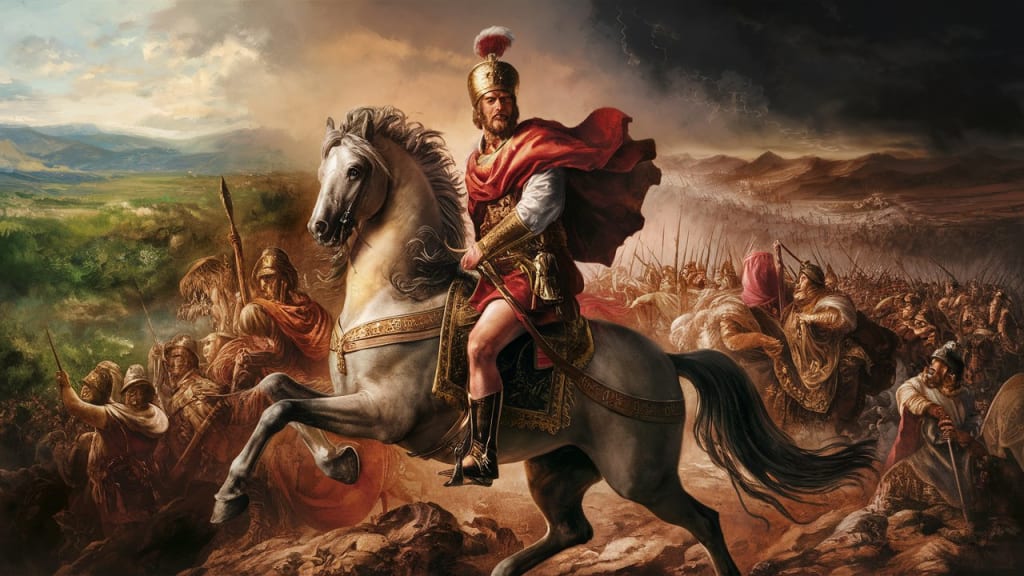
The Rise and Fall of Alexander the Great: The Story of History's Greatest Conqueror
Introduction: Alexander the Great Between Myth and Reality
Alexander the Great is one of the most fascinating figures in ancient history. He was a military genius and a conqueror who established one of the largest empires the world had ever seen, leading his army to unprecedented frontiers. However, Alexander's story is not just a series of military victories; it is also a tale of boundless ambition and a dream of uniting the world under one banner. Yet, his life ended abruptly and tragically, leaving behind a complex legacy that continues to be studied and analyzed to this day.
The Early Life of Alexander the Great
His Childhood and Education
Alexander was born in 356 BCE in Pella, the capital of the ancient kingdom of Macedonia. He was the son of King Philip II and Queen Olympias. From a young age, Alexander showed signs of intelligence and physical strength. He was tutored by the famous philosopher Aristotle, who instilled in him a love for knowledge, philosophy, and leadership skills.
The Influence of Philip II
Alexander's father, Philip II, was a brilliant military leader who unified Macedonia and transformed it into a major military power. Philip prepared his son to be his successor, teaching him the arts of war and governance from an early age. This early training had a profound impact on Alexander's character and leadership abilities.
The Beginning of Alexander's Reign
The Assassination of Philip II and Alexander's Ascension
In 336 BCE, Philip II was assassinated, and Alexander ascended to the throne at the age of 20. At the time, Macedonia was a significant military power but was surrounded by enemies on all sides. Alexander quickly proved himself capable of maintaining the kingdom's stability and even expanding it.
Unifying Greece
Alexander's first task was to secure his rule over Greece. He suppressed revolts in Greek cities and forced them to acknowledge his authority. Afterward, he began planning his grand military campaign against the Persian Empire, which was considered Greece's primary enemy.
Alexander's Military Campaigns
The Battle of Granicus (334 BCE)
The Battle of Granicus was the first major battle between Alexander and the Persian forces. Alexander achieved a decisive victory, opening the way for his advance into Asia Minor. This battle demonstrated Alexander's tactical brilliance and his ability to lead his army effectively.
The Battle of Issus (333 BCE)
At the Battle of Issus, Alexander faced the Persian army led by King Darius III. Despite being outnumbered, Alexander secured a decisive victory, forcing Darius to flee. After this battle, Alexander gained control over most of the western territories of the Persian Empire.
The Battle of Gaugamela (331 BCE)
The Battle of Gaugamela was the decisive confrontation between Alexander and Darius III. Once again, Alexander achieved a resounding victory, leading to the fall of the Persian Empire and the flight of Darius, who was later killed by one of his own commanders. After this battle, Alexander became the master of most of the known world.
Advancing Eastward
After defeating the Persians, Alexander continued his march eastward, reaching the borders of India. His army faced significant challenges due to harsh terrain and difficult climates, but Alexander insisted on pushing forward. However, after the Battle of the Hydaspes against the Indian king Porus, his troops mutinied and refused to advance further.
Alexander's Administration of His Empire
Cultural Integration Policies
Alexander believed in the idea of cultural integration among the peoples he conquered. He encouraged his soldiers to marry local women and adopted some Persian customs and traditions. He also founded numerous cities, the most famous being Alexandria in Egypt, which became a major cultural and scientific center.
Administrative Challenges
Despite his military successes, Alexander faced significant challenges in administering his vast empire. The enormous distances and cultural differences among the conquered peoples posed major difficulties. Additionally, some of his generals began to rebel or act independently.
The End of Alexander the Great
His Sudden Death
In 323 BCE, Alexander died in the city of Babylon at the age of 32. The cause of his death remains debated; some sources suggest he died of illness, while others point to possible poisoning. His sudden death left his empire without clear leadership.
The Division of the Empire
After Alexander's death, his empire entered a period of chaos and internal conflict. It was divided among his generals, known as the Diadochi. This period, known as the Wars of the Diadochi, led to the fragmentation of the empire Alexander had built.
The Legacy of Alexander the Great
Cultural Impact
Alexander left an immense cultural legacy. He founded numerous cities that became centers of learning and culture, spreading Greek culture throughout the Middle East and Asia. This period, known as the Hellenistic Era, witnessed significant cultural exchange between East and West.
Military Influence
Alexander is considered one of the greatest military leaders in history. His strategies and tactics are still studied in military academies today. His ability to inspire his troops and achieve victories under challenging conditions made him a model for future leaders.
Myth vs. Reality
Over time, Alexander became a legendary figure. He was depicted in literature and art as almost a superhuman hero. However, it is important to distinguish between myth and reality; Alexander was a human being with his own achievements and failures.
Lessons from Alexander's Story
The Importance of Inspirational Leadership
Alexander demonstrates the importance of inspirational leadership in achieving great goals. He was able to motivate his troops and achieve victories against all odds.
The Limits of Ambition
On the other hand, Alexander's story also shows the limits of ambition. His desire for endless expansion exhausted his army and ultimately led to the downfall of his empire.
Conclusion: Alexander the Great Between Greatness and Tragedy
The story of Alexander the Great is one of boundless ambition, unparalleled military achievements, and a sudden end. He changed the face of the ancient world and left a legacy that continues to be studied and analyzed to this day. However, his life reminds us that true greatness lies not only in achieving victories but also in how success is managed and challenges are faced. Alexander was human, just human, but his accomplishments made him immortal in the pages of history.
About the Creator
💓 Pulse of Stories 💓
The world of short and inspiring stories! Here you will find stories that touch hearts, ignite the imagination, and take you on quick yet deep journeys.
Keep reading
More stories from 💓 Pulse of Stories 💓 and writers in History and other communities.
The Chilean Revolution: The Fall of Allende
The Chilean Revolution: The Fall of Allende Introduction: Chile at a Crossroads of History Chile, the long, narrow country stretching along the western coast of South America, witnessed one of the most controversial periods in its modern history during the 1970s. This era was marked by political and social upheavals that forever changed the face of the nation. At the heart of these events was Salvador Allende, the first democratically elected Marxist president in the world. However, his presidency was far from smooth and ended in a tragic downfall that continues to spark debate to this day.
By 💓 Pulse of Stories 💓about a year ago in History
The Mystery of the “Damaged” Ship Finally Solved
For decades, a mysterious shipwreck discovered deep beneath the sea puzzled historians, archaeologists, and maritime experts. The vessel, often described as a “damaged” or “cursed” ship due to the strange condition in which it was found, seemed to carry secrets that no one could fully explain. Now, after years of research and technological investigation, scientists believe they have finally solved the mystery behind the ship’s unusual damage and tragic fate.
By Irshad Abbasi 2 days ago in History


Comments (4)
Nice You Have Payment Method Problem.
The Rise and Fall of Alexander the Great: The Story of History's Greatest Conqueror Introduction: Alexander the Great Between Myth and Reality Alexander the Great is one of the most fascinating figures in ancient history. He was a military genius and a conqueror who established one of the largest empires the world had ever seen, leading his army to unprecedented frontiers. However, Alexander's story is not just a series of military victories; it is also a tale of boundless ambition and a dream of uniting the world under one banner. Yet, his life ended abruptly and tragically, leaving behind a complex legacy that continues to be studied and analyzed to this day.
The Rise and Fall of Alexander the Great: The Story of History's Greatest Conqueror Introduction: Alexander the Great Between Myth and Reality
The Rise and Fall of Alexander the Great: The Story of History's Greatest Conqueror