
The Remarkable Legacy of the Phoenicians
Ancient Masters of Navigation and Trade

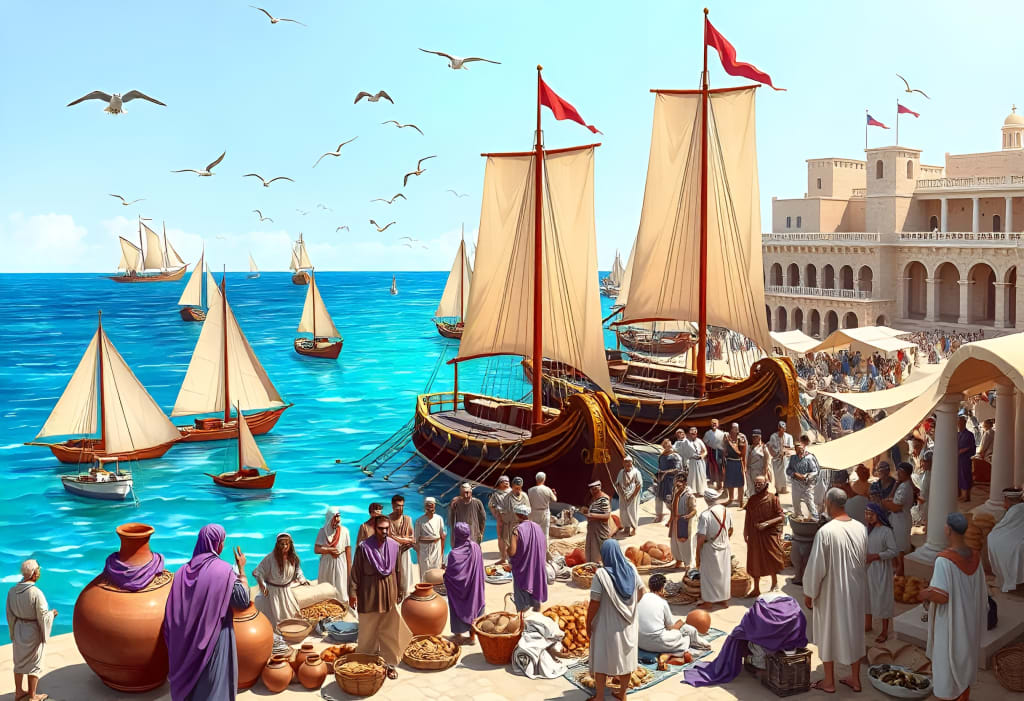
The Phoenicians are frequently hailed as one of the most accomplished maritime civilizations of antiquity. Renowned for their exceptional seafaring abilities, they not only excelled in navigation but also pioneered the principles of international commerce, founding colonies throughout the Mediterranean. This vast web of trade routes and settlements empowered the Phoenicians to exert influence over far-flung territories, creating a legacy that resonates to this day. In this article, we shall delve into the origins, culture, and notable contributions of this extraordinary civilization.
The Phoenicians were the original inhabitants of the northern coastal territories of ancient Canaan, encompassing what is now Lebanon, Syria, and northern Israel. Their remarkable civilization flourished between 2300 and 1200 BCE. While they shared linguistic and religious traits with the neighboring Canaanite cultures, the Phoenicians distinguished themselves through their exceptional maritime prowess. Ancient tablets dating back to the 14th century BCE refer to these intrepid seafarers as "Canani" or "Kenani," underscoring the renown of their voyages and their esteemed role as purveyors of the coveted Lebanese cedar wood to Egypt.c cd.
In stark contrast to the grand empires of their time, like those of the Egyptians and Assyrians, the Phoenicians were distinguished by their organization into independent city-states. Notable among these were Byblos, Tyre, Sidon, and Arwad, each flourishing under its own governance. These city-states frequently acted autonomously, sometimes as rivals and at other times as allies, prompting historians to ponder whether the Phoenicians viewed themselves as a unified entity. Nevertheless, despite this apparent disunity, the cities of Phoenicia were united by shared cultural traits, including a common language, religious practices, and, perhaps most importantly, their innovative alphabet.
The Phoenicians bestowed upon civilization one of its most remarkable legacies: their alphabet. This elegant writing system, comprised of 22 distinct characters, was a phonetic marvel that laid the groundwork for numerous subsequent scripts. As the Phoenicians engaged in their far-reaching trade endeavors, their alphabet gracefully traversed the Mediterranean, where it was embraced and refined by the Greeks, ultimately shaping the Latin alphabet that dominates much of the Western world today.
The Phoenicians, while significantly shaped by the rich tapestry of Mediterranean cultures, also imparted their distinctive beliefs to the cultural milieu. Their pantheon, which included prominent deities such as Baal and Melqart, reveals intriguing similarities with Greek mythology, as these Phoenician gods were frequently likened to figures like Zeus, Hades, and Poseidon. Temples devoted to Melqart graced various ports across the Mediterranean, ultimately becoming esteemed sites of veneration for the Greek hero Hercules.
Between 1500 and 300 BCE, the Mediterranean was graced by the unparalleled prowess of Phoenician merchants and traders. Their elegantly designed galleys, masterfully equipped with both oars and sails, enabled them to traverse vast distances for trade. They are renowned for the innovation of the bireme, a remarkable vessel featuring dual tiers of oars that enhanced both speed and stability. Initially, their commercial endeavors were centered on interactions with the Greeks, to whom they provided a wealth of precious goods, including timber, slaves, and the illustrious Tyrian purple dye—extracted from the murex sea snail and coveted by the elite of Greece for its exquisite hue.
As the Phoenician trade networks flourished, they established a series of colonies across the Mediterranean, with Carthage in North Africa standing out as a prominent hub. The Phoenicians engaged in a vast array of trade, reaching distant lands to procure silver from the Iberian Peninsula, tin from Britain, and copper from Cyprus. The esteemed Greek historian Strabo chronicled the lucrative exchanges between the Phoenicians and the British Isles, underscoring the significance of their commercial endeavors.
Their reach extended even further: a remarkable expedition in the 6th century BCE, led by Phoenician navigators and commissioned by the Egyptian Pharaoh Necho II, is said to have successfully circumnavigated Africa. This remarkable voyage, which traversed what is now recognized as the Strait of Gibraltar, highlighted the Phoenicians' unmatched prowess in maritime navigation.
The Phoenicians, despite their formidable economic and cultural prowess, ultimately succumbed to the relentless expansion of the Persian Empire under the reign of Cyrus the Great in 539 BCE. This Persian dominion fragmented the once-unified Phoenician city-states into subordinate kingdoms, significantly undermining their collective strength and influence. The ascendance of Alexander the Great and the ensuing Hellenistic period further eroded Phoenician dominance in trade, with the pivotal conquest of Tyre in 332 BCE serving as a critical juncture in their decline. Nevertheless, Carthage—established by Phoenician colonists—persisted as a formidable force in North Africa until its eventual downfall at the hands of Rome during the Punic Wars in the 2nd century BCE.
About the Creator
A História
"Hi. My name is Wellington and I'm a passion for general history. Here, I publish articles on different periods and themes in history, from prehistory to the present day.
Keep reading
More stories from A História and writers in History and other communities.
Haiti’s Revolutionary History
The Haitian Revolution is considered a pivotal moment in history, yet it often lacks the acknowledgment it merits. Haiti was the second country in the Americas to gain independence, after the United States in 1776. Furthermore, it became the first Black republic globally and stands as the sole example of a successful uprising by enslaved people that led to the establishment of an independent nation.
By A Históriaabout a year ago in History
When the Portuguese Turned the Tide of Indian History
The arrival of the Portuguese in India at the end of the 15th century marked a turning point in the history of the Indian Ocean and the Indian subcontinent. What began as an ambitious maritime expedition soon transformed into a powerful political and economic presence that reshaped trade routes, introduced new cultural influences, and altered the balance of power in the region.
By Irshad Abbasi about 22 hours ago in History


Comments
There are no comments for this story
Be the first to respond and start the conversation.