
Haiti’s Revolutionary History
How the First Black Republic Rose and Inspired the World


The Haitian Revolution is considered a pivotal moment in history, yet it often lacks the acknowledgment it merits. Haiti was the second country in the Americas to gain independence, after the United States in 1776. Furthermore, it became the first Black republic globally and stands as the sole example of a successful uprising by enslaved people that led to the establishment of an independent nation.
The initial documented European presence on the island of Hispaniola occurred with Christopher Columbus's arrival in 1492. Subsequently, numerous European settlers from Spain, France, England, the Netherlands, and Portugal came to the island, competing for dominance and riches. In 1697, a treaty transferred a section of the island to France, which designated it as Saint-Domingue. This colony rapidly emerged as one of the richest in the Americas, frequently referred to as "The Pearl of the Antilles," owing to its lucrative sugar, coffee, and tobacco plantations, all established through the harsh exploitation of African slaves.
The French Revolution of 1789, characterized by its principles of "liberty, equality, fraternity," ignited a sense of hope among the enslaved population in Saint-Domingue. At that time, more than 85% of the island's inhabitants were enslaved, suffering under harsh conditions and systemic oppression. The ideals of freedom and equality struck a profound chord with them, leading to the commencement of a coordinated revolt in 1791. This movement was spearheaded by leaders such as Toussaint Louverture and Jean-Jacques Dessalines, who rallied enslaved Africans in their quest for liberation.
Toussaint Louverture, a former enslaved individual who emerged as a formidable military strategist, played a crucial role in consolidating the efforts of Black Haitians against the French, Spanish, and British forces. Despite attempts by these colonial powers to quell the rebellion, they were unable to match the determination and tactical prowess of the Haitian fighters.
In 1801, Louverture proclaimed the autonomy of Saint-Domingue and established a constitution that abolished slavery. This significant action, however, was met with disapproval from Napoleon Bonaparte, who aimed to reassert control over the colony. In response, Napoleon sent his brother-in-law, Charles Leclerc, along with a substantial military contingent to restore French authority and reinstate slavery. Although Louverture was captured and exiled to France, he famously remarked, “In overthrowing me, you have cut down only the trunk of the tree of liberty; it will spring up again by the roots, for they are numerous and deep.”
After Louverture's capture, Jean-Jacques Dessalines rose to leadership. Through a vigorous campaign, Dessalines and his forces successfully defeated the French troops, bolstered by a devastating outbreak of yellow fever that severely impacted the French ranks. On January 1, 1804, Dessalines proclaimed Haiti's independence, naming the new republic after the indigenous Taíno word "Ayiti," which translates to "land of high mountains."
The Haitian Revolution reverberated across the Americas and beyond, motivating enslaved and marginalized populations globally. Nevertheless, Haiti's resistance and achievements instilled fear in slaveholding countries, prompting many to impose economic isolation on the nascent nation. France insisted that Haiti compensate for the "loss" of slave labor and colonial assets—a financial burden that severely weakened Haiti’s economy for more than a hundred years and continues to have enduring effects.
In the subsequent decades, Haiti faced significant political turmoil, marked by numerous changes in leadership and foreign interventions. Between 1843 and 1915, only a single Haitian president managed to serve a complete term. In 1915, the United States intervened and occupied Haiti, justifying the action by emphasizing the protection of American interests. This occupation continued until 1934, resulting in a complicated legacy that shaped Haiti's political environment.
In 1957, François “Papa Doc” Duvalier ascended to power, positioning himself as a champion of the populace. With a background in medicine and connections to “voodoo” practices, he adeptly garnered a devoted base of support. Nevertheless, his administration grew increasingly repressive, utilizing a secret police unit known as the Tonton Macoute to suppress dissent. Duvalier proclaimed himself “President for Life,” leaving a profound impact on Haiti. In 1971, his son, Jean-Claude “Baby Doc” Duvalier, took over, perpetuating a similar authoritarian regime until his exile in 1986.
The earthquake in 2010 inflicted additional suffering on Haiti, worsening its existing economic and social difficulties. However, the Haitian Revolution stands as a strong emblem of resilience, liberty, and the bravery to resist oppression. The influence of figures such as Toussaint Louverture and Jean-Jacques Dessalines persists, motivating global movements for social justice.
In spite of enduring numerous hardships over the centuries, Haiti's revolutionary spirit remains vibrant, serving as a testament to the importance and strength of the struggle for freedom in the face of overwhelming challenges.
About the Creator
A História
"Hi. My name is Wellington and I'm a passion for general history. Here, I publish articles on different periods and themes in history, from prehistory to the present day.
Keep reading
More stories from A História and writers in History and other communities.
Yasuke
Yasuke's beginnings are shrouded in mystery, yet historical accounts indicate that he arrived in Japan in 1579 with the Italian Jesuit missionary Alessandro Valignano. This was a tumultuous time in Japan, known as the Sengoku or "Warring States" period, characterized by fierce battles among powerful landowners, or daimyōs, who were competing for dominance and shaping the nation's political future. Valignano aimed to spread Christianity throughout East Asia, but it was Yasuke's striking height—reportedly around 1.90 meters (6'2")—that captivated many, including the prominent daimyō Oda Nobunaga, as he was one of the few Black men they had ever encountered.
By A Históriaabout a year ago in History
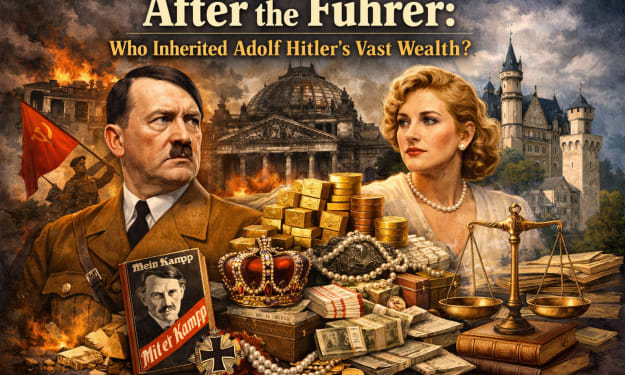
After the Führer: Who Inherited Adolf Hitler’s Vast Wealth?
When Adolf Hitler died by suicide on April 30, 1945, inside his bunker in Berlin, the Third Reich was collapsing around him. Soviet troops were closing in, and Nazi Germany was on the brink of total defeat. Yet even as Europe lay in ruins, a curious legal and financial question lingered: what happened to Hitler’s personal wealth, estimated to be worth hundreds of millions—if not billions—of today’s dollars?
By Irshad Abbasi 7 days ago in History



Comments
There are no comments for this story
Be the first to respond and start the conversation.