
The Queer Genius Who Changed Art Forever
Explore the hidden side of Caravaggio’s art, sexuality, and the campaign that tried to erase him from history.

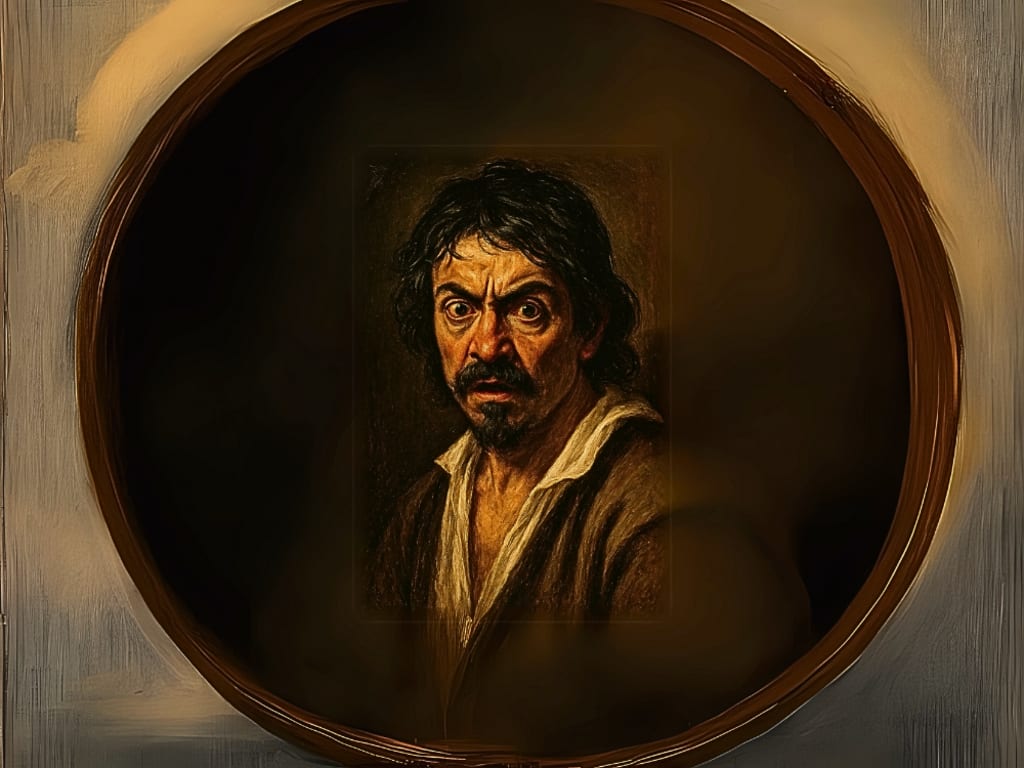
It was the summer of 1606. Across Italy, bounty hunters carried notices with a name etched in bold: Michelangelo Merisi da Caravaggio. Rome had sentenced him to death for murder. His patrons had vanished. His friends had scattered. But in churches across the city, his paintings still standout, terrifying, transcendent, too real to ignore. Even as he fled through the ports of Naples, the island of Malta, and the dark corners of Sicily, Caravaggio was painting furiously. Each canvas was a cry of defiance. Each image a page they would try to burn.
Caravaggio had always been dangerous. Born in 1571 in the Lombardy town of Caravaggio, near Milan, he trained in painting but defied every convention. By the 1590s, he arrived in Rome penniless but determined. In a city where Renaissance ideals still reigned, portraying idealized beauty, Caravaggio raw scenes beaming with realism was considered eccentric to say the least.
He painted ordinary people as sacred figures: prostitutes as the Virgin, beggars as apostles, rough street boys as angels. He filled his canvases with a violent chiaroscuro, a brutal contrast of light and dark that became his signature. His saints had torn robes and weary faces. His Madonnas had bare swollen feet. Viewers were shocked but at the same time mesmerized with this new shocking style.
Rome at the time was bustling with talent and art. After the trauma of the Protestant Reformation, the Catholic Church fought back through spectacle. The Counter-Reformation called for art that would inspire devotion and awe, but also obedience to the doctrine of the church. Caravaggio’s work fulfilled the first and violated the second. His images stirred not safe admiration but unsettling reflection. Nevertheless, commissions poured in. In the Cerasi Chapel of Santa Maria del Popolo, his Crucifixion of Saint Peter and Conversion of Saint Paul pulsed with violence and revelation. His fame soared. But so did his notoriety and not for the right reasons! Church officials were quite alarmed about his controversial style, to the extent that they refused his work. In Death of the Virgin (1606), Caravaggio painted Mary as a swollen corpse, her bare feet exposed and modeled, rumor claimed, on a drowned prostitute, the painting was rejected as blasphemous. Other works were quietly censored or replaced. His uncompromising realism exposed the hypocrisy and fear of a Church that wanted beauty without truth.
Yet it was not just his art that scandalized Rome. Caravaggio’s life was a catalogue of chaos. He brawled constantly, his police records a grim litany of assaults and arrests. He carried weapons illegally. He consorted with prostitutes and openly used male models in ways that stirred rumours of sodomy, a capital crime under Roman law.
His outbursts became legendary. In one infamous incident, Caravaggio attacked a waiter who served him a plate of artichokes prepared in butter instead of oil. Furious, he hurled the dish into the man's face and drew his sword, an act recorded in police files. In another episode, he assaulted his own landlady over an unpaid rent dispute, smashing her window and threatening her with violence. These were not isolated moments; they were symptoms of a volatile temper that erupted in taverns, streets, and courts alike.
His personal enemies multiplied. Some were moralists offended by his behavior; others were jealous rivals in the cutthroat Roman art scene. The painter’s open defiance of social codes, combined with the carnal humanity of his images, made him a target. His early works, such as Boy with a Basket of Fruit and Bacchus, featured strikingly sensual young male figures. The languid poses, flushed cheeks, and soft lighting invited readings that unsettled conservative viewers. His John the Baptist paintings, in particular, walked a fine line between the sacred and the erotic, with adolescent models gazing provocatively from the canvas.
Giovanni Baglione, a rival painter and one-time admirer, grew to despise Caravaggio. Their feud spilled into the courts, with Baglione accusing Caravaggio of slander and even of immoral conduct. Baglione’s writings dripped with bitterness, portraying Caravaggio as an amoral brute, a corrupter of youth, and a dangerous influence on both art and society. These accusations, amplified by gossip and clerical suspicion, deepened the campaign against him.
Later art historians would erase or sanitize these elements, but at the time, they fueled the campaign against him.
Then came the fatal night. In May 1606, during a heated tennis match and subsequent street brawl, Caravaggio killed Ranuccio Tomassoni, a well-connected young man. The reasons remain disputed, honour, jealousy, an unpaid debt. But the result was clear: murder. Caravaggio fled. A bando capitale, a bounty, was placed on his head. Any citizen could kill him with impunity.
Thus began his years in exile. In Naples, he produced dark, haunting masterpieces: The Seven Works of Mercy and David with the Head of Goliath (his own face, gaunt and terrified, painted as the severed head). In Malta, he sought the protection of the Knights of Saint John but soon quarreled with them. Imprisoned, he escaped, how, no one knows.
In Sicily, his paintings grew ever more somber. The Burial of Saint Lucy, The Adoration of the Shepherds, and The Raising of Lazarus were filled with darkness, figures swallowed by shadow, as if reflecting his own descent. His technique was radical, his realism unmatched—but his name was poison. Commissions grew scarce. Patrons hesitated. His enemies spread word of his alleged crimes and vices.
Even in Rome, his reputation collapsed. His earlier works were censored. Paintings like Death of the Virgin were hidden or sold abroad. The homoerotic elements in his John the Baptist series were quietly excised from scholarly discussion. His violent realism, once celebrated, was condemned as vulgarity.
Then, in 1610, at age 38, Caravaggio died under mysterious circumstances. Officially fever, but rumors spoke of assassination, poison, revenge. He died unpardoned, his grave unmarked. Within decades, his influence was buried too. Classicist critics dismissed his style as crude. His followers were labeled the Caravaggisti, derided as minor talents. His personal life, his sexuality, his violence, his defiance was erased from most histories.
For three centuries, Caravaggio was largely absent from the canon. His surviving works were misattributed or neglected. Art history favored the safe triumphs of Raphael and Bernini. The pages that told of Caravaggio’s human flaws, his outlaw years, and the radical empathy of his images were torn out or burned.
It was not until the 20th century that scholars began to recover the truth. Critics like Roberto Longhi rediscovered and restored his reputation as a master who reshaped European art. Modern artists embraced his chiaroscuro and raw humanity. Art historians explored the erased dimensions of his life and art. Today, Caravaggio is revered as one of the greatest painters of all time. Museums proudly display his once-censored works. His influence echoes in photography, cinema, and contemporary painting. But even now, the full story is not always told. The Church’s censorship of his most daring works, the suppression of his queer identity, the conspiracy of silence around his murder, these are the pages that were burned. Yet they smolder still beneath the surface.
Caravaggio’s triumph is that his paintings survived. They confront us still with blood, with light, with human frailty and grace. They remind us that art is not obedience, and beauty is not perfection. They speak of a man who refused to lie with his brush, who painted what he saw and who he was.
They tried to hide the man and the art but centuries later, Caravaggio’s light still breaks through the darkness.
#HiddenHistory #caravaggio #HistoryFigures #arthistory #baroqueart
About the Creator
Strategy Hub
Pharmacist with a Master’s in Science and a second Master’s in Art History, blending scientific insight with creative strategy to craft informative stories across health science, business history and cultural enrichment. Subscribe & follow!
Keep reading
More stories from Strategy Hub and writers in History and other communities.
Why Francesco Borromini’s Churches Were Almost Erased from History
It was August of 1667, and the corridors of San Giovanni dei Fiorentini in Rome, echoed with silence. Francesco Borromini, once the most daring architect in the Italian city of Rome, lay dying from self-inflicted wounds. Though his buildings breathed with imagination and mathematical wonder, his name was already fading. Rome’s piazzas were filled with the applause of his rival Bernini. Borromini’s masterpieces, tucked in narrow alleyways and cloisters, went unnoticed. He had reshaped the soul of Baroque architecture, yet history was writing him out of its pages. Gian Lorenzo Bernini, Borromini's rival, was everything Rome loved: charming, politically astute, and an unrivaled master of spectacle. He was adored, mythologized, and immortalized. Rome became his stage, and he knew how to play it. In contrast, Borromini, with his ascetic temperament and uncompromising vision, refused to perform. And Rome, a city that adored performance, chose the actor over the architect.
By Strategy Hub9 months ago in History
Hidden Void Discovered Inside the Great Pyramid of Khufu
For centuries, the Great Pyramid of Khufu in Egypt has fascinated historians, archaeologists, and travelers from around the world. Built more than 4,500 years ago during the reign of Pharaoh Khufu, the pyramid is the largest and oldest of the three pyramids of Giza. Despite decades of research and exploration, many secrets of this ancient structure remain hidden. Recently, scientists revealed one of the most intriguing discoveries yet — a large hidden void inside the pyramid that had remained unknown for thousands of years.
By Irshad Abbasi a day ago in History



Comments
There are no comments for this story
Be the first to respond and start the conversation.